
Global Korea Scholarship (GKS) Scholar Nicolai from Denmark Shares His Journey of Securing a Fully Funded PhD at the Korea University, Republic of Korea
University: Korea University
Degree: PhD in International Relations
Previous Education: BSc in International Studies from Roskilde University; MSc in Global Studies from Roskilde University
Scholarship: Global Korea Scholarship (GKS) – Full Funding (Living Expenses, Round-Trip Flight, Tuition Fees for Language Programme and University Degree)
Social Media
LinkedIn: linkedin.com/in/nicolai-hede-613a43183/
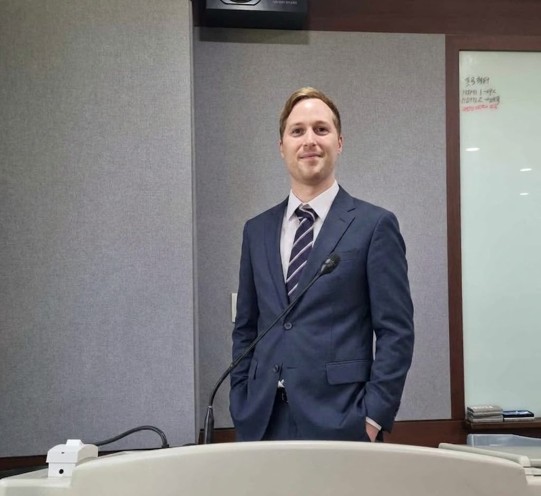
The Journey
My name is Nicolai. I am 31 years old and from Denmark.
I am currently a PhD student at Korea University, Seoul, Republic of Korea. I hold a BSc in International Studies and an MSc in Global Studies from Roskilde University, Denmark.
When I first entered Roskilde University as an undergraduate student almost a decade ago, I knew I wanted to study the social and political sciences, but I was not yet sure which path to take. Luckily, Roskilde University allows students to choose the specialisation programme during the first year, following the introductory courses in disciplines such as Sociology, Political Science, Economics, and Strategic Resource Management. During this time, I had some very competent and inspiring professors who, in the end, motivated me to pursue a full BSc in International Studies.
I continued at Roskilde University for my graduate studies and completed my MSc in Global Studies in 2021. During my time at Roskilde University, I also did exchange semesters in Korea at Sungkyunkwan University and Chung-Ang University.
I wanted to pursue further education in this field because I worked as a research assistant during my graduate degree and wanted to continue exploring international affairs and develop as a social scientist. During my exchange semesters, I became particularly interested in East Asian, especially Korean, foreign policy. This motivated me to develop my understanding of Korean foreign affairs.
I eventually applied for the NIIED (국립국제교육원) GKS scholarship (Embassy Track) through the Korean Embassy in Denmark and was selected in 2023. I was offered my three prioritised PhD spots and chose Korea University. After completing my studies at the Korea University Language Center, I entered the Graduate School of International Studies (GSIS) at Korea University as a PhD candidate in International Relations.
The PhD programme follows a structured format similar to US-style programmes, meaning that you are both a student taking courses and a researcher preparing your dissertation. There is a required number of courses and credits, with the research requirements and a comprehensive examination that must be completed before submitting your dissertation. Courses may cover areas such as international commerce, international development, and international peace and security, along with various elective courses. There are also mandatory research methods courses and PhD seminars. It is possible to take some courses in Korean, and it is also possible to take courses at other GSIS departments across other Korean universities’ GSIS departments.
Global Korea Scholarship Details
Institution: Korea University
Scholarship: Global Korea Scholarship (GKS)
The scholarship provides approximately 1,400,000 KRW per month (as of 2026) to cover living expenses, including accommodation, utilities, and food during both the language programme and degree studies.
The following costs are also covered:
- One round-trip flight ticket between your home country and Korea
- Tuition fees for both the language programme and the university degree (fully waived under the GKS scholarship)
The application process, in short, is as follows:
You must follow the guidelines and application forms provided by the Korean Embassy in your country of citizenship. These are usually published on the embassy’s official website. You cannot apply through just any Korean embassy; you must apply through the Korean embassy in your country of citizenship.
Under the Embassy Track, you can select up to three universities in order of preference.
The embassy may conduct multiple selection rounds, such as an initial screening and interviews.
If you pass the embassy stage, NIIED will conduct a further evaluation and, if successful, recommend you to your chosen universities. The final admission decision is made by the university.
The typical structure of the programme is as follows:
Upon arrival in Korea, you are enrolled in a language institution affiliated with your host university. This usually lasts around one year or a bit less than a year. During this period, you must meet the language centre’s requirements and achieve at least TOPIK Level 3 before the start of your degree programme, in accordance with your university’s deadlines.
If you do not achieve TOPIK Level 3, you may risk forfeiting your scholarship. However, depending on your score and the policies of both your university and NIIED, you may either still be admitted or be granted an extension of up to six months to reach the required level; you may have to pay some of the cost in relation to this. Failure to meet this requirement may result in the loss of the scholarship.
Once enrolled in your Master’s or PhD programme, the standard duration is two years for Master’s students and three years for PhD candidates. You must comply with both university and NIIED regulations, which could include maintaining a minimum GPA score and attendance requirements. NIIED provides official guidelines, which may be updated periodically, so it is important to stay informed on this when you are a GKS scholar.
Educational Background
Denmark does not normally use the GPA system; instead, it uses the 7-step grading scale, which can be converted to the European ECTS scale. However, converting these grades into a 4.0 GPA system was not straightforward, as Roskilde University does not provide such conversions. Therefore, applicants to GKS should consult the Korean Embassy and contact their home university to check possible alternatives. One option may be to convert the grades “manually”.
While GPA is important as an indicator of academic ability and commitment, it is equally important to demonstrate a willingness to improve and develop academically.
My educational background was not specifically geared to making such applications, but it provided a strong foundation in international and social sciences. Ultimately, it is essential to have a genuine interest in the field you are applying to, especially if you intend to pursue a full Master’s or PhD degree in it.
Did You Take Any Standardized Tests? If So, How Did You Prepare for Them?
I found information about the GKS scholarship through the Korean Embassy in Denmark, whose staff were very helpful.
I took the IELTS exam but did not prepare extensively, as I was confident in my English abilities.
My BSc involved a lot of English “learning by doing”, and my MSc was conducted entirely in English, which gave me confidence in my language skills.
That said, I would recommend that future applicants prepare for the IELTS. Reading academic journals, practising academic writing, and speaking English regularly, especially in one-on-one conversations with an English-speaking friend or acquaintance, can help build both skills and confidence.
How Did You Prepare to Apply for the Global Korea Scholarship?
The application timeline, from the announcement to submission and the first round of selection, was relatively short (at least in Denmark), so preparation time was limited. However, I prepared in advance by reviewing application materials from previous years.
I drafted a personal statement and study plan for my first-choice university and researched various PhD programmes, including course offerings and faculty members. As I narrowed down my options, I contacted several universities via email to ask specific questions about their programmes.
I also tried to prepare the required personal and official documents well in advance, including certified true copies as required by the embassy’s GKS guidelines.
If certain documents are difficult to obtain, either as originals or certified copies, I recommend starting the process early, especially if administrative procedures in your country are slow or complex.
Are Your Classes Conducted in English or Korean?
All my courses are conducted in English, and many of my peers come from diverse international backgrounds.
Would Potential Students Have Any Problems Not Knowing Korean?
For speakers of the Germanic languages, such as Danish, Korean is very different and can be difficult to learn, and it has a steep learning curve. I recommend that incoming students acquire at least basic Korean skills before arriving, as it makes everyday life a bit easier.
Academically, the importance of Korean depends on your programme. If your degree is conducted in Korean, you will need strong language proficiency before starting. Without it, international students are likely to struggle a lot.
What Do You Think Made Your Application Stand Out?
It is relatively uncommon for Danish applicants to pursue a PhD in Korea. Additionally, I had experience working in a Danish government agency, which provided relevant professional experience and strengthened my application.
What Would You Have Done Differently if You Were Going Through the Process Again?
I would have started preparing for the TOPIK exam earlier. While basic Korean is helpful, the GKS scholarship requires you to obtain at least TOPIK Level 3 during the language programme. Achieving this level before applying would have made the process smoother.
What Advice Would You Give Those Looking to Apply for a Similar Scholarship?
- Familiarise yourself with previous years’ applications and requirements, and prepare a rough draft in advance
- Check the application process and deadlines through the Korean Embassy in your country; contact them if you have questions, as they are very helpful
- Check the required (personal and official) documents and how you can obtain them
- Start preparing for IELTS and the TOPIK exam early, and aim for TOPIK at least Level 3 or 4
- While you can take TOPIK after arriving in Korea (during the language programme), I recommend taking it beforehand
- Get a clear idea of which universities and programmes you want to apply for
- Be genuinely interested in your field of studies, whether in specific courses, a professor’s work, or a potential thesis topic
- Being interested in the Korean language and culture is important, but keep in mind that you will also need to spend significant time on your academic field during your studies.
Want to submit your
scholarship journey?
Submit Your Story Here!
More Scholarship Recipients
My name is Ian Cawich. I’m a proud Belizean, specifically from a small northern town called Orange Walk, which serves as t .... Read more
My name is Miguel Felipe Arévalo Castiblanco, and I'm originally from Colombia. I'm currently a PhD candidate in Electrical .... Read more
My name is Brendon Munashe Mahere, and I am from Zimbabwe. I graduated from Al Akhawayn in 2024 with a BSc in Engineering an .... Read more
Leave A Comment