
Korea University Scholarships for International Students 2027
Students considering Korea University can explore scholarships that range from fully funded support to partial awards. This shortlist highlights higher coverage options first.
For institution funded support at Korea University, these scholarships are frequently highlighted when prioritizing higher coverage. Global Leader Scholarships is usually considered full tuition, and typical coverage can include full tuition fees (admission fees are also covered) for 4 semesters for Global Leader Scholarship A awardees and 50% tuition fees (admission fees are also covered) for 4 semesters for Global Leader Scholarship B awardees. A strong option is Graduate Global Leader Scholarship which is full tuition and often covers 100% of tuition fees and entrance fee and living allowance of KRW 500,000 per month for 4 months of the semester.
Outside the university’s own funding routes, Korea University students may be eligible for external programs that can offer substantial support. Here are a few to consider. Global Korea Scholarship (GKS) is fully funded and typically covers tuition fees, airplane tickets, and living stipend. KOICA Scholarship is commonly categorized as fully funded support, and coverage that often includes tuition fees, monthly living allowance, and accommodation. With POSCO Asia Fellowships, students may receive fully funded support, and coverage frequently includes full tuition, living expense stipend of 1,000,000 KRW per month, and national health insurance.
This is only a shortlist. Additional scholarships and funding options appear further down on this page.
Korea University Scholarships for International Students
The scholarships at Korea University can help fund your study expenses. There are currently 8 scholarships being offered to international students at the Korea University, all with varying requirements, benefits, and application processes. We have compiled them in this list to help you find the scholarship that best fits you.
Undergraduate Scholarships
Graduate Scholarships
External Scholarships
There are many degrees that are open to international students right now — find yours.
Korea University Admissions
Here are the official admission pages for Korea University:
| Degree | Admissions Pages |
|---|---|
| Bachelor's | International Students Admissions Page |
| Master's | International Students Admissions Page |
Admissions and Scholarship Results at Korea University
Here are some of the admissions and scholarship results from previous applicants to Korea University, which you might find helpful. For more results to Korea University, please see the Korea University Admissions Profile Page .
| Nationality / Region | SAT/ACT | EFC | GPA | Scholarship | Status |
|---|---|---|---|---|---|
| Malaysia | N/A | N/A | N/A | N/A | Rejected |
| Nigeria | N/A | N/A | 3.71/ 4.0 | N/A | Rejected |
| India | N/A | N/A | 4.02/5.0 | N/A | Rejected |
| Japan | N/A | N/A | 4.2 / 4.5 | 14000000 | Accepted |
Korea University Application Deadlines
| Degree | Admission Deadline |
|---|---|
| Bachelor's (Fall) | March 27, 2026 |
| Bachelor's (Spring) | August 31, 2026 |
| Master's | September 10, 2025 |
Tuition Fees at Korea University for International Students
Indicative annual tuition fee ranges for international students at Korea University. Exact fees vary by program, so always confirm the current cost on the university's official tuition fee pages.
| Degree Level | Typical Annual Range |
|---|---|
| Bachelor's Tuition | 10,600,000 – 14,200,000 KRW |
| Master's Tuition | 10,474,000 – 26,798,000 KRW |
Please note that tuition fees can vary based on the specific program you choose. For the most accurate and current fee information, consult the official tuition fee pages linked above.
Korea University Scholarship Recipients
International students who received scholarships to study at Korea University, documented by Global Scholarships.
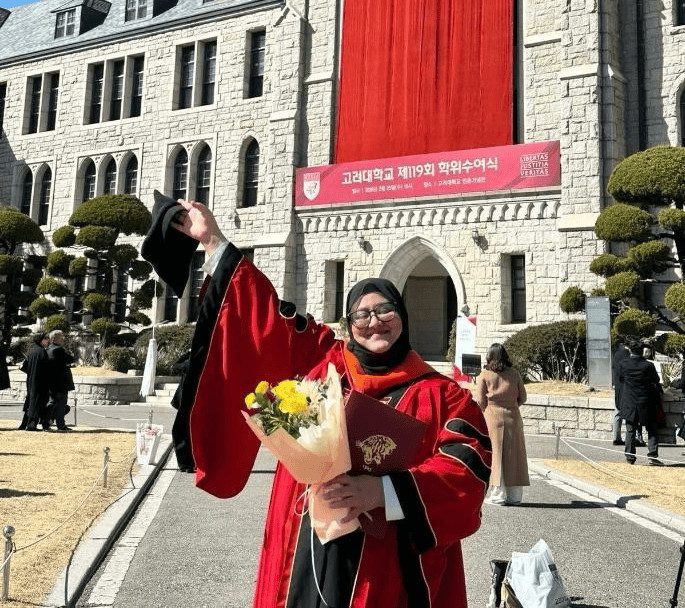

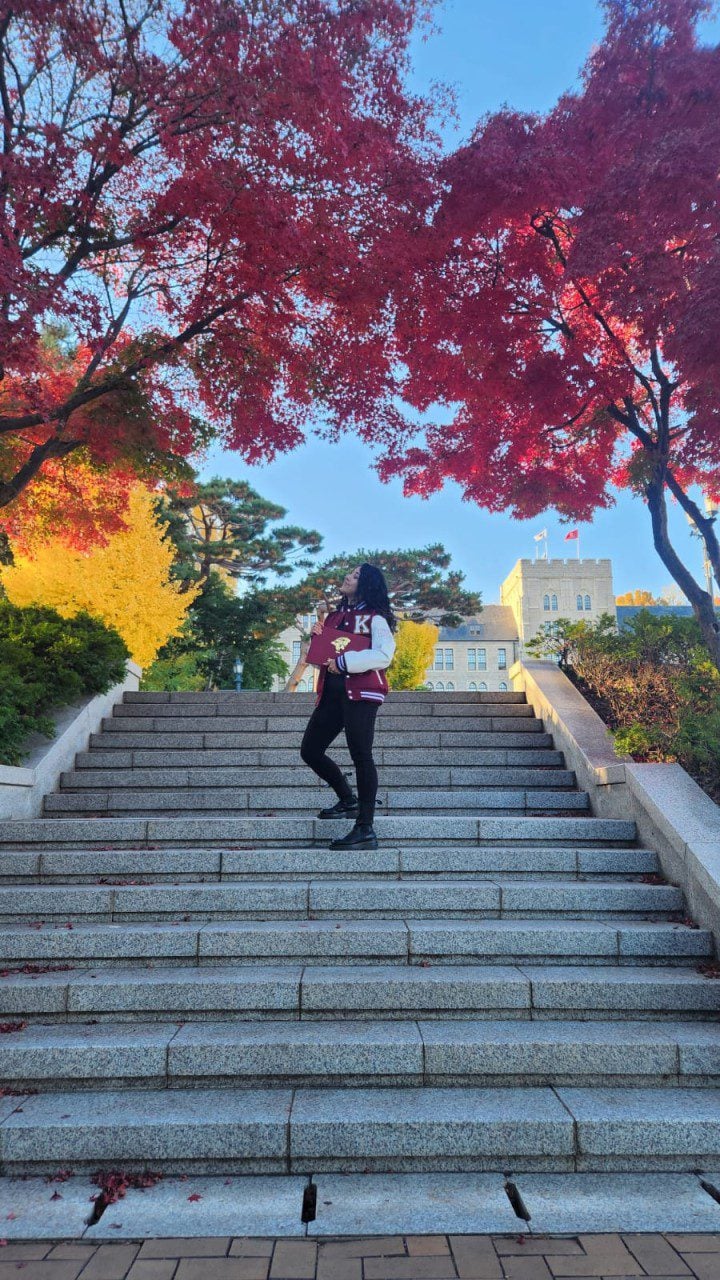




What Scholarship Recipients Say
Advice and insights from international students who successfully secured funding to study at Korea University.
"This scholarship covers tuition fees, Korean language program fees, monthly allowances, airfares, as well as research and settlement allowances."
"Thoroughly read and understand the official scholarship guidelines. Invest time in self-research and document preparation. Seek feedback and continuously revise your application materials"
"Although I am now pursuing a Master's degree in Urban Planning and Design under the College of Engineering at Korea University."
"The curriculum was challenging and demanding, pushing me to expand my knowledge and problem-solving skills."
"Beyond academic growth, I’ve had the chance to experience Korean culture firsthand and build meaningful friendships with people from diverse countries and backgrounds."
"studying abroad is not only about academics but also about experiencing the culture and embracing diversity."
Frequently asked questions
Common questions about scholarships, admissions, and studying at Korea University.
Most Korea University (KU) scholarships are designed for on-campus degree study (undergraduate/graduate) rather than fully online degrees. The scholarship stories on GlobalScholarships also reflect this: Deepak Kumar used GKS to complete a Bachelor’s in Electrical Engineering at KU, and Islamuddin used GKS for a KU master’s, and both were campus-based programs.
It’s both. KU has many Korean-taught courses, but also a large and growing set of English-taught offerings (especially in internationally oriented tracks and certain colleges). Recipients describe a mixed reality depending on major: Islamuddin says, “My classes are mostly in English. However, there are some classes that are conducted in Korean.” Meanwhile, Alisson Onzueta shares, “my classes were conducted in both English and Korean,” noting she had “several science courses taught in Korean” as a Biotechnology + International Studies double major. Even in engineering, Deepak Kumar chose KU partly because “most of the classes were being taught in English,” while still acknowledging Korean can appear in coursework and daily life.
KU’s internal scholarships typically focus on enrollment status and academic performance rather than a strict age cap, but major government scholarships can have age limits. For example, Global Korea Scholarship (GKS) commonly sets age thresholds (the limit differs by track/program). In practice, recipients include both early-stage and later-stage applicants: Lakhwinder Kaur applied after working for several years and explains she chose the “University Track” and prepared extensive documents; this kind of profile is common in graduate funding routes that allow a wider age range than undergraduate routes. If you’re applying via GKS, always check the specific year’s guideline for the age rule; if you’re applying to KU scholarships after you’re enrolled, it’s usually about meeting KU’s scholarship criteria (credits/GPA/eligibility) rather than age.
KU scholarships and major external scholarships (like GKS) cover a wide range of subjects across KU’s colleges, STEM, engineering, business, humanities, and more. The recipient stories show that breadth: engineering (Deepak Kumar, Electrical Engineering), STEM/physics (Islamuddin, Quantum Information Physics), data/AI (Lakhwinder Kaur, Big Data Science), urban planning/design (Hening Tyas Subekti and Anjavola Rasolonjatovo), and interdisciplinary fields (Alisson Onzueta, Biotechnology + International Studies). For business, KU’s Business School is a major hub, and scholarships commonly exist at both university and college levels. For medicine: KU does have medicine and nursing pathways for international admissions in certain intakes, but medicine is typically highly regulated and often Korean-language-heavy, so international eligibility depends on the specific admissions track, language readiness, and program rules; if you’re aiming for medicine, plan early for Korean proficiency and carefully verify major-specific admissions constraints.
Many KU scholarships are aimed at international students broadly (non-Korean nationality holders), while some are targeted by region, development status, or specific program rules. In KU’s international scholarship listings, you’ll see scholarships designed for international cohorts and criteria like academic performance, STEM output, financial need, or language achievement. The recipient stories also show wide nationality diversity, India (Deepak Kumar, Lakhwinder Kaur), Indonesia (Islamuddin, Hening), Madagascar (Anjavola), Peru (Alisson), which is a good sign that funding routes are not limited to a narrow set of passports. If you’re applying via GKS, nationality eligibility is determined by that year’s country list and track rules; if you’re applying via KU, nationality rules usually hinge on your “international student” qualification status and documentation.
For KU admissions, language proof is commonly required in some form (either official test scores like TOPIK/TOEFL/IELTS or approved alternatives such as proof of prior schooling in the language of instruction). In scholarships, language can be either a formal requirement or a competitive advantage depending on the funding type. Recipients show multiple pathways: Islamuddin says, “I took the IELTS test and obtained an overall score of 7.5,” while Anjavola explains, “I did not have any official standardized language test scores such as TOEFL or IELTS. Instead, I submitted an English proficiency certificate issued by the English academy I attended.” For Korean, Deepak Kumar notes, “I only had TOPIK level 2,” and still secured GKS for an engineering degree path. Having strong language scores can also unlock extra benefits later. Some KU scholarships explicitly reward achieving high TOPIK after admission, so even when not strictly mandatory, language proof can meaningfully improve your scholarship odds and campus experience.
KU doesn’t have a single “one-number” GPA cutoff that guarantees admission across all majors; competitiveness varies by department and intake, and the holistic review looks at transcripts, fit, and supporting materials. That said, the scholarship recipient stories give a realistic sense of what successful applicants often look like academically: Hening applied with “GPA: 3.80/4.00,” Islamuddin reports “CGPA 3.86/4.00,” and Anjavola shares “CGPA 3.60/4.0.” For undergraduate GKS context, Alisson notes she maintained a high high-school average “18/20” and focused on showing purpose and readiness. In short: aim for the strongest grades you can, but also treat the rest of the application (fit + clarity + evidence) as equally important.
A strong scholarship profile is usually a blend of (1) solid grades, (2) clear alignment between your past work and your intended program, and (3) a compelling purpose. Recipients describe exactly that: Hening explains that the relevance of her prior field “allowed me to write a focused and coherent study plan for my application.” Lakhwinder emphasizes preparation quality, saying the application required “Academic transcripts and certificates (apostilled and, where necessary, translated)” plus a “personal statement and study plan” and “letters of recommendation.” And Alisson frames it as showing transformation and purpose; she believes what mattered was “not just academic merit, but showing how I intended to use education as a tool for transformation.” If you can combine strong academics with evidence of direction (projects, research, work, leadership) and explain the “why KU/why this major/why now,” you’ll look like a scholarship-ready candidate.
Document requirements depend on your level (undergrad/grad) and track, but commonly include: application forms, passport/ID copies for you and your parents, proof of relationship, academic transcripts and graduation certificates, language proficiency proof, and personal statements (plus additional items like portfolios for art/design). Recipient experiences mirror this: Lakhwinder lists core items including “Academic transcripts and certificates (apostilled and, where necessary, translated),” “Personal statement and study plan,” and “Letters of recommendation.” Anjavola highlights how language proof can be flexible in some scholarship contexts: she used an English academy certificate instead of TOEFL/IELTS. At the other end of the spectrum, Deepak Kumar explains that for his undergraduate GKS application, “my high school certificate was the only credential I had,” showing how document depth can vary by route and life stage. Always verify the exact checklist for your intake because KU can require both online uploads and mailed hard copies depending on the admissions cycle.
Korea University offers a full spectrum of majors and graduate programs across humanities, social sciences, business, engineering, natural sciences, and interdisciplinary fields, plus professional tracks that can be more specialized. The scholarship recipients themselves illustrate the variety of what’s actually being studied at KU: Electrical Engineering (Deepak), Quantum Information Physics (Islamuddin), Urban Planning & Design (Hening, Anjavola), Big Data Science (Lakhwinder), and Biotechnology + International Studies (Alisson).
Yes, application fees exist, and the amount can vary by program and level.
There are many degrees that are open to international students right now — find yours.
About the Author: Hyun Lee


When do people start applying for 2024
Hello, admissions for Spring 2024 for Korea University has already been passed (September 1st, 2023), and the admissions deadlines for Fall 2024 has not been announced yet. However, given this year’s admissions deadlines, we can estimate that the applications will be open on February 2024 and close on March 2024.
Hi, is this master’s program in taught in English or Korean ?
There are some Master’s program taught in Korean and some in English. Here are some English programs available.
Thanks for sharing this information Hyun. Very helpful :)
You are welcome!
Hi, is the application guidelines for undergraduate fall 2024 already out as I tried finding it but unfortunately I can’t find it. About application form is it available to as whenever I reach the website it shows up that the page doesn’t exist.
Hi Rubaia, thank you for letting us know that the links are outdated. We will update this page ASAP. In the meantime, you can google the Admissions at Korea University and see the pages.
What documents will I need to go to Korea after high school?
Hello, the documents vary by university; for Korea University, please see the Admissions Section.
Do they teach m.sc nursing in English?
Hello, according to Graduate Page in Korea University, there’s no 100% English degree. They do have Master’s in Nursing available, but you most likely need to know Korean in order to follow the courses in Korean.
Hi there, can you please guide me to apply? I can’t see that link. Thank you
Hello, you can see the link for application process by going to the Admissions Section.
Is Forensic Science taught there? In English?
No, Forensic Science is not taught in Korea University
Is theology course taught there?
No, Theology is not taught in Korea University
Hi is there a 100% fee and stipend coverage scholarships for general nursing in Korea University? and how can I apply for them?
Hello, there is a Graduate Global Leader Scholarship for graduate studies that is fully funded, but full tuition scholarship called Global Leader Scholarships. I don’t know if they accept international students at Korea University for nursing, so you do need to check that out
I am a student from Myanmar, and I just finished year 12. Can i get scholarship in South Korea?
It is possible for students from Myanmar to get scholarships in South Korea. Please check out our database for more information.
Hi, I am a student in Ghana seeking the GKS 2025, but I can’t get through it, so can I have an agent who’s willing to put me through.
Hi Mensah, we currently don’t do any agency work. Please refer to the GKS Official website for more information on how to apply
Hey, I completed my diploma in electronics engineering from Bangladesh, and I got a CGPA of 3.92 out of 4. Am I able to get a fully funded scholarship?
Hi, many merit scholarships are awarded based on GPA. please check out our scholarship database for graduate scholarships. while you have an excellent CGPA, please not that there are other factors that are considered when awarding scholarships.
I find it difficult to apply for these scholarships. Is there any guide that can put me through?
Hello, check out our YouTube channel! We also do livestreams where you can ask questions.
Hi, is there any scholarship provided for bachelor’s degree in Fashion design?
Thank you
Hello, Global Leader Scholarships are for all subjects, so if fashion design is taught in Korea University, that scholarship should be available.
Hi I want to complete my master studies there in korea. Is there any scholarship provided for master degree in digital marketing, and how can i apply for it? I don’t know the deadline
Hello, the scholarships are institution-specific and not subject-specific. So, you should see which institutions are offering digital marketing and apply there. The deadlines will be different. Also, you can apply for scholarships like Global Korea Scholarships, which applies to many universities, some of which offer digital marketing.
Is Aerospace engineering taught there ?
No Korea University doesn’t have an aerospace engineering major; in fact, most universities in Korea don’t. Places like Seoul National University, Sejong University, and Korea Aerospace University have it, so check them out.
Hello i am From Timor Leste
I want to apply in korean university
Because i want to study in korean
Please help me How to apply?
Hello, you can take a look at the admissions procedures linked in this institution page and also for other universities that you are interested in!