
Sungkyunkwan University Scholarships for International Students 2027
Sungkyunkwan University is linked to scholarships that can reduce costs in meaningful ways. Here are a few strong options prioritized by funding level.
On the institution side, Sungkyunkwan University is connected to scholarships that can reduce tuition and sometimes extend to other study costs. These are practical starting points. A strong option is Samsung Global Sungkyun Scholarship for Foreign Students which is fully funded and often covers 100% of tuition and entrance fees, KRW 570,000 per month for living expenses, and priority dormitory assignment. Admission Scholarships is full tuition, and coverage often includes 10% - 100% or tuition and entrance fees. STEM Scholarship is full tuition and typically covers up to 100% of tuition fees for the first semester. Admission Scholarship is commonly categorized as full tuition support, and coverage that often includes 10% to 100% of tuition and admission fees.
Beyond campus funding, Sungkyunkwan University applicants often explore outside opportunities including government backed and independent programs. These are common starting points. POSCO Asia Fellowships is commonly categorized as fully funded support, and coverage that often includes full tuition, living expense stipend of 1,000,000 KRW per month, and national health insurance. With Samsung Global Hope Scholarships, students may receive fully funded support, and coverage frequently includes undergraduate level : KRW 3,900,000 per semester and Master's and PhD level : KRW 3,500,000 or KRW 5,000,000 per semester. Global Korea Scholarship (GKS) is a fully funded award, and the listed benefits often include tuition fees, airplane tickets, and living stipend.
For the complete set of linked scholarships including additional options and details, continue below on this page.
Sungkyunkwan University Scholarships for International Students
The scholarships at Sungkyunkwan University can help fund your study expenses. There are currently 10 scholarships being offered to international students at the Sungkyunkwan University, all with varying requirements, benefits, and application processes. We have compiled them in this list to help you find the scholarship that best fits you.
Undergraduate Scholarships
Graduate Scholarships
External Scholarships
There are many degrees that are open to international students right now — find yours.
Sungkyunkwan University Admissions
Here are the official admission pages for Sungkyunkwan University:
| Degree | Admissions Pages |
|---|---|
| Bachelor's | International Students Admissions Page |
| Master's | International Students Admissions Page |
Admissions and Scholarship Results at Sungkyunkwan University
Here are some of the admissions and scholarship results from previous applicants to Sungkyunkwan University, which you might find helpful. For more results to Sungkyunkwan University, please see the Sungkyunkwan University Admissions Profile Page .
| Nationality / Region | SAT/ACT | EFC | GPA | Scholarship | Status |
|---|---|---|---|---|---|
| Indonesia | N/A | N/A | 3.65 | Fully funded | Accepted |
| Kenya | N/A | N/A | N/A | N/A | Accepted |
Tuition Fees at Sungkyunkwan University for International Students
Indicative annual tuition fee ranges for international students at Sungkyunkwan University. Exact fees vary by program, so always confirm the current cost on the university's official tuition fee pages.
| Degree Level | Typical Annual Range |
|---|---|
| Bachelor's Tuition | 10,174,000 – 15,616,000 KRW |
| Master's Tuition | 13,482,000 – 18,472,000 KRW |
Please note that tuition fees can vary based on the specific program you choose. For the most accurate and current fee information, consult the official tuition fee pages linked above.
Sungkyunkwan University Scholarship Recipients
International students who received scholarships to study at Sungkyunkwan University, documented by Global Scholarships.
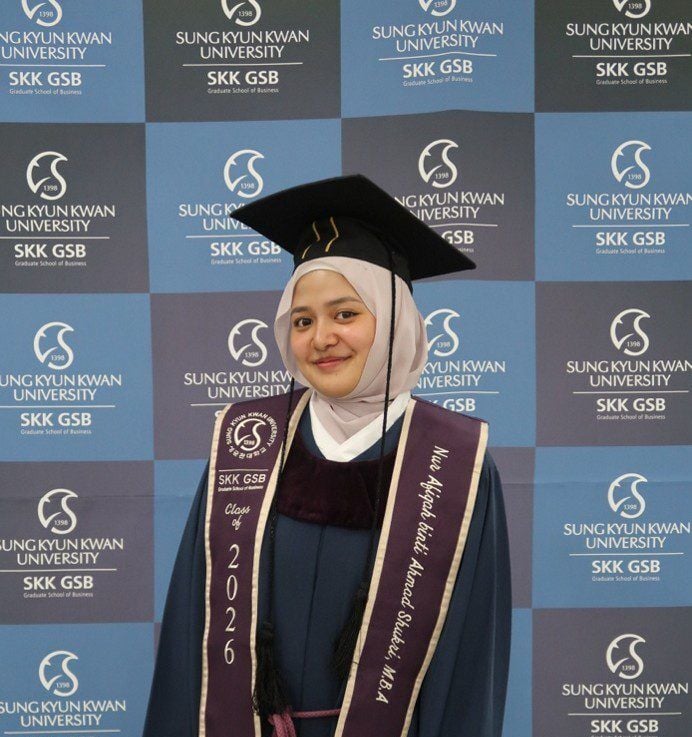

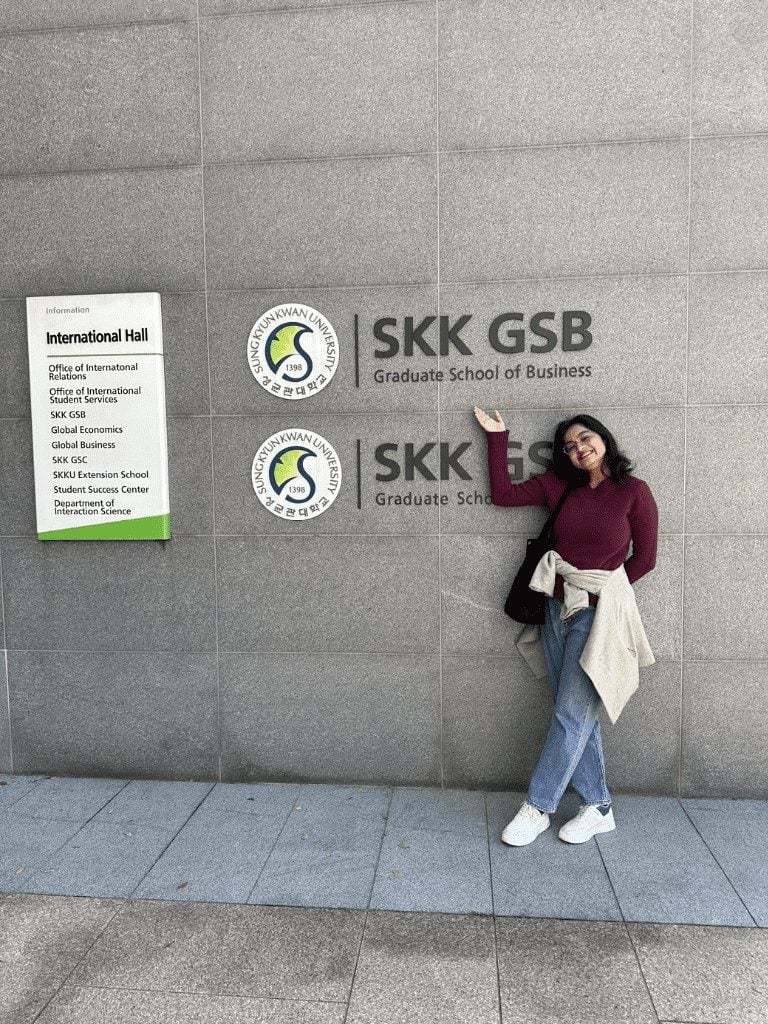

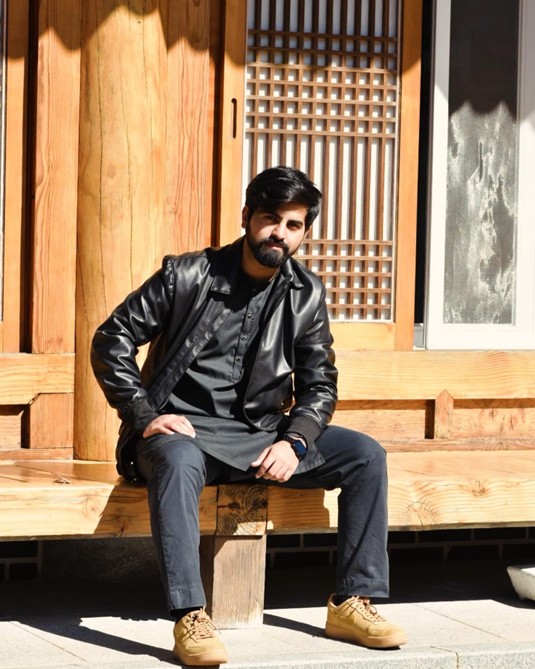

What Scholarship Recipients Say
Advice and insights from international students who successfully secured funding to study at Sungkyunkwan University.
"I was awarded the Global Korea Scholarship (GKS), which is offered by the South Korean government through the National Institute for International Education (NIIED). The scholarship covered full tuition, monthly living allowance, a settlement allowance, health insurance, language training, and round-trip airfare. This comprehensive support allowed me to focus entirely on my academic and professional development while living in Korea."
"Focus on finding a lab that truly matches your interests. Reach out to professors respectfully, showcase your practical experience, and be clear about your goals. The lab environment is the most important thing; everything else is secondary. Preparing early and being persistent really makes a difference."
"My name is Kristien Contino, and I’m a first-generation college student and Cuban-American from Miami, Florida. I have a Bachelor’s degree in International Relations and Asian Studies from Florida International University, and I recently earned my Master’s degree in Political Science from Sungkyunkwan University in Seoul, South Korea."
"It’s been great. The research environment is collaborative, and the facilities are excellent. The international office and lab mates were very helpful in making my transition smooth. Unlike other universities, SKKU provides an initial settlement fund of around $500"
"SKKU is one of the top 5 universities in Korea. The academic standard is high, and the research output is impressive. I’m proud to be part of it."
"My experience at Sungkyunkwan University was deeply rewarding. The academic environment was rigorous and research-focused, and I appreciated the high expectations placed on graduate students. I also enjoyed collaborating with international and Korean peers and having professors who were experts in their fields."
Frequently asked questions
Common questions about scholarships, admissions, and studying at Sungkyunkwan University.
Most SKKU scholarships are designed for degree-seeking students who are formally enrolled at SKKU (with requirements tied to semesters, credits, and GPA), rather than for standalone online courses.
Both. SKKU offers many courses in Korean, and also a significant number taught in English. SKKU’s course information notes that general courses are typically taught in Korean, while courses marked “International Language” are taught in English.
In the scholarship stories, you can see that mix in real life: Muhammad Omer said, “Mostly yes, and lab meetings are also in English,” while Kristien Contino shared that she “struggled at first with classes that were not in English.”
For many SKKU-run scholarships, eligibility is usually based on your admission status (international student track), academic performance, and scholarship-specific conditions. An explicit age cap is often not the main deciding factor.
However, if you’re applying through large external scholarships that can be used at SKKU (especially government programs), age limits can apply. For example, Kristien’s scholarship route (GKS) is known for eligibility rules that can include age criteria depending on whether you apply for undergraduate or graduate tracks.
SKKU scholarships span a wide range of subjects. At the graduate level, SKKU explicitly lists scholarships for international students in Humanities, Social Sciences, and Arts, and also separate scholarship pathways for Natural Sciences, Engineering, and Medical departments (often grouped as STEM for scholarship purposes).
That range shows up in recipient stories too: Muhammad Omer pursued “Graduate Studies in Medical Image Processing” with a professor-sponsored STEM scholarship, while Kristien Contino completed a Master’s in Political Science with the fully funded GKS.
In general, SKKU’s international scholarships target international applicants (i.e., students applying through international student admissions). Many are open to a wide range of nationalities, but some are intentionally more targeted. External scholarships used at SKKU can have their own nationality rules: Muhammad Omer applied as a Pakistani student, while Kristien Contino applied through GKS as a Cuban-American from the U.S.
Language proof requirements can vary by program and track, but language test scores can be especially important for certain scholarships. SKKU’s undergraduate scholarship listings include scholarships specifically for high English proficiency (with IELTS/TOEFL thresholds) and also scholarships tied to Korean proficiency (TOPIK levels).
The recipient stories show flexible real-world routes: Muhammad Omer explained, “I only needed to prove English proficiency, so I prepared for and submitted the TOEIC (Listening and Reading only),” and also noted, “No GRE or SAT was required.” Meanwhile, Kristien Contino emphasized that “getting a TOPIK score is crucial” for the GKS path and said she submitted her TOPIK score and proof of Korean language programs.
So yes, strong language scores can directly help you win language-based scholarships, and they can strengthen your admissions profile even when not strictly mandatory for every program.
SKKU admissions decisions are typically holistic (reviewing transcripts and other materials), and many tracks describe evaluation based on academic transcripts, personal statements, and language ability rather than publishing one single “minimum GPA” that guarantees admission.
That said, scholarships can be more explicit about academic thresholds, especially for continuation once you’re enrolled (e.g., credit completion and GPA requirements). In the recipient stories, you can see that different profiles can succeed: Muhammad Omer reported a “GPA of 3.31” in his bachelor’s and still secured fully funded support by aligning closely with a professor’s lab, while Kristien Contino described having “a strong academic record” and building a research-focused application for a competitive government scholarship.
A strong academic background helps, but the “best” profile depends on the scholarship type. For professor-linked graduate STEM scholarships, research fit and relevant projects can matter as much as raw grades; for competitive external awards (like GKS), well-prepared documents and a clear study plan can be decisive.
Muhammad Omer described a very research-fit approach: he shortlisted universities by faculty research, contacted professors directly, and said he “customized my CV and statement of purpose accordingly.” Kristien Contino emphasized alignment and planning too, explaining she aligned her “personal statement and study plan” with goals and that reviewers want confidence you can finish and graduate.
Document requirements vary by degree and track, but commonly requested items include academic transcripts, a personal statement (and/or statement of purpose), proof of language ability, and identification documents (like a passport copy). Some scholarship routes also require recommendation letters and formal study plans.
The scholarship stories make this very concrete: Kristien Contino said, “I gathered academic transcripts, letters of recommendation, personal statements, and a study plan, all of which needed to be notarized.” Muhammad Omer also highlighted practical application materials, contacting professors, tailoring a CV, and preparing a statement of purpose as part of his process.
SKKU offers a broad set of undergraduate and graduate programs across humanities, social sciences, business, natural sciences, engineering, and medicine/biomedical fields. SKKU also publishes “International Language” course offerings (English-taught course categories) alongside Korean-taught general courses.
- Business: Examples include global-track departments like Global Business Administration and Global Economics.
- Engineering / STEM: Engineering and science fields are central to SKKU’s graduate scholarship pathways; Muhammad’s “Medical Image Processing” is one example of an applied, interdisciplinary STEM route.
- Humanities & Social Sciences: Programs such as Political Science (Kristien’s field) sit within the scholarship-supported Humanities/Social Sciences categories.
- Medicine / Biomedical: SKKU’s graduate medical/biomedical tracks include advanced research-focused programs, and medical departments are explicitly included in graduate scholarship listings for international students.
Yes, international application guides commonly list an application fee (for example, KRW 100,000 is shown in SKKU’s undergraduate international admission guide, with a note that it is non-refundable).
There are many degrees that are open to international students right now — find yours.
About the Author: Hyun Lee


I need to apply for a program
Hello, you can apply through the Sungkyunkwan University Admissions Section.
How to apply master scholarship in Sungkyungkwang University?
Hello, you can go to the Master’s scholarships page that you are interested in and see the application procedure there.
Hello, does sungkyungkwan university school of medicine provide professor’s scholarships??
Hello, scholarships based on professor’s recommendation are given to these majors “Science / Technology / Engineering / Mathematics (STEM) (including Pharmacy & Biomedical Science) fields” so medicine would not be included.
Sir, is there any scholarship for medicine at sungkyunkwan university for international students?
Hello, I don’t believe there is
Is there any PhD scholarship in psychology?
Hello, it seems like they have a Ph.D. program according to their psychology page, but I’m not sure if they offer any scholarships
Hello! Please tell me how can I apply for Samsung global hope scholarship!?
Hello, check out the Samsung Global Hope Scholarships Page!
Is there a scholarship for law student freshman
I don’t believe law is available for international students
Is it possible to transfer for a second year? I’m currently studying AI and Big Data at a university in Korea and want to transfer to SKKU. Not sure about deadlines and the major is it English taught or not. Emailed admission office they just sent undergrad admission guidelines without answering questions I needed
Hello, transfer is a whole different story for Korean students than regular admissions. Usually, you transfer after your second year and start in the new institution in your third year. I’m not sure if international students are accepted for transfer though.