
MA International Development Studies Graduate Obaid Arshad Khan from Pakistan Shares His Journey of Studying at The George Washington University as a Fulbright Scholar
University: The George Washington University, Elliott School of International Affairs, United States
Degree: Master of Arts in International Development Studies (Quantitative Research & Evaluation Specialization)
Previous Education: BSc (Hons.) in Economics – Lahore University of Management Sciences (LUMS), Pakistan (Dean’s Honor List: Spring 2011 & Spring 2014)
Scholarship: Fulbright Foreign Student Program – Fully Funded (Full Tuition, Monthly Living Stipend, Settling-in Allowances, Health Insurance, Round-Trip Airfare)
Social Media
LinkedIn: linkedin.com/in/obaidkhan-evaluation/
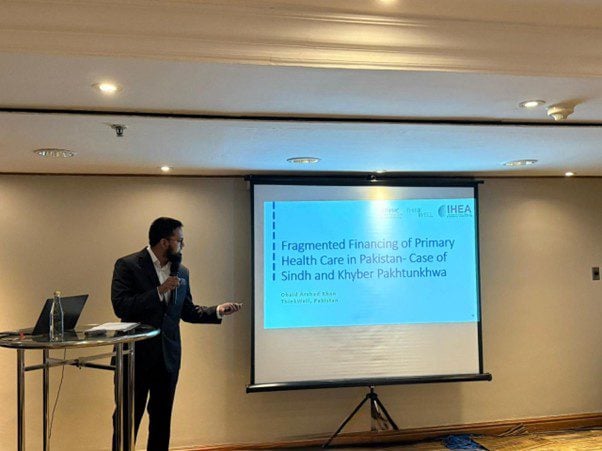
The Journey
My name is Obaid Arshad Khan. I am from Karachi, Pakistan, where I was born and raised in a family of six. With limited financial resources, education was always the central priority in our household. My parents understood early that it was the greatest equalizer, and that belief proved correct.
I am a public policy analyst, development researcher, and practitioner with over ten years of experience across government, international organizations, and the development sector. I currently serve as Technical Advisor at Health Systems Insight (formerly ThinkWell), where I provide strategic guidance to the Government of Sindh on evidence-based resource allocation, strategic purchasing for primary healthcare, and universal health coverage implementation.
I pursued my Master of Arts in International Development Studies at the Elliott School of International Affairs, The George Washington University (GWU), graduating in 2017 as a Fulbright Scholar with a CGPA of 3.98/4.00. I chose this field because my undergraduate years - studying Economics at LUMS and accumulating a substantial portfolio of internships across health, social protection, and evaluation - had given me a clear set of questions about why development interventions succeed or fail, and a strong desire to build the analytical and policy skills to help answer them. A graduate degree in International Development Studies, with a specialization in Quantitative Research and Evaluation, was the natural next step.
Fulbright Scholarship Details
Scholarship: Fulbright Foreign Student Program
Administered by: United States Educational Foundation in Pakistan (USEFP), on behalf of the U.S. Department of State
Institution: The George Washington University, Elliott School of International Affairs
Degree: Master of Arts in International Development Studies (Quantitative Research & Evaluation specialization)
Funding: Fully funded; covering full tuition, monthly living stipend (plus one-off settling-in allowances), health insurance, and one round-trip international airfare
The Fulbright Foreign Student Program is one of the most prestigious government-funded scholarships in the world, sponsored by the U.S. Department of State. For Pakistani applicants, it is highly competitive and fully covers the cost of a Master's or PhD degree at a U.S. university, along with living and travel expenses.
Were You Offered Any Other Scholarships?
Through the Fulbright process, I was offered placements at three U.S. universities: Boston University, Northeastern University, and The George Washington University. The Fulbright program places scholars at universities on the basis of the study objectives outlined in the application, so receiving multiple placement offers indicated that my profile was a good fit across several strong programs.
I chose GWU's Elliott School for a combination of reasons: the M.A. in International Development Studies was the closest match to my study objectives; Washington D.C. offered unparalleled proximity to the World Bank, International Development Organizations, and a dense ecosystem of policy think-tanks, making the city itself part of the educational value; and GWU's renowned Capstone Project model placed students in real engagements with organizations as part of the curriculum - which aligned with how I wanted to learn.
Educational Background
BSc. (Hons.) in Economics - Lahore University of Management Sciences (LUMS), 2014
Dean's Honor List: Spring 2011 and Spring 2014
LUMS was genuinely transformative. Beyond the academic rigour, coursework in Development Economics, Econometrics, International Finance, Political Economy of Pakistan, Game Theory, and Agriculture & Food Policy, the most valuable things I took away were a habit of critical analysis and an openness to new ideas, new experiences, and criticism. Quality institutions break down mental barriers, and LUMS did that for me.
My undergraduate GPA was average rather than exceptional. However, I complemented the academic record with something I believed mattered just as much: a sustained 'side hustle' of internships throughout all four years of my degree. By the time I graduated, I had worked at Sindh Growth and Rural Revitalization Program (now PPRP), UNICEF, IRD Global, the Sindh AIDS Control Program, the Fishermen's Association for Community Empowerment, the Children's Cancer Hospital, and the Pakistan National Forum on Women's Health, among others. These were not resume items - they were genuine exposures to Pakistan's development challenges on the ground, and they gave me the raw material for a compelling Fulbright application.
This combination - strong analytical training, a clear-eyed sense of Pakistan's development challenges, and a demonstrated record of field engagement - prepared me to articulate a coherent and credible study purpose.
How Did You Prepare to Apply to the George Washington University?
How Did You Find Information About the Fulbright Scholarship and the George Washington University?
LUMS had a culture of openly discussing international scholarships: Fulbright, Commonwealth, Chevening, DAAD - partly because professors, alumni, and seniors had been through these processes themselves. Their mentorship was invaluable in demystifying the process. Once I understood that the Fulbright was not reserved for some abstract category of exceptional people but was genuinely accessible to well-prepared candidates, the mental barrier came down.
For university selection, I researched deliberately rather than relying on rankings alone. Washington D.C. was a strategic choice: the concentration of international development institutions - World Bank, International Development Organizations, and a dense network of policy think-tanks - meant the city was as much a part of the learning environment as the campus. I reviewed GWU's program structure carefully, paying particular attention to the flexibility to take courses across departments, the Capstone Project model, and the Quantitative Research and Evaluation specialization that aligned with where I wanted to go professionally.
Did You Take Any Standardized Tests? If So, How Did You Prepare for Them?
The Fulbright application requires the GRE, and the TOEFL is required after acceptance.
For the TOEFL, I did not prepare separately. English had been the medium of instruction throughout my entire schooling and undergraduate education in Pakistan, so it was not a test I needed to prepare for in any dedicated way. For applicants who share a similar background, this is one less thing to worry about. However, I would still recommend familiarising yourself with the test format so there are no surprises on the day.
My GRE score was quite strong, which helped offset an undergraduate GPA that I would describe as average rather than exceptional. This is worth highlighting for prospective applicants: a strong GRE can meaningfully compensate for a modest GPA, particularly when the rest of your application is coherent and compelling. For GRE preparation, I used a combination of approaches - self-study with books and online resources, some structured coaching, and extensive timed practice testing. Understanding the logic behind question types mattered far more than rote memorization, particularly for the verbal and analytical writing sections. My advice: start early, take multiple full-length practice tests under exam conditions, and be honest with yourself about where you are losing marks.
How Did You Prepare to Apply to the Scholarship?
The Fulbright application has two major essay components: a Statement of Purpose and a Study Objectives essay. These are where the application is genuinely won or lost, and I invested significant time in both - not in producing multiple drafts of the same thing, but in thinking carefully about what I actually wanted to say and why it mattered.
Beyond the standard application requirements, I submitted supplementary work: an essay on predominant economic theories and an independent study I had undertaken on Mexico's Progresa (now Prospera) conditional cash transfer program and its potential replicability in the Pakistani context. This was not padding - it was a genuine attempt to demonstrate that my intellectual engagement with development economics went beyond coursework and job titles. The Progresa study in particular connected a global evidence base to a concrete, locally relevant policy question: could a proven social protection model from Latin America be adapted for Pakistan's institutional environment? That kind of grounding - showing you understand both the global literature and the local context - is exactly what a strong Fulbright application communicates.
I also sought feedback on my essays from mentors and seniors who had been through similar scholarship processes, which helped sharpen the narrative significantly.
How Was Your Experience at the George Washington University?
My two years at GWU's Elliott School were everything I had hoped for - and more demanding than I had anticipated. I graduated with a CGPA of 3.98/4.00, which I mention not to boast but to note that I arrived with an average undergraduate GPA and left with near-perfect marks. The difference was not innate ability; it was genuine engagement. When you are studying exactly what you want to study, in an environment that rewards rigorous thinking and intellectual honesty, the work comes naturally.
The Capstone Project was a highlight. I worked with the World Bank's Independent Evaluation Group on a randomised controlled trial evaluating a community monitoring intervention for health and education service delivery in Burkina Faso - an experience that took me to West Africa and gave me hands-on exposure to impact evaluation at the highest level. I also worked with YMCA Youth and Family Services on program evaluation design as part of a course, and consulted part-time with Humanitas Global Development throughout my studies.
Washington, D.C., delivered on its promise. Attending think-tank events, World Bank seminars, and policy discussions - including a CSIS session featuring Pakistan's Planning and Development Minister - placed me in intellectual conversations that no classroom alone could replicate. The city was a live-action policy laboratory, and I tried to use every moment of it.
How Do You Rate the George Washington University Academically and Why?
I would rate GWU's Elliott School very highly. The program offered genuine flexibility - I took courses across the departments of international affairs, public health, public policy, economics, and education - which allowed me to build an interdisciplinary foundation that has proven directly useful in my career. The faculty were accessible, the coursework was rigorous, and the Capstone model ensured that academic learning was constantly tested against real-world problems
The strategic location in Washington, D.C., amplified the academic experience considerably. The city's concentration of international development institutions, think-tanks, and government agencies meant that the classroom extended well beyond the campus.
How Does the George Washington University Support International Students?
GWU has a well-established international student support infrastructure. The International Services Office handles visa and administrative support, and the campus has a genuinely diverse international student body, which meant I was never made to feel like an outsider. The Fulbright program itself also provides an additional layer of institutional support - USEFP in Pakistan and the Institute of International Education (IIE) in the U.S. offer orientation, peer networks, and advisory support throughout the scholarship period. The combination of GWU's own services and the Fulbright network made the transition to studying and living in the U.S. significantly smoother than it might otherwise have been.
What Did You Pursue After the Scholarship?
I returned to Pakistan, as the Fulbright scholarship requires, and built the career I had outlined in my application essays. I served as Social Sector Policy Advisor at the Planning and Development Department, Government of Sindh, for over five years, working across public sector development review & planning, financial & economic appraisal of development proposals, health sector review, social protection, COVID-19 response, and the 2022 floods recovery. I also worked as a Policy Analyst (Consultant) with UNDP Pakistan, and consulted with the International Trade Centre, DAI, and the Pakistan Institute of Development Economics.
Since 2023, I have been with ThinkWell (now Health Systems Insight), where I contribute towards health financing and strategic purchasing reform work in Sindh province - providing technical guidance to the Government of Sindh on evidence-based resource allocation, public financial management, and universal health coverage implementation. I have presented research at the International Health Economics Association (IHEA) Congress in Bali and co-authored multiple policy briefs and analytical publications.
In short, the Fulbright opened a door. What I have built since is what I came home to build.
What Do You Think Made Your Application Stand Out?
It was the coherence of the overall picture - not any single exceptional credential.
My undergraduate GPA was average. My GRE was strong. My internship record was extensive and genuinely relevant - four years of working across health, social protection, evaluation, and community development during my undergraduate studies. My essays were, I believe, compelling without being over-the-top: they articulated an honest and clear trajectory, grounded in real experience and real questions about Pakistan's development challenges.
The supplementary work - the independent economic theory essay and the Progresa-Pakistan replicability study - added a layer that signalled intellectual initiative beyond formal requirements. It showed curiosity and follow-through, and it demonstrated that my interest in development economics was substantive rather than stated.
The Fulbright selection process in Pakistan is rigorous. Committees are looking for candidates who will represent Pakistan meaningfully in the U.S. and who have a credible plan for contributing back home. My application tried to answer that question clearly: here is where I have come from, here is what I want to understand better, and here is why it matters for Pakistan.
What Would You Have Done Differently if You Were Going Through the Process Again?
I would have started the essay drafting process even earlier and sought more structured feedback - particularly from people who had been through Fulbright or similar scholarship applications themselves, rather than just from friends or family. Mentors who understand what selection committees are looking for can identify gaps in your narrative that you simply cannot see.
I would also have been more deliberate about articulating what I learned from each internship experience, rather than assuming its relevance would be self-evident. Scholarship committees read hundreds of applications. The experiences matter, but how you frame them - what questions they raised, what you did differently as a result - matters just as much.
One thing I am genuinely glad I did: the independent study on Progresa. It was extra work that no one asked me to do, and it turned out to be one of the most distinctive parts of my application. My advice to prospective applicants: do not wait to be assigned interesting questions. Pursue them on your own.
What Advice Would You Give Those Looking to Apply for a Similar Scholarship?
- Build your record before you write your essays.
The Fulbright is not purely an academic scholarship - it values demonstrated engagement with real-world challenges. Internships, fieldwork, independent research, and community involvement: these are not supplementary. They are the evidence base for the story your essays will tell. Start early in your undergraduate years, and choose experiences that genuinely interest you.
- Let your essays be honest, not heroic.
The biggest mistake in scholarship essays is attempting to sound exceptional at the cost of sounding real. Committees read thousands of applications and can tell the difference between genuine reflection and performed achievement. Write about what you actually care about, what you have actually learned, and where you genuinely want to go. Compelling but not over-the-top is exactly the right register.
- Show intellectual initiative beyond your formal responsibilities.
If there is a policy question that genuinely fascinates you, write about it - as an independent study, an essay, or a structured piece of analysis. My Progresa study was not assigned by anyone. It emerged from a real question I wanted to answer. That kind of self-directed curiosity is precisely what a Fulbright is designed to identify and support.
- Choose your university strategically, not just by ranking.
Think about what you want the years after your degree to look like, and choose a program and city that maximise your chances of getting there. For me, Washington, D.C., was as important as GWU itself. Think about faculty interests, capstone opportunities, cross-departmental flexibility, alumni networks, and the broader environment - not just the name on the degree.
- A strong GRE can compensate for a modest GPA - but only if everything else is strong.
Do not be discouraged by an average GPA. Invest seriously in the GRE, and invest even more seriously in your essays and the overall narrative of your application. The Fulbright selection is holistic. No single number defines your candidacy.
Want to submit your
scholarship journey?
Submit Your Story Here!
More Scholarship Recipients

I am Aleezay Anjum Ahmed from Pakistan, and I hold a bachelor’s degree in chemistry with a minor in mathematics. I was awa .... Read more
My name is Alhaji Alusine Kebe. I am an agronomist specializing in soil–plant–climate interactions, sustainable agri-foo .... Read more

My name is Sarbinaz Nagyzkhan, and I am originally from Kazakhstan. I am currently a Marie Skłodowska-Curie Doctoral Fellow .... Read more
Leave A Comment