
MBA Student Niharika Gupta from India Shares Her Journey of Studying at Sungkyunkwan University, South Korea
University: Sungkyunkwan University (SKKU), South Korea
Degree: Master of Business Administration (MBA)
Previous Education: BTech – Indian Institute of Information Technology (IIIT) Una, India
Scholarship: Global Korea Scholarship (GKS) – Fully Funded
Other Offered Scholarships: Social Impact Scholarship – Sungkyunkwan University (3.2 million KRW)
Social Media
LinkedIn: linkedin.com/in/nimrodcoder/
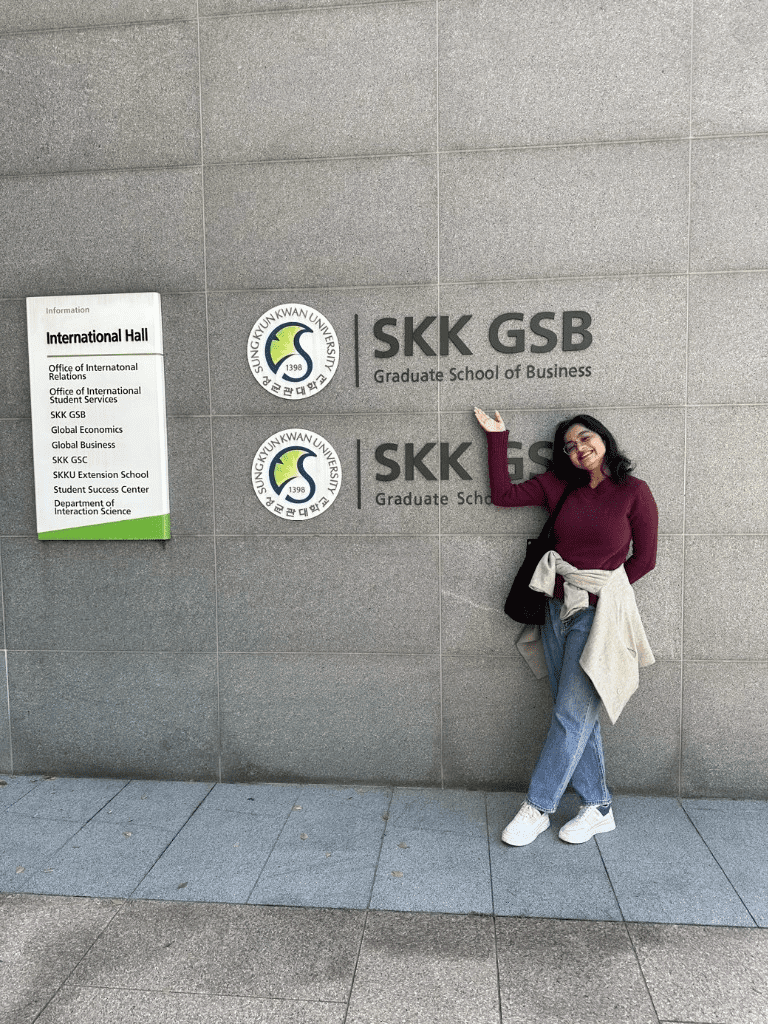
The Journey
Hello, my name is Niharika Gupta, and I am from Karnal, Haryana, India. I am about to graduate from the full-time MBA program at Sungkyunkwan University (SKKU) in Seoul, South Korea, where my entire program was funded through the Global Korea Scholarship (GKS).
Before pursuing my MBA, I worked as an engineer for three years, gaining strong technical and problem-solving experience. However, over time, I realized that I wanted to move beyond purely technical roles and transition into management, where I could contribute to decision-making, strategy, and cross-functional leadership. I was also keen to develop these skills in a global environment, which motivated me to explore opportunities to study abroad.
Through this process, I discovered the Global Korea Scholarship and the academic and professional opportunities that an international MBA in Korea could offer. This path aligned well with my long-term goal of building a global career at the intersection of technology, business, and international markets.
Global Korea Scholarship Details
was awarded the Global Korea Scholarship (GKS), funded by the National Institute for International Education (NIIED) under the Government of South Korea. GKS is a fully funded scholarship program available for undergraduate, master’s, and PhD students from around the world.
The scholarship provides comprehensive financial support, including:
- Round-trip airfare to and from South Korea
- Full tuition coverage for both the Korean language program and the degree program
- One year of Korean language training at a designated language institute for scholars who do not meet the required TOPIK level at the time of admission
- A monthly living stipend of 1.1 million KRW during the Korean language year and 1.3 million KRW during the degree program
This structure allows international students to focus entirely on their academic and cultural experience without financial burden, while also gaining strong language and cultural foundations before starting their degree studies.
Were You Offered any Other Scholarships?
Yes. I was awarded a Social Impact Scholarship by Sungkyunkwan University (SKKU) in recognition of my work during a summer internship with a company focused on renewable energy and carbon offset projects. The organization’s work directly supports African farmers in Rwanda by improving livelihoods through sustainable development initiatives.
The scholarship amount was approximately 3.2 million KRW. This award recognized both the academic value and the real-world social impact of the internship experience.
Educational Background
I completed my Bachelor of Technology (BTech) from the Indian Institute of Information Technology (IIIT) Una, where I graduated with a GPA of 9.01/10. For eligibility under the Global Korea Scholarship, applicants are required to have a minimum of 80% or equivalent, and maintaining a strong academic record was an important part of my application.
Beyond academics, I consciously worked to build a well-rounded profile. During my undergraduate studies, I actively pursued internships, extracurricular activities, and leadership opportunities, which allowed me to develop skills beyond technical coursework. These experiences helped demonstrate my interest in management, teamwork, and real-world problem-solving, rather than positioning myself solely as a one-dimensional engineering student.
This combination of strong academic performance and diverse practical exposure prepared me well for a transition into an MBA program, where analytical thinking, communication, and leadership are equally important.
How Did You Prepare to Apply to Sungkyunkwan University?
I applied through the Embassy Track of the Global Korea Scholarship and began my preparation by thoroughly researching universities that aligned with my academic and career goals. I reviewed individual university websites to identify institutions offering a Global MBA or fully English-taught MBA programs.
After shortlisting relevant programs, I compared universities using a combination of QS World University Rankings and local Korean rankings, while also researching the historical acceptance difficulty, both through GKS and regular admissions. This helped me make informed and realistic choices when selecting my universities under the Embassy Track.
How Did You Find Information About Scholarships and Institutions?
I relied on a mix of official sources and peer-shared experiences. I carefully reviewed scholarship guidelines and university requirements from official websites, while supplementing this information through blogs, student experiences, and online communities.
I followed discussions and updates on Telegram, Facebook, and Instagram, and also joined WhatsApp groups that were specific to universities and application cycles (which were especially common in India). While these platforms were extremely helpful, I made a conscious effort to separate opinions from verified facts, always cross-checking information with official documents before making decisions.
Did You Take Any Standardized Tests? If So, How Did You Prepare for Them?
took a proactive approach and prepared for multiple standardized tests to keep my options open beyond the Global Korea Scholarship. I prepared for the GMAT in case I decided to apply to MBA programs in other countries, such as Singapore, Malaysia, or even Korean universities apart from the GKS available ones.
For GMAT preparation, I relied on Udemy courses, which I found to be both cost-effective and reliable. Given my background as an engineer, I already had a strong foundation in quantitative reasoning and verbal skills, so I did not feel the need to invest in expensive, dedicated GMAT coaching packages.
For TOPIK, I primarily used HowToStudyKorean.com for structured lessons and the Memrise app for vocabulary and flashcard-based revision. At the time of application, I already held TOPIK Level 2, which is relatively achievable for beginners.
For IELTS, my preparation was minimal, as the program I applied to was fully English-taught. I took a mock test mainly to familiarize myself with the exam format rather than for intensive preparation. IELTS was also a mandatory requirement for my MBA program and contributed additional points during the GKS evaluation.
Applicants should carefully verify the minimum TOPIK level required for their specific degree program—in my case, this was TOPIK Level 3. During the mandatory Korean language training year, scholars are expected to clear the required level before progressing to their degree program.
How Did You Prepare to Apply to the Global Korea Scholarship?
- Document Preparation
I began by preparing all required documents well in advance. This included my birth certificate, graduation certificate, academic transcripts, and government-issued identification. These documents must be notarized and apostilled (unless the ID is a passport), which can be a time-consuming process. I would strongly recommend starting early and, if possible, using a reliable document processing agency to avoid last-minute delays. - Statement of Purpose (SOP) and Study Plan
The Statement of Purpose is one of the most critical components of the GKS application. I focused on making mine coherent, concise, and easy to read, addressing key questions such as:
- Why Korea
- Why this specific course in Korea
- Why a career transition from engineering to management
- Why the Global Korea Scholarship
- What I hoped to achieve during my time in Korea
I recommend keeping the SOP within 1,200 words. A simple self-check I used was reading it late at night—if I could read it through without losing focus, it was concise enough. Since evaluators read dozens of SOPs daily, clarity and readability matter as much as content.
The Study Plan functioned as a structured goal timeline, outlining what I planned to achieve each semester. I included both academic and personal goals, such as learning the Korean language, understanding Korean culture, attending industry expos and fairs, collecting data, and gaining exposure to the Korean business environment. For applicants pursuing research-based degrees, this section can also be aligned with a thesis timeline.
- Recommendation Letters
Recommendation letters are another key element of the application. Typically, one to three letters are required. I chose recommenders who knew my work most recently, such as a current or recent supervisor or a professor, ensuring the recommendations were relevant and credible. - Interview Preparation
For the interview stage—especially under the Embassy Track—I made sure I was thoroughly familiar with my SOP and Study Plan. I also stayed updated on current affairs and bilateral relations between my home country and South Korea, as these topics can come up during the interview.
How is (was) Your Experience at Sungkyunkwan University?
My experience at Sungkyunkwan University has been extremely positive and transformative. The MBA courses are truly international in nature, designed to encourage critical thinking, collaboration, and exposure to diverse perspectives. The program not only helps develop professional skills but also contributes significantly to personal growth, confidence, and networking abilities.
The faculty comprises both international and industry-experienced professionals, who consistently place classroom learning within a global business context. This approach helped bridge theory with real-world applications and provided valuable insights into international markets.
SKKU also offers extensive academic and professional resources for MBA students, including access to global databases, newspapers, online business news platforms, and academic reading subscriptions. Beyond academics, the university actively facilitates networking opportunities with students and professionals from Professional MBA and Executive MBA programs, as well as interactions with professors and industry experts.
One of the most impactful components of the program was the Applied Business Project, where students work directly with a real company to solve an actual business problem, allowing us to apply classroom knowledge in a practical setting. Additionally, the program includes a global immersion trip, in our case to Cambodia, which involved seminars focused on the business and economic context of the host country, further strengthening our international exposure.
How Do You Rate Sungkyunkwan University Academically and Why?
I would rate Sungkyunkwan University a strong 9 out of 10 academically. The curriculum is rigorous, well-structured, and designed to provide both theoretical grounding and practical exposure. The university also offers excellent career and employment support, including access to career resources, networking opportunities, and industry interactions.
How Does Sungkyunkwan University Support International Students?
Office of International Affairs organises cultural experiences, Korean classes ( business korean etc) , they let you know about other programs being held in the city, help you through visa changes, dorm changes, etc
Are Your Classes Conducted in English or Korean?
English, but it can be different depending on the program you choose at the university.
What Did You Pursue After the Scholarship? (Work, Further Study, Research, or Something Else?)
I’ll be starting work right after graduation at a Korean Company
Would Potential Students Have Any Problems Academically Not Knowing Korean?
It depends on your course, but for GKS, knowing Korean (at least level 3) after your language year is compulsory
What Do You Think Made Your Application Stand Out?
I tried to give myself every plus point possible: gave language exam + gmat, plus good and ordered documentation, no gaps, ensured coherence of timelines in the entire application.
What Would You Have Done Differently if You Were Going Through the Process Again?
Probably prepare Korean language test in advance
What Advice Would You Give Those Looking to Apply for a Similar Scholarship?
I think as long as it makes logical sense of “why Korea” and “why this major in Korea” to a person’s personal context, and you are able to justify everything with probable documentation and proof, your application would work.
Optional questions are provided to help future applicants better understand your experience, but you are not required to answer them. Please feel free to skip any questions you’re uncomfortable with, especially if they relate to difficult or personal experiences you'd prefer not to make public.
Want to submit your
scholarship journey?
Submit Your Story Here!
More Scholarship Recipients
My name is Mona Perlingeiro, and I am from São Paulo, Brazil. São Paulo is the Brazilian city with the largest number of m .... Read more
I am Ludmille Lyvert, and I am from Haiti. I hold a master’s degree in Women’s Studies, and I am currently a Ph.D. stude .... Read more
My name is Leisha Ravindra Babu, and I am from India. I am currently a Global Korea Scholarship (GKS) scholar completing my .... Read more
Leave A Comment