
DAAD Study Scholarship Scholar Farida Zeynalli from Azerbaijan Shares Her Journey of Securing a Fully Funded Master's in Neuroscience at Humboldt-Universität zu Berlin, Germany
University: Humboldt-Universität zu Berlin (Berlin School of Mind and Brain)
Degree: MSc in Neuroscience
Previous Education: Bachelor’s degree in Psychology, Istanbul 29 Mayıs University
Scholarship: DAAD Study Scholarship for Master Studies for All Academic Disciplines – Comprehensive Funding (Monthly Stipend, Annual Study Allowance, Travel Allowance, Full Insurance Coverage, Rent Subsidy)
Other Offered Scholarships: Internal scholarship by Istanbul 29 Mayıs University – Full Funding (Tuition Fees, Monthly Allowance, Health Insurance, University Dormitory)
Social Media
LinkedIn: linkedin.com/in/faridazeynall%C4%B1/
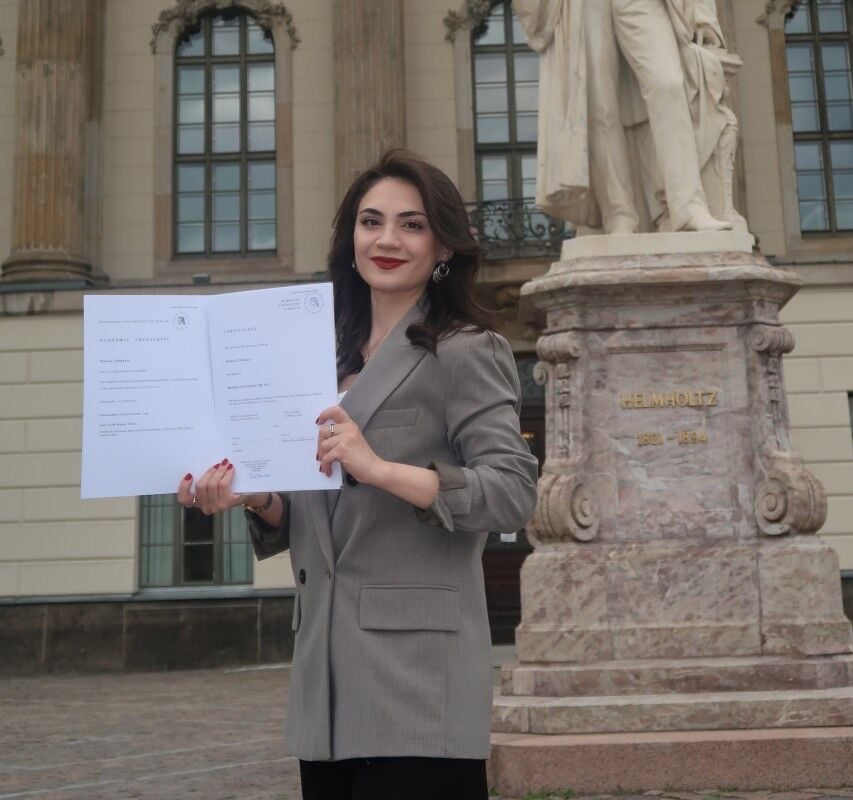
The Journey
My name is Farida Zeynalli, and I am originally from Azerbaijan. Although my academic journey first began with an interest in chemistry, taking a psychology course during my first year became a turning point for me. I later completed my Bachelor’s degree in Psychology at Istanbul 29 Mayıs University in Türkiye on a full scholarship, graduating as the valedictorian of my faculty.
During my undergraduate studies, I became increasingly interested in social cognition, social affect, and the neural mechanisms underlying these processes, especially from a translational mental health perspective. This motivated me to pursue an MSc in Neuroscience at the Berlin School of Mind and Brain, Humboldt-Universität zu Berlin, as a DAAD scholarship recipient. My current research focuses on vulnerability and resilience pathways to psychopathology, particularly in relation to trauma-related socio-cognitive and affective processes.
DAAD Scholarship Details
I was honored to receive the DAAD Study Scholarship for Master Studies for All Academic Disciplines for the period 2023–2025, which supported my MSc in neuroscience at Humboldt-Universität zu Berlin, Berlin School of Mind and Brain. The scholarship provided a monthly stipend of 934 euros, annual study allowances of 460 euros, a travel allowance of 500 euros, and full insurance coverage. In addition, since I was living in Berlin, where accommodation costs are relatively high, I received a monthly rent subsidy of 300 euros for part of my funding period. This comprehensive support allowed me to fully focus on my academic training, research development, and professional growth in Germany.
Were You Offered Any Other Scholarships?
I was also awarded an internal scholarship by Istanbul 29 Mayıs University in Türkiye for my Bachelor’s degree in Psychology. The scholarship covered my tuition fees, provided a monthly allowance, included health insurance, and allowed me to stay in the university dormitory. However, for my MSc studies in Germany, the DAAD Study Scholarship was the only scholarship I received.
Educational Background
I completed my Bachelor’s degree in Psychology with a CGPA of 3.83/4.00, graduating as the valedictorian of the Faculty of Arts. I was also the top student of the English Preparatory Program, and as a result, I was awarded funding to attend a language course in the UK. In addition, I ranked first in my university’s Erasmus English examination, which made me eligible for Erasmus-funded learning mobility in Poland and Erasmus internship mobility in the UK. During my undergraduate studies, I became actively involved in research on social cognition and social affect. I assisted in several studies across different research labs, while also conducting my own research projects, including funded undergraduate research. I presented my work through oral and poster presentations at academic conferences. Therefore, by the time I applied, I already had a clear research direction, had contacted potential supervisors, and had specific reasons for pursuing further training abroad. Germany, and Berlin in particular, stood out to me because Berlin is a major neuroscience hub, bringing together several interdisciplinary research centers in social neuroscience and clinical psychology. Having this concrete academic direction and well-prepared application strategy was very helpful during both the scholarship and university application processes.
Did You Take Any Standardized Tests? If So, How Did You Prepare for Them?
I found information about scholarships and institutions mainly through the DAAD scholarship database, university websites, international offices, and by reviewing the research profiles of faculty members and laboratories. Contacting potential supervisors in advance was also a major advantage, as it helped me understand whether my research interests aligned with the programs and labs I was applying to. For standardized tests, I took IELTS and prepared through academic reading, writing practice, and useful online resources such as YouTube channels, mobile applications, and exam-preparation websites.
How Did You Prepare to Apply for the DAAD Scholarship?
I started to learn about the DAAD scholarship application process almost a year in advance. I carefully reviewed the scholarship requirements and application guidelines, and I reached out to previous scholarship recipients and students through LinkedIn to understand the expectations more clearly.
This helped me identify both the strengths and gaps in my profile. If I noticed that something was missing, such as an additional course on my transcript or supporting certificates, I consciously worked on improving that area before the application period. I also started writing my motivation letter long before the deadline, because I knew it would be one of the most important parts of my application. This strategic preparation helped me submit a focused and coherent application.
Are Your Classes Conducted in English or German?
My classes at the Berlin School of Mind and Brain, Humboldt-Universität zu Berlin, were conducted in English, so both my academic training and research experience were mainly in English.
Would Potential Students Have Any Problems Not Knowing German?
Berlin is a highly international city where academic life and many daily-life responsibilities can be managed in English, although learning German is still very helpful for administration and integration. If you are interested in clinical research involving participant interaction or working student positions, German is definitely a strong advantage.
What Do You Think Made Your Application Stand Out?
Although my application included strong research experience, hands-on experience with several research tools and statistical programs, funded study-abroad experiences, and extracurricular activities, I believe the strongest part was how I presented these experiences in my motivation letter. Rather than simply listing my achievements and goals, I connected every experience to a clear academic narrative: why I moved from psychology toward neuroscience, why Germany and Berlin were the right environment for me, how the DAAD scholarship would support my long-term research goals, and how I hoped to contribute to Germany’s neuroscience research environment as a DAAD scholar. I think this coherent presentation helped the selection committee see not only what I had achieved but also how each experience contributed to my future academic direction.
What Would You Have Done Differently if You Were Going Through the Process Again?
If I could give advice to Farida from the past, I would say:
- Research your five university choices earlier and more carefully.
I would tell myself to spend even more time researching the five universities I listed in my DAAD application and other suitable programs that I could apply to in principle. Since the order of these universities can shape where you may eventually study, I would not only focus on the DAAD checklist but also check each program’s deadlines, admission criteria, and expectations in detail. Doing this earlier would give me more time to identify possible gaps in my profile and strengthen my application before the deadline.
- Build the technical skills your future field expects.
Based on my first advice, I would also tell myself to strengthen my technical skills earlier. For neuroscience degrees, programming is increasingly important and often essential for lab work. If I were applying again, I would try to become more familiar with Python, MATLAB, or R before the application period, especially coming from a psychology background.
What Advice Would You Give Those Looking to Apply for a Similar Scholarship?
- Start early and create a clear application tracking system.
Do not only check the DAAD scholarship requirements; also, research the universities, programs, deadlines, and admission criteria in detail. I strongly recommend creating a table for deadlines, portals, submission methods, and required documents, with separate checklists for DAAD and university-specific documents. - If possible, visit or connect with your top-choice university or lab.
A short visit, an internship, or a conversation with students or potential supervisors can make your motivation much more concrete. It helps you explain not only why the program looks good on paper, but also why you genuinely see yourself there. - Invest serious time in your motivation letter.
In my opinion, the motivation letter is one of the most important parts of the application. Rather than simply listing achievements, connect your experiences to a clear academic and professional narrative. Show how your background, current interests, and future plans fit together. You may be asked why you selected specific universities or why you placed them in a certain order. Be ready to explain the academic, research, and personal reasons behind your choices. Also, understand DAAD’s mission and show this in your letter. DAAD does not necessarily require you to return to your home country after graduation, but its mission is strongly connected to international academic exchange and developing specialists who can contribute to their fields and societies. Therefore, explain how your education can create impact beyond your individual career. - Study your CV and motivation letter very well, because the interview may feel like an oral examination of your own application.
During the interview, many questions may come directly from your CV and motivation letter. The committee wants to see whether you can genuinely and convincingly explain what you wrote: what you want, why you want it, why this program and country are the right fit, and how the scholarship will help you achieve your long-term goals. In short, they want to see whether you are consistent, authentic, and able to explain your own story clearly. - Be authentic, not cliché.
If you are asked about learning German, studying in Germany, or your future plans, avoid generic answers. - Prepare for the interview from the day you submit your application.
Reach out to previous scholars from your field and ask how long their interview lasted and what kinds of questions they received. Your questions will not be exactly the same, because the interview is usually based on your own story. Still, understanding the general interview structure can help you anticipate possible questions and prepare more confidently.
Some questions may be theoretical and feel serious, while others may be based on personal experiences and feel more like a friendly conversation. In both cases, the interview is not only about what you know, but also about how you manage stress, present your ideas clearly, acknowledge what you do not know, and explain how you plan to learn or improve.
Want to submit your
scholarship journey?
Submit Your Story Here!
More Scholarship Recipients
My name is Anna Nana Agyeiwaa Mensah, a professional nurse from Ghana. My interest in Global Health grew out of my experienc .... Read more
My name is Ratul Chakraborty, and I am from Bangladesh. My background is interdisciplinary, actually. Before coming to Germa .... Read more
My name is Mabel Zuñiga. I am a graduate student from Panama pursuing a Master’s degree in Public Policy at the Universit .... Read more
Leave A Comment