
Erasmus Mundus Scholar, Alexander Ryusandi Pratama from Indonesia, Shares His Journey of Pursuing the Joint Master’s in Transition, Innovation and Sustainability Environments (TISE) Across Portugal, Ireland, Poland, and Austria
University: Universidade NOVA de Lisboa (Portugal); University College Dublin (Ireland); Poznań University of Economics and Business (Poland); Danube University Krems (Austria)
Degree: Erasmus Mundus Joint Master’s in Transition, Innovation and Sustainability Environments (TISE)
Previous Education: Bachelor of Social Science (S.Sos) in Sociology – Universitas Indonesia
Scholarship: Erasmus Mundus Joint Master’s Degree Scholarship – Fully Funded (Covers tuition, living stipend of €1,000–€1,400 per month for up to 24 months, travel allowance, and participation costs)
Other Offered Scholarships (if any): University of Queensland Scholarship; LPDP (Indonesia) – Rejected; Australia Awards Scholarship (Reached Interview Stage)
Social Media
LinkedIn: linkedin.com/in/alexryusandi/
The Journey
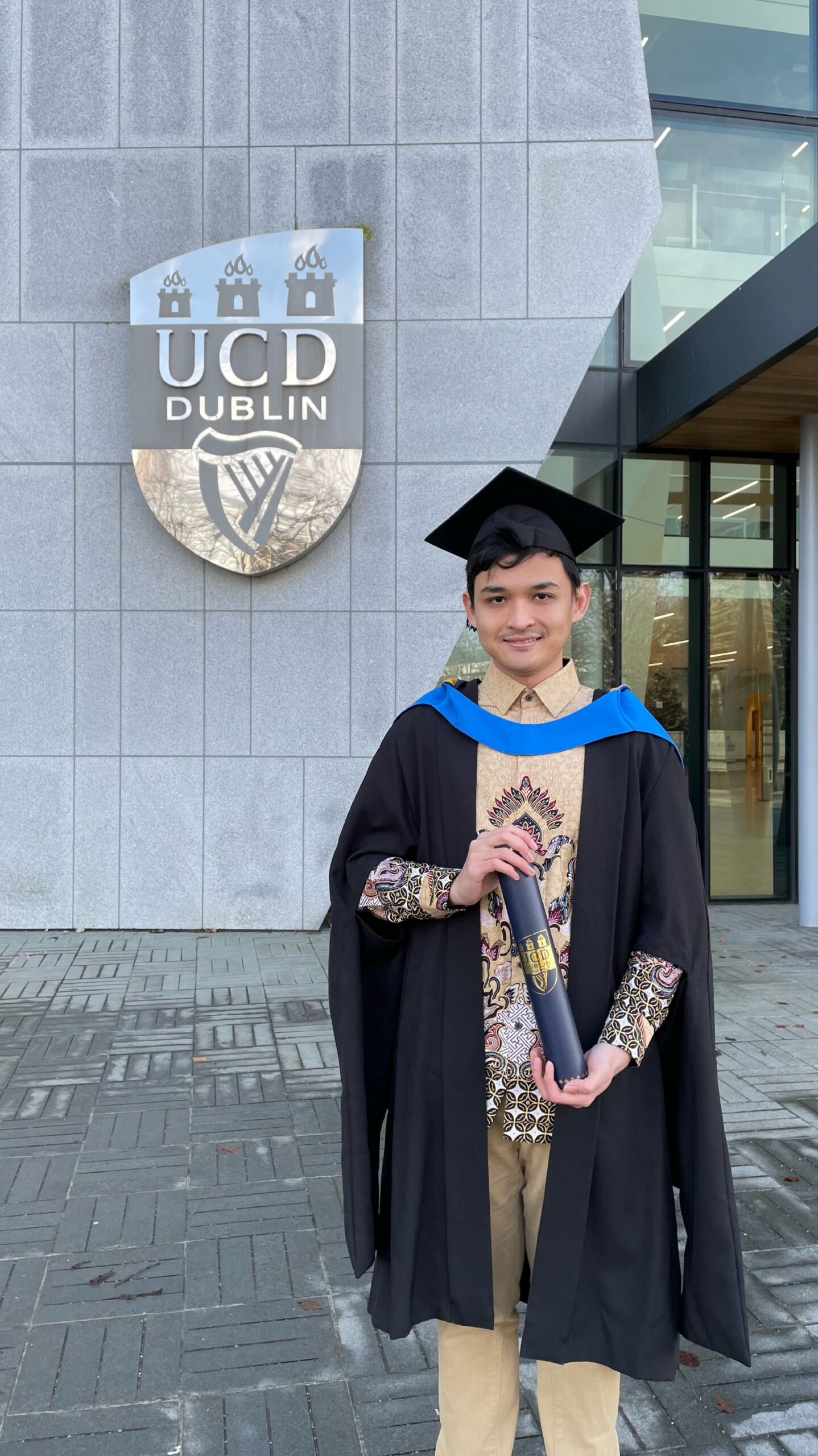
My name is Alexander Ryusandi Pratama (Alex). I am a 24-year-old Indonesian transdisciplinary practitioner working at the intersection of social sustainability and applied AI, where I try to make complex social and environmental problems measurable without making them shallow. I was part of the Erasmus Mundus Joint Master’s MSc in Transition, Innovation and Sustainability Environments (TISE), a two-year program delivered across four partner universities: Universidade NOVA de Lisboa (Portugal), University College Dublin (Ireland), Poznań University of Economics and Business (Poland), and Danube University Krems (Austria). The program is designed as a full mobility track, so I studied in Portugal, Ireland, Poland, and Austria, one semester in each country, and rebuilt my life every few months, new city, new housing market, new rules, same academic intensity.
Educational Background
Before Erasmus Mundus, I completed a Bachelor of Social Science (S.Sos) in Sociology with a focus on Computational Sociology at Universitas Indonesia. That background trained me to do two things at the same time: stay close to human reality (institutions, culture, power, inequality) and still work with disciplined analysis (data, modelling, evidence, limits). It prepared me for a multi-country master’s because I was already used to switching contexts and translating between different “systems” without losing the thread: stakeholder incentives, policy constraints, messy datasets, and the cultural assumptions people bring into decision-making. I also strengthened my technical readiness through applied work and targeted upskilling in Python, R, SQL, and project management, so I could contribute in settings where you are expected to execute, not just discuss.
How Did You Prepare to Apply to the Institution?
I treated the application like a case I had to prove, not a story I had to sell. First, I broke down what TISE values: systems thinking, transition design, and the ability to work across disciplines without becoming vague. Then I mapped my own evidence to those signals: projects where I had to deliver under constraints, research where I had to be precise about methods, and leadership roles where outcomes mattered. I rewrote my statement until every major claim could be backed by a concrete example, a responsibility I held, and a result I could explain. I also prepared practically for mobility (and for being evaluated by multiple universities): I organized documents early, built a clean portfolio of work, and made sure my narrative showed not only ambition, but a credible plan for how I would use the program.
How Did You Prepare to Apply for the Erasmus Mundus Scholarship?
Before Erasmus Mundus, I applied to LPDP (Indonesian Government Scholarship) and was rejected due to a document-upload issue, which taught me a hard lesson: administrative precision is part of the competition, not a separate side task. I also applied for AAS (Australia Awards Scholarship) and reached the interview stage, and I won the University of Queensland scholarship, but Erasmus Mundus came first and fit my direction more sharply. I chose Erasmus Mundus because its structure matched my real learning need: not just studying sustainability, but stress-testing transition ideas across countries, institutions, and disciplines, with a built-in mobility track that forces you to adapt.
To stand out, I focused on signal strength and coherence. I avoided broad claims like “I am interdisciplinary” unless I could show it through a track record: social-impact work, research responsibilities, and technical capability that could support systems-level analysis. I framed my profile as someone who can move between social theory and operational tools, especially data and AI, without pretending the technical layer replaces the human layer. I also treated the scholarship like a high-stakes selection process and shaped my application accordingly: clear motivation, measurable outcomes, and a visible ability to execute consistently across contexts.
Could You Briefly Discuss the Erasmus Mundus Program You Pursued and the Specific Field of Study It Focused On?
TISE is an Erasmus Mundus Joint Master’s designed to train “change agents” for complex human-environment systems, meaning people who can understand how culture, economics, technology, institutions, and organizations shape transitions, and who can design interventions that survive contact with reality. Under a systems Science umbrella, it integrates socio-cultural studies, ethics and information systems, economics, and transdisciplinary methods, so you learn how to diagnose a transition problem from multiple angles and still decide what to do next.
A simple example of how I apply this approach is urban transport decarbonization. Instead of treating it as only a “technology” issue, I frame it as a system: people’s habits and trust (culture), who gains or loses access (ethics), what data is collected and how it is used (information systems), and how prices and incentives change behaviour (economics). Then I compare policies such as better bus lanes, integrated ticketing, and congestion charging using clear indicators (emissions, commute time, ridership, and fairness by income group). The result is a decision-ready recommendation that shows trade-offs, uncertainty, and what to monitor after rollout so the policy can adapt rather than fail.
One detail I value about TISE is that the curriculum is in how it is organized. It is structured across four semesters and four countries, with each semester having a clear focus: Culture and Transition (Portugal, NOVA FCSH), Ethics and Information Systems (Ireland, UCD), Economics in Transition (Poland, PUEB), and Systems Science and Transdisciplinarity (Austria, Danube University Krems). It is a 120 ECTS, four-semester master’s taught in English, which means the program expects sustained full-time output, not occasional intensity.
For me, the “field” was not a single label. It was learning how to translate complex societal problems into frameworks that can be modelled, tested, and improved, while staying honest about uncertainty and trade-offs. That matches how I work: using computational tools (including AI methods) to support better decisions in sustainability transitions, without pretending that numbers alone can carry the full truth.
How Did the Cost of Living Vary Across the Countries You Studied In? Which Country Was the Most Affordable or Expensive, and How Did You Manage Financially?
In my experience, Ireland, especially Dublin, was the most expensive, mainly because rent and basic living costs compound quickly there. Portugal (Lisbon) felt more manageable if you are disciplined, and Poland (Poznań) was the most affordable day-to-day relative to what you get for the same money. Austria (Krems region) sat somewhere in between, depending on housing choices, but it was still easier to manage than Dublin if you prioritize budget housing.
I managed financially by treating housing as the main lever and choosing practicality over comfort repeatedly. I consistently picked the budget room available, which often meant sacrificing space, privacy, or distance. In Ireland, I lived far enough from campus that the commute could take around 1.5-3 hours each way, depending on the traffic. That is roughly 3 hours a day, about 15 hours a week if you go in five days, so I often woke up at 5 AM to make morning classes realistic. In Lisbon, I chose a central location but accepted a very narrow room (about 2.5 meters wide), so the library became my real workspace, and home became mostly for sleep. Beyond housing, I cooked most meals, used student discounts, planned transport carefully, and avoided spending that would quietly steal time or stability. I travel around mostly by bus, rarely by plane or train, to save money. The simple rule was: protect study time first, then comfort if anything is left.
Did You Face Any Language Barriers, and if So, How Did You Overcome Them? Did the Language of Instruction Change From One Country to Another?
Academically, English was the language of instruction across the program, so classroom learning stayed consistent. The language barrier showed up in daily life: housing contracts, health systems, local bureaucracy, and workplace culture during internships or group projects, where not everyone defaults to English.
I handled this in practical ways rather than aiming for fluency on paper. I learned survival phrases early, built routines for repeat tasks (banking, transport, appointments), and chose clarity over guessing when I was unsure. In Portugal, I took extra Portuguese lessons run weekly by a classmate, focusing on phrases I could use immediately. That helped later in Porto, where not all colleagues were comfortable in English. In Austria, I joined German classes offered locally, which made everyday life smoother even when my academic work stayed in English.
Would You Recommend the Erasmus Mundus Program to Others? What Advice Would You Give to Someone Considering This Scholarship?
Yes, I would recommend Erasmus Mundus to people who want high-intensity learning and can handle constant change without losing discipline. A joint master's is not only “study abroad”; it is repeated relocation while you still have deadlines. The reward is that you not only learn concepts, but you also learn how concepts behave in different systems.
My advice is to treat the application like a research proposal about yourself. Make every claim testable: if you say you lead, show what you led and what changed. If you say you are technical, show what you built or analysed. Use numbers when they are real, not decorative. Explain why the mobility structure is necessary for your goals, not just attractive. Also, show that you can handle the operational side: documents, deadlines, coordination, and sustained output. In Erasmus Mundus, execution is not optional.
If you receive the EMJM scholarship, understand the scale and what it implies. The scholarship is often described using a standard unit cost model: €1,000 with additional travel allowance or €1,400 per month for up to 24 months (a maximum of €33,600), combined with a participation-cost contribution that typically covers tuition and mandatory costs through the consortium structure. Knowing these figures helps you plan realistically and avoid underestimating how much the mobility lifestyle still demands.
Looking Back, Would You Have Done Anything Differently During Your Time in the Program?
I would have been more deliberate about continuity. Mobility can reset your network every semester if you let it, so I would have invested earlier in maintaining relationships across countries, not just building new ones. I would also have documented outputs more systematically as I went: decisions, results, reflections, and evidence in one place, so I would not need to reconstruct my work later from memory.
Finally, I would have started structured language learning earlier, not to be impressive, but to reduce daily friction. When you are moving every semester, small obstacles multiply fast. Even basic competence in the local language and local systems can save hours each week, and in a 120 ECTS program, hours are not a small thing.
Want to submit your
scholarship journey?
Submit Your Story Here!
More Scholarship Recipients
Hi, my name is Daris Fajar Ramadan, and I’m from Bogor, Indonesia. I have a background in mechanical engineering, where I .... Read more
I’m Benjamin from Ghana. I have completed a bachelor's in Biological Sciences at Kwame Nkrumah University of Science and T .... Read more
My name is Amos Prince Kastigu, and I come from Malawi, often referred to as the Warm Heart of Africa. I am a real estate pr .... Read more
Leave A Comment