
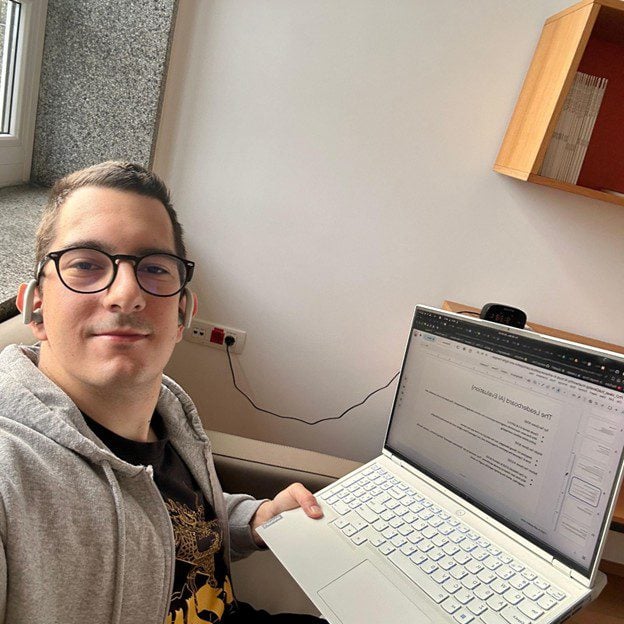
Marie Skłodowska-Curie Actions (MSCA) Doctoral Network Scholar Vuk Dinić from Serbia Shares His Journey of Pursuing a PhD in AI, Data, and Society at the Jožef Stefan Institute
University: Jožef Stefan Institute, Ljubljana, Slovenia
Degree: PhD in Artificial Intelligence, Society, and Political Participation (part of the Datavysts – Data2Action MSCA Doctoral Network)
Previous Education: Master’s and Bachelor’s in Sociology – University of Niš, Faculty of Philosophy (GPA: 9.29/10 and 9.38/10)
Scholarship: Marie Skłodowska-Curie Actions (MSCA) Doctoral Network Scholarship – Fully Funded (includes living, mobility, and family allowances under Horizon Europe Grant No. 101169037 and UKRI Grant No. EP/Z536581/1)
Social Media
LinkedIn: https://www.linkedin.com/in/vukdinic/
The Journey
I’m Vuk Dinić from Aleksinac, Serbia. I made quite an academic shift with my PhD. My previous education includes a bachelor’s and a master’s degree in sociology, but I’ve always been interested in the intersection of technology and society. When I discovered a PhD program that blends AI, the common good, and political participation, it immediately felt like the perfect fit for me.
Marie Skłodowska-Curie Actions (MSCA) Doctoral Network Scholarship Details
I’m part of a project called Datavysts (Data2Action), a Marie Skłodowska-Curie Actions (MSCA) Doctoral Network funded by Horizon Europe [grant number 101169037] and UK Research and Innovation (UKRI) under the UK government’s Horizon Europe Funding Guarantee [grant number EP/Z536581/1].
The MSCA provides competitive remuneration packages, including living, mobility, and (if applicable) family allowances, ensuring financial stability during the PhD journey.
Five academic institutions across Europe are hosting a combined cohort of 13 doctoral fellows. MSCA Doctoral Networks are unique because they mean I am part of a much bigger project than just my PhD. I get the opportunity to work with all of these fellows and supervisors, and benefit from a shared training programme. We will also get to meet in person at meetings and conferences over the next three years. The fellows are from all over the world (one of the requirements of MSCA is that you move country), and so we will benefit from a global perspective on the work.
My host institution is the Jožef Stefan Institute in Ljubljana, Slovenia.
Interested in finding out more about the project? Sign up for our newsletter here.
Educational Background
My previous university degrees are from the Faculty of Philosophy at the University of Niš. I completed my bachelor’s degree with honors (GPA: 9.38/10), ranking as the top graduate in my department and receiving the Dositeja Scholarship, an award from the Serbian Government’s Fund for Young Talents given to students with outstanding academic performance. My master’s degree, also in sociology, focused more on science and research, particularly on social science methodology, and I graduated with a GPA of 9.29/10.
During my bachelor’s studies, I took many courses in methodology and data analysis, and I quickly fell in love with the field. I soon realized that the software we were using (SPSS) lacked flexibility and that learning R and Python would open the door to far more interesting work, so I committed to learning both. Later, I joined the INVENT project, where I had the chance to sharpen my skills and confirm that I wanted to pursue a career as a data scientist.
How Did You Prepare to Apply to Jožef Stefan Institute?
How Did You Find Information About the Marie Skłodowska-Curie Actions (MSCA) Doctoral Network and Jožef Stefan Institute?
I found information about this PhD on the EURAXESS website. I was browsing PhD opportunities when this one really caught my attention. I read the description several times, checked whether I was eligible, and then submitted my application.
Did You Take Any Standardized Tests? If So, How Did You Prepare for Them?
No
How Did You Prepare to Apply to the Marie Skłodowska-Curie Actions (MSCA) Doctoral Network Scholarship?
Part of the selection process included an interview where I needed to present some of my previous work. By coincidence, I had recently started working on a topic similar to my current supervisor’s research, analyzing parliamentary session data and enriching NLP resources for underrepresented languages. I prepared a short presentation on this work and presented it during the interview.
To be eligible for an MSCA Doctoral Network, you must not have a doctoral degree already. You must also comply with the mobility rule, which states that you must not have lived or worked in the country of the recruiting institution for more than 12 months in the 36 months prior to recruitment. The scholarships are open to all nationalities.
How is (was) Your Experience at Jožef Stefan Institute?
Right now, I’ve been here for just a month, but I have nothing but praise for the institution. Before arriving, I was a bit anxious about how everything would work out in a new country, a new city, but it all went great. My colleagues are very kind and helpful, and the other students are as well. I was also worried I might feel lonely, but that hasn’t been the case at all. In just one month, I’ve already met many great and interesting people.
How Do You Rate Jožef Stefan Institute Academically and Why?
Similar to my previous answer, I’ve only been here for a month, but I really enjoy the academic and research environment. I have the opportunity to learn a lot from experts in their fields, and I genuinely feel included in the academic work. People here understand that science is a group effort, so you’re never left alone to figure everything out by yourself.
How Does Jožef Stefan Institute Support International Students?
A part of the Jožef Stefan Institute is the International Postgraduate School, so we have many international students here. In that regard, I have no complaints. I can ask both the school and institute administration anything I need, and they’re always very helpful. I haven’t needed any serious support so far, but it’s clear that they would assist me if any problems came up.
Are Your Classes Conducted in English or Slovenian?
Because the postgraduate school is international, all classes and study materials are in English.
Would Potential Students Have Any Problems Academically Not Knowing Slovenian?
Not really. Everyone at the institute and the postgraduate school speaks English. In addition, many people in Ljubljana speak English as well, whether in grocery stores, bars, restaurants, or government institutions.
What Do You Think Made Your Application Stand Out?
Probably the fact that my previous work and research interests aligned with my supervisor’s work and the overall project idea. But perhaps even more significant was that I was genuinely motivated and passionate about the topic, and both my supervisor and the department head recognized it.
What Would You Have Done Differently if You Were Going Through the Process Again?
Be less anxious and more confident in sharing my ideas. I might also try a different approach for the interview presentation, perhaps focusing on another project or a similar topic.
What Advice Would You Give Those Looking to Apply for a Similar Scholarship?
The process of getting a PhD position is very different from applying for a job at a company. In a PhD interview, your future supervisor and other panel members want to see whether you are passionate about the project and trainable. If you act as if you already know everything or come across as difficult to work with, you will likely fail. You don’t need to know everything about the research area, but you do need to be motivated to learn.
Want to submit your
scholarship journey?
Submit Your Story Here!
More Scholarship Recipients
Hi! My name is Davi Augusto Mattoso, and I am originally from Brazil. I have a Bachelor's in Chemistry from the Federal Univ .... Read more

Hello, my name is Manasi, and I am from India. I completed my Bachelor’s degree in Civil Engineering from Dr. Babasaheb Am .... Read more

Hi, I am Malik Nauman Rauf, currently a Master's in Aerospace Engineering student and a Fulbright Scholar at Georgia Institu .... Read more
Leave A Comment