
MPA-DP Graduate Swathi Pottabathini from India Shares Her Journey of Studying at Columbia University, USA
University: Columbia University, City of New York, USA (MPA-DP, SIPA)
Degree: Master of Public Administration – Development Practice (MPA-DP)
Previous Education: B.E. in Computer Engineering – COEP Technological University, India; PG Diploma in Liberal Studies (Young India Fellowship) – Ashoka University, India
Scholarship: Joint Japan/World Bank Graduate Scholarship Program (JJ/WBGSP) – Fully Funded (Full Tuition, Monthly Living Stipend, Round-Trip Airfare, Health Insurance, Travel Allowance; ~USD 215,000 total value for Columbia program)
Other Offered Scholarships (if any): 30–50% Departmental Scholarships – University of Chicago (Harris School); University of California, Berkeley (Goldman School)
Social Media
The Journey
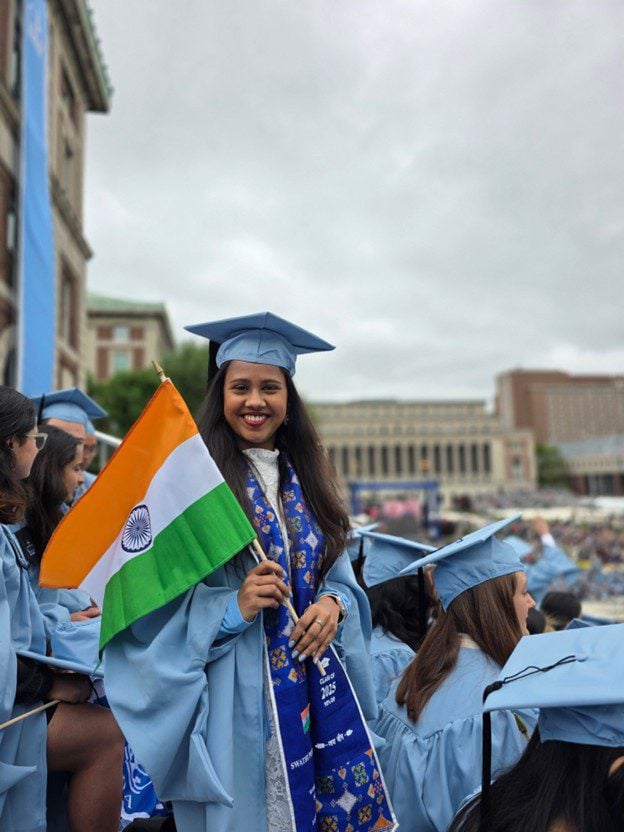
I'm Swathi Pottabathini, and I'm currently working for an upcoming impact fund in the US. I completed my Master's in Public Administration-Development Practice (MPA-DP) from Columbia University, City of New York, in May 2025.
I am from India, and before coming to the US, I worked for over five years in the development sector (social/public sector) across nonprofits and social enterprises on strategy and operations in various sectors ranging from agriculture, poverty alleviation, rural development, and governance. I was part of the founding team of an agribusiness startup that was featured in the Forbes Asia list and also did government consulting on data-driven governance. Despite being educated as a Computer Engineer, I transitioned to the development sector through a fellowship called the Young India Fellowship, which is primarily a PG Diploma in Liberal Arts.
The reason to come to Columbia University and study MPA-DP was to gain international exposure to the field of development and figure out what I wanted to do in the next decade of my career. Of course, I also wanted to build networks in the international community through fellow peers, professors, alumni, and industry professionals. And having the opportunity to do this while being in New York City, the financial capital of the world, I thought would be an invaluable experience. It was while studying here that I realized I wanted to build a career that would marry my love for impact and my interest in finance; that's how I got interested in impact investing and the broader sustainable finance space. The program and networks I built have been instrumental in helping me secure my current role, allowing me to contribute to development work from a financial lens.
Joint Japan/World Bank Scholarship Details
I received the Joint Japan/World Bank scholarship (applications are open!), which, as the name suggests, is offered by the two entities, i.e,. funded by the Government of Japan and administered by the World Bank Group. The scholarships are available to citizens of certain developing countries with relevant development/public sector professional experience and who want to pursue one of the 44 Participating Master’s Programs across 24 universities in the U.S., Europe, Africa, Oceania, and Japan in key areas of development.
This is a fully-funded scholarship that provides everything a student needs to just focus on their experience and not worry about finances: full tuition coverage, a monthly living stipend, round-trip airfare, health insurance, and travel allowance. Since I studied at Columbia University in New York City, all of these costs amounted to approximately $215,000. However, this amount would vary for each program, university, and the duration of the program.
The only caveat or expectation after earning the degree is for scholars to return to their home countries and contribute to the socioeconomic development of their countries with the exposure, networks, and experience from the host country.
Were You Offered any Other Scholarships?
N/A for Columbia University, but I had applied to other universities like the University of Chicago and the University of California, Berkeley, where I received generous 30-50% internal department scholarships.
Educational Background
I studied Computer Engineering in India from one of the top and oldest colleges, College of Engineering, Pune (currently known as COEP Technological University).
I then pursued a PG Diploma in Liberal Studies at Ashoka University through the Young India Fellowship.
While I never directly applied what I studied in engineering to my development sector jobs, the problem-solving mindset and comfort with evolving technology, be it coding earlier or AI now, definitely helped me in my work. More importantly, Liberal Arts opened up critical thinking and writing, challenged my own personal biases in decision-making and actions, and gave me the ability to engage meaningfully with people from diverse fields and backgrounds. This interdisciplinary approach became essential for my work in development, where understanding various stakeholders and sectors is crucial.
The Young India Fellowship was truly my bridge from engineering to development work. Since Ashoka University had tie-ups with various international universities and professors from across the globe, I saw peers pursuing varied subjects like Public Policy, Psychology, History, Film-making, Law, Sociology, and Business from the top universities in the world. This exposure gave me the confidence to even think about studying abroad, and strengthened my belief that I can pursue the career of my choice and still aim for the best within it—moving beyond the conventional engineering and MBA trajectories.
How Did You Prepare to Apply to Columbia University?
Frankly, I was late in starting my applications to colleges. I didn't have time to even prepare and write the GRE, so I decided to apply only to top public policy programs at universities that had waived off the GRE (thanks to COVID!) for that cycle, with a backup plan to try next cycle again with the GRE if needed. But thankfully, the universe spared me from that nightmare!
I narrowed down my list to three top programs and universities: Master of Public Policy (MPP) at the Harris School, University of Chicago; Master of Development Practice (MDP) at Goldman School, UC Berkeley; and MPA-DP at the SIPA, Columbia University. I chose these because they all had strong, practical, field-based approaches to development work, which aligned with what I was looking for.
I focused on spending the time I had intentionally on the applications: writing essays, getting them reviewed by 1-2 colleagues and alumni, and iterating over them multiple times, reaching out to recommenders for letters of recommendation well in time, and preparing for the IELTS. I also researched each program thoroughly to understand its unique strengths and tailored my statement of purpose accordingly to show genuine fit.
Despite starting late, I made it in time for early action applications and got acceptances from all three universities! So if you're starting late, don't get discouraged. Just be strategic with your time and put in focused effort where it counts.
How Did You Find Information About Joint Japan/World Bank Scholarship and Columbia University?
Since this was the pre-GPT era, I relied a lot on internet searches and looked up resources, blog posts, podcasts, and spoke to my network to collate a list of scholarships and institutions that I was eligible for and would fit my interests in the public policy space. I made an Excel sheet of all those and applied to nearly 10-15 scholarships in India, wherever I was eligible, looked up departmental scholarships at universities, and external scholarships like JJWBGSP too.
In my Excel sheet, I tracked eligibility criteria, deadlines, required documents, and funding details for each scholarship. This helped me stay organized and ensure I wasn't missing any deadlines or requirements.
My criteria for shortlisting were pretty straightforward: Did I meet the eligibility requirements? Was it fully or nearly fully funded? And what did the actual program look like? Did it have capstone projects, professors who had real-world experience as practitioners, strong alumni connections, and networks that extended beyond just the university bubble?
Did You Take Any Standardized Tests? If So, How Did You Prepare for Them?
I only took the IELTS since I was running short of time to prep for the GRE, as I mentioned earlier. IELTS prep really depends on your comfort level with English. Since all my education was in English and I'd actually taken the IELTS before, I wasn't too stressed about it. I prepped for about a month, but only got serious in the last two weeks.
My advice would be to take a mock test first to understand where you stand, then focus on improving the sections you're weakest in. No need to overdo it, as you only need to meet a certain minimum across all sections. My strategy was to aim for full marks on reading and listening since those are objective tests. Since speaking and writing are marked subjectively, I practiced enough to do well and get at least a 7 or above.
For listening, reading, and writing, I practiced mock tests through various online portals to get used to the computer format. For speaking, I focused on getting my grammar right and using varied vocabulary. So nothing fancy, just basic fundamentals.
How Did You Prepare to Apply to the Joint Japan/World Bank Scholarship?
I approached each scholarship application differently because I realized they all had different missions and selection criteria.
My baseline story about transitioning from engineering to development work stayed the same across applications, but I adjusted how I presented it based on what each scholarship was asking for. Some wanted succinct responses, while others needed detailed answers with specific examples and statistics from my work. I made sure to substantiate my claims with concrete examples.
For recommendations, I reached out to people I'd worked closely with who could speak to specific projects and contributions rather than seeking out big names who might only provide generic endorsements. I approached my recommenders early and shared my application materials with them so they understood what the scholarship was looking for.
I also made sure to gather all required documents well in advance—transcripts from colleges, work experience letters, passport copies, etc. This gave me peace of mind and let me focus on the actual application content rather than scrambling for documents at the last minute.
Similar to my university applications, I had 1-2 trusted colleagues and alumni review my scholarship essays and incorporated their feedback where it made sense, but I made the final decisions on what to include myself.
What Do You Think Made Your Application Stand Out?
Honestly, there's an element of unpredictability in these selection processes. I've seen strong applications get rejected and others that barely met the criteria get through. But reflecting on what may have worked in my favor:
For the university admissions, I believe my essays and letters of recommendation were clear and focused. They established that I had worked across different types of institutions (nonprofits, social enterprises, and government) and demonstrated my contributions and potential to lead in the development space.
For the Joint Japan/World Bank scholarship specifically, I made sure to clearly connect my past experience with my future goals and how the scholarship would help bridge that gap. I think my profile stood out as someone willing to experiment across sectors and organizations, with proven experience working at scale through government consulting, and the potential to create broader systemic impact. This aligned well with the scholarship's mission of developing leaders who would contribute to their home countries' development.
What Would You Have Done Differently if You Were Going Through the Process Again?
I wouldn't tie my self-worth to the outcomes. I applied to a lot of scholarships in India and abroad and faced multiple rejections. Each rejection felt personal, and I let it affect my confidence more than it should have.
I also wouldn't have over-consulted people about my chances. I spoke to people who got through and who didn't; those who got through told me it was partly luck, and those who didn't told me getting this scholarship with my experience would be next to impossible (including someone who's now a good friend of mine). All this feedback just added to my anxiety without really helping.
Looking back, I understand now that scholarships and admissions have an element of randomness beyond just qualifications. I would worry less about the outcome and focus more on putting together the best application I could. Sometimes you just need to tune out the noise and trust your own process.
What Advice Would You Give Those Looking to Apply for a Similar Scholarship?
(Try to) Start early and stay organized. Create a detailed Excel sheet tracking scholarships, eligibility criteria, deadlines, required documents, and funding details. All I can say is: if you apply, you at least have a chance to make it; if you don't apply, you take away that chance too.
Tailor each application specifically. Each scholarship has different goals and selection criteria. Go through their materials meticulously and adjust your application to align with what they're looking for.
Choose recommenders strategically. Focus on getting good recommendations from people who know your work intimately and can speak to specific contributions, rather than chasing big names who can only write generic letters.
Gather documents early. Get transcripts, work experience letters, passport copies, and other required materials ready well before deadlines. Administrative delays have derailed many good applications.
Limit your reviewers. Have 1-3 trusted people review your application, but make the final decisions yourself. Too many opinions can dilute your authentic voice.
Give your best and leave the rest. The process has unpredictable elements. Qualified candidates get rejected, and it reflects nothing about your worth. Submit the strongest application you can, then release the outcome. Also, don't over-consult about your chances. Most opinions are speculation. Trust your judgment and apply. You miss every shot you don't take.
Want to submit your
scholarship journey?
Submit Your Story Here!
More Scholarship Recipients
I am Dr. Priyanka Sheoran, originally from Haryana, India. By profession, I am a veterinarian, and by passion, I am deeply c .... Read more
I am a South-Asian Kenyan, blessed to have been born and raised in wonderful Kenya. At university, I double majored in Envir .... Read more
Hi, my name is Patrick, and I'm originally from Indonesia. I moved to Singapore six years ago and am currently pursuing a de .... Read more
Leave A Comment