
Marie Skłodowska-Curie Actions (MSCA) Doctoral Fellow, Michela Prestianni from Italy, Shares Her Journey of Pursuing a PhD in Reproductive Biotechnology through the AFRODITA Doctoral Network in Spain
University: University of Murcia, Spain / INIA-CSIC, Madrid
Degree: PhD in Reproductive Biotechnology (AFRODITA Doctoral Network)
Previous Education: Bachelor’s Degree in Biotechnology, University of Ferrara, Italy – Master’s Degree in Reproductive Biotechnology, University of Teramo, Italy
Scholarship: Marie Skłodowska-Curie Actions (MSCA) AFRODITA Doctoral Network – Fully Funded (includes salary, social security, mobility allowance, and research/training expenses under Horizon Europe)
Social Media
LinkedIn: linkedin.com/in/michela-prestianni/
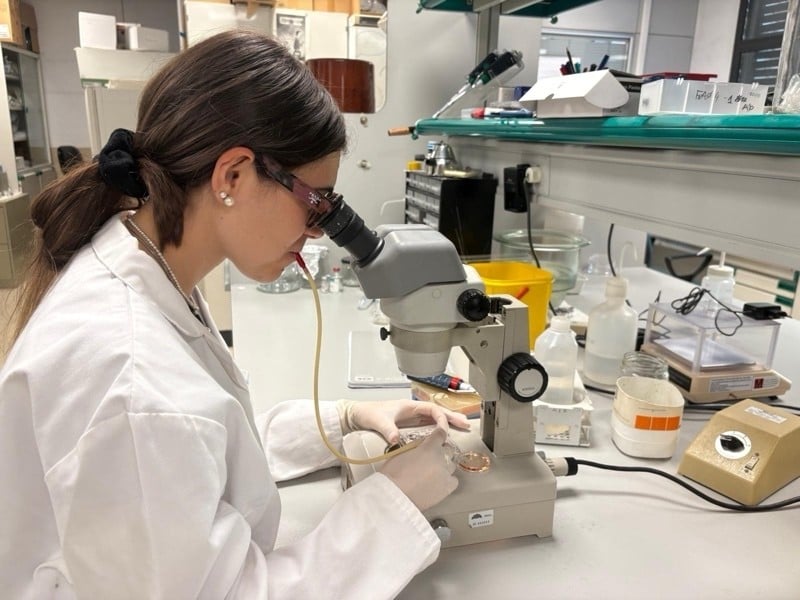
The Journey
My name is Michela Prestianni, I am 27 years old, and I come from Sicily, Italy. Since October 2024, I have been a PhD student within the AFRODITA Doctoral Network, a Marie SkłodowskaCurie Action funded by the European Commission.
I obtained my Bachelor’s degree in Biotechnology from the University of Ferrara, and later pursued a Master’s degree in Reproductive Biotechnology at the University of Teramo. I chose this field because I was deeply motivated by the desire to become an embryologist and help couples and individuals facing infertility.
After a few months working as a junior embryologist, I realized that the clinical environment did not fully meet my expectations, particularly due to the limited interaction with patients and the routine nature of the work. This experience helped me understand that my true inclination was toward scientific research, where I could contribute to innovation and long-term impact. This realization ultimately led me to pursue a PhD.
Marie Skłodowska-Curie Action Details
The scholarship I received is part of the AFRODITA Project, a Doctoral Network (DN) aimed at training a new generation of researchers in fertility and reproduction through innovative technological applications. AFRODITA stands for Advancing Fertility and Reproduction through Dedicated and Innovative Technological Applications.
AFRODITA is a Marie Skłodowska-Curie Action (MSCA) funded under the Horizon Europe program of the European Commission. The consortium includes 9 beneficiary institutions and 8 associated partners, bringing together academia, research centers, hospitals, and industry. The network is coordinated by the University of Murcia (Spain) and involves 17 institutions across 9 countries: Spain, France, Ireland, Belgium, Denmark, the Netherlands, Italy, and the USA. For my specific project, the host institution is INIA-CSIC in Madrid, with secondments and collaborations involving:
- University of Murcia (Spain)
- University of Dublin (Ireland)
- IVI Clinic (Murcia, Spain)
The salary follows MSCA regulations and national laws of the recruiting country and includes full social security benefits, a monthly living allowance, and a mobility allowance.
Educational Background
Talk about your previous degrees, including GPAs, which will be helpful. How did your educational background prepare you to apply for the specific fields? I completed:
- Bachelor’s Degree in Biotechnology – University of Ferrara
- Master’s Degree in Reproductive Biotechnology – University of Teramo
My academic background provided me with a strong foundation in molecular biology, cell biology, reproductive physiology, and laboratory techniques, which were essential for applying to a research-focused PhD program in reproductive science. My master’s thesis and laboratory experience were particularly important in demonstrating my readiness for doctoral research.
How Did You Prepare to Apply to the University of Murcia?
How Did You Find Information About Scholarships and the University of Murcia?
I mainly found information through:
- European research portals
- University and project-specific websites
- Academic networks and word of mouth from professors and colleagues
The AFRODITA call was clearly advertised online with a detailed project description, eligibility criteria, and selection process.
Did You Take Any Standardized Tests?
My application was primarily evaluated based on my academic background, research experience, CV, motivation letter, and interviews. I initially submitted a Certificate of English Language Proficiency at a minimum B2 CEFR level as required for the application. However, for official enrollment at the University of Dublin, I was required to demonstrate an advanced B2 level of English proficiency, which I fulfilled by taking the Duolingo English Test.
How Did You Prepare to Apply to the Marie Skłodowska-Curie Action?
I carefully tailored my CV and motivation letter to highlight:
- My academic and laboratory experience in reproductive biotechnology
- My research interests and their strong alignment with the AFRODITA project
- My motivation for international mobility and interdisciplinary training
Additionally, I emphasized my Spanish communication skills, as two of the three projects within the consortium for which I expressed my preference were based in Spain, and I believed this would facilitate both professional integration and effective collaboration.
How Is (Was) Your Experience at the University of Murcia?
At the moment, I have mainly been working at my host institution, apart from the various training activities organized by the AFRODITA network, which are fundamental for acquiring new skills, exchanging ideas with other PhD students and supervisors, and building a strong professional network.
My experience so far has been very positive. The research environment is stimulating and highly collaborative, and I feel supported both scientifically and personally. I particularly appreciate the strong emphasis placed on training, mobility, and professional development, which are key strengths of the AFRODITA program.
Are Your Classes Conducted in English or Spanish?
The PhD training, courses, and scientific activities are conducted primarily in English. However, at my host institution, I use Spanish on a daily basis for routine communication and everyday interactions within the laboratory and administrative environment.
What Do You Think Made Your Application Stand Out?
Based on the evaluation feedback I received, my application stood out for my strong academic background, training experiences at different institutions, and my high motivation to learn and grow in reproductive biology. Additionally, my knowledge of Spanish was considered an asset for easier integration into the host institution. At the time of application, a recognized weakness was my limited research activity, which I hope I have now at least partially improved after more than a year of experience.
What Would You Have Done Differently if You Were Going Through the Process Again?
I don’t regret being honest in highlighting not only my strengths but also the areas where I had less experience. However, if I could do it again, I would try to present myself with more confidence, emphasizing my potential and ability to grow as a researcher.
What Advice Would You Give Those Looking to Apply for a Similar Scholarship?
My main advice is:
-
- Start early
- Carefully read the project description and eligibility criteria
- Tailor your application to the specific project
- Show genuine motivation and curiosity
- Don’t be afraid of international mobility—it is a huge opportunity for both personal and professional growth
Want to submit your
scholarship journey?
Submit Your Story Here!
More Scholarship Recipients

My name is Hajiyev Sarkhan, and I am from Shemkir, Azerbaijan. My academic journey has been shaped by a strong belief that e .... Read more
My name is Nainsi Chauhan, and I am from Mumbai, India. I was born into an economically weak family and raised in an orthodo .... Read more
My name is Swaleha J. Khowaja, and I am from Karachi, Pakistan. I am currently pursuing the MSc in Global Mental Health, a j .... Read more
Leave A Comment