
Marie Skłodowska-Curie Doctoral Network Scholar, Marta Yabar from Spain, Shares Her Journey of Pursuing a PhD in Bioprocess Engineering at Ghent University, Belgium
University: Ghent University, Belgium
Degree: PhD in Bioprocess Engineering (YAF Marie Skłodowska-Curie Doctoral Network)
Previous Education: Master’s in Bioprocess Engineering – IMC University of Applied Sciences, Krems, Austria; Bachelor’s in Biotechnology – Universitat Rovira i Virgili, Spain
Scholarship: Marie Skłodowska-Curie Actions (MSCA) Doctoral Network – Fully Funded (Includes competitive salary, mobility allowance, research and training budget, and international secondments)
Social Media
LinkedIn: linkedin.com/in/marta-yabar-a22219198/
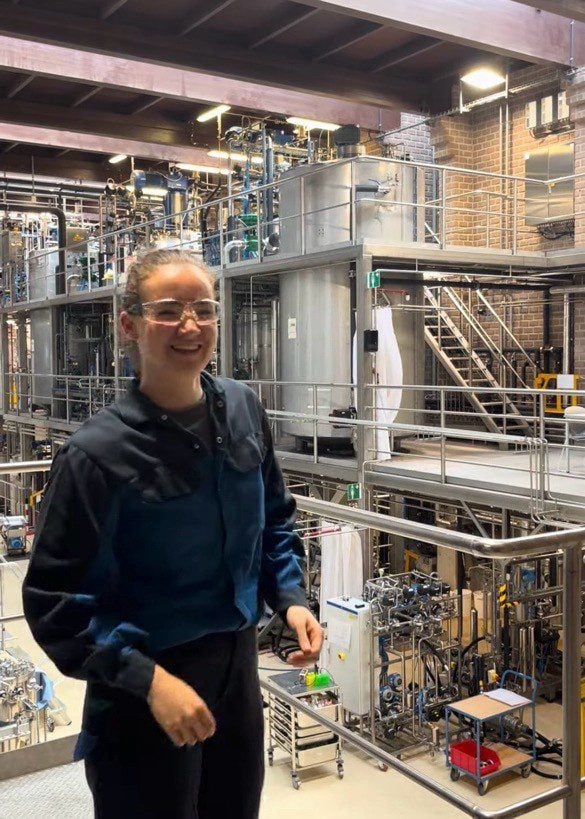
The Journey
My name is Marta Yabar, and I am originally from Pamplona, Spain. I have a background in bioprocess engineering, with a specialization in downstream processing and experience in industrial environments across several European countries.
I am currently pursuing a PhD within the YAF Marie Skłodowska-Curie Doctoral Network, which has given me the opportunity to work in a highly international and industry-oriented setting. I decided to pursue doctoral training not only to strengthen my technical expertise, but also to become a better thinker and improve how I make decisions, manage complex projects, communicate effectively, and develop leadership skills.
Marie Skłodowska-Curie Actions (MSCA) Doctoral Network Scholarship Details
I am a recipient of a Marie Skłodowska-Curie Actions (MSCA) Doctoral Network scholarship.
- Host institution: Bio Base Europe Pilot Plant, a state-of-the-art, multi-purpose pilot facility for the bioeconomy located in Ghent, Belgium.
- Doctoral school: Ghent University.
- Scholarship type and funding: Fully funded doctoral position, including a competitive salary, a mobility allowance, and a dedicated research and training budget.
- Training and research framework: Enrolment in a PhD program combined with a highly collaborative, multidisciplinary and intersectoral training program. Doctoral candidates receive technical training in complementary scientific and technological topics at reference institutions across Europe, alongside structured training in soft skills such as communication, leadership, project management, and decision making.
- International exposure: Two secondments within the consortium, one academic and one non-academic, as well as opportunities to participate in national and international conferences.
A key added value of the program is the strong sense of community it fosters. The twelve doctoral candidates within the YAF project come from different scientific backgrounds and specializations, yet we share the same training activities throughout the program. This collaborative environment encourages knowledge exchange, mutual support, and learning from one another, which significantly enriches both the scientific and personal aspects of the doctoral experience.
Educational Background
I hold a Bachelor’s degree in Biotechnology from Universitat Rovira i Virgili (Tarragona, Spain). To gain a stronger industrial focus, I pursued a Master’s degree in Bioprocess Engineering at IMC University of Applied Sciences Krems in Austria. During the second year of the program, I focused on entering the industrial sector. After several selection processes, interviews, and rejections, I joined Boehringer Ingelheim in Vienna, working in downstream process development. This experience played an important role in my development. Working at a leading pharmaceutical company, alongside highly experienced supervisors and a collaborative team, confirmed my interest in industry and process development.
After completing my Master’s degree, I joined Lonza in Visp, Switzerland, as a downstream processing manufacturing specialist. This role provided hands-on experience in large-scale biopharmaceutical production.
This experience further strengthened my understanding of industrial manufacturing and highlighted the value of additional training. I therefore decided to pursue a PhD with clear criteria: to work within an industrial environment, in a field aligned with my previous experience, at a reference institution, and within a program that supports both technical and personal development.
How Did You Find Information About the Marie Skłodowska-Curie Actions (MSCA) Doctoral Network Scholarships and Institutions?
I found the position through the Marie Skłodowska Curie Actions open positions portal and applied via the Bio Base Europe Pilot Plant website.
Did You Take Any Standardized Tests?
No
How Did You Prepare to Apply to the Marie Skłodowska-Curie Actions (MSCA) Doctoral Network Scholarship?
- Something that may seem obvious but often is not: before every interview, I took the time to reflect on myself. I reflected on my background, what differentiated my profile, what I could realistically contribute, and why I was genuinely motivated for this specific position.
- I prepared for interviews with a simple mindset: be kind, be humble, and be reliable. Recognizing knowledge gaps is important. Recruiters do not expect complete mastery, but they do look for openness and a strong willingness to learn.
- I prepared my own questions for the interview and approached the process as a mutual evaluation. It was not only about being selected, but also about assessing whether the position and the environment were the right fit for me.
- I studied the structure of the MSCA program and its evaluation criteria to understand what the program values.
- I researched the host institution, the project topic, and the people involved in the selection process to better understand the context of the position.
- I reviewed the scientific background of the project and familiarized myself with its technical scope.
- I reached out to people from my “future” host institution and to researchers who had previously received the same scholarship to learn from their experience.
How Is Your Experience at Bio Base Europe Pilot Plant?
My experience at Bio Base Europe Pilot Plant (www.bbeu.org) has been extremely positive. The facilities are state of the art and uniquely positioned to bridge research and industrial application, providing access to pilot-scale infrastructure that is rarely available in academic settings. This environment allows research to be conducted with a clear focus on scalability and real-world implementation.
Equally important is the working atmosphere. The environment is collaborative and supportive, with strong guidance and supervision.
The combination of high-quality infrastructure, a positive and professional working culture, and close interaction with experienced colleagues makes Bio Base Europe Pilot Plant an exceptional place for industry-oriented doctoral training.
Are Your Classes Conducted in English?
The working language at Bio Base Europe Pilot Plant is English, due to its highly international environment. All doctoral courses, training activities, and MSCA program events are also conducted in English.
What Do You Think Made Your Application Stand Out?
I believe my selection was the result of a combination of factors, including being in the right place at the right time, with relevant prior experience. Plus, as in every selection process, there was an element of luck. My previous industrial experience, combined with a clear motivation and alignment with the project, likely played a key role.
At the same time, it is important to highlight that selection processes are complex and a rejection does not define one’s value or potential. To reach a “yes,” one often has to go through many “no’s.”
One aspect that I personally found interesting throughout my professional journey so far is that, both in industrial recruitment processes and during this scholarship application, academic transcripts were never requested. While grades are often perceived as central, my experience has been that selection processes place greater emphasis on experience, motivation, and overall fit, particularly for applied and industry-oriented positions. I believe this is a valuable point to highlight for prospective applicants.
What Would You Have Done Differently If You Were Going Through the Process Again?
My interview was highly technical. There were specific technical questions that I could have answered better with more targeted preparation. If I were to go through the process again, I would dedicate more time to in depth literature review directly related to the project topic.
What Advice Would You Give Those Looking to Apply for a Similar Scholarship?
- Preparation and consistency matter more than talent. They don’t guarantee success, but they increase the likelihood of being ready when opportunities appear.
- In every selection process, keep in mind that it is a two-way evaluation. It is not only about being selected, but also about deciding whether the position and environment are right for you.
- Plans will rarely unfold exactly as expected, but having one provides direction.
- Take the time to understand why you do things.
Want to submit your
scholarship journey?
Submit Your Story Here!
More Scholarship Recipients

Hi! My name is Banu, and I come from Kazakhstan. I was born and raised there, and upon high school graduation, I decided to .... Read more
Hello! My name is Yumna Arif, and I am from Pakistan. I hold a PhD in Business and Management from Warwick Business School, .... Read more

I am Vishnu Vardhan. I hail from the Telangana state of India. I hold a bachelor’s degree in electrical and electronics en .... Read more
Leave A Comment