
Marie Skłodowska-Curie Actions Co-Fund PhD Fellow, Maria Guarini from Italy, Shares Her Journey of Pursuing a Doctorate in Molecular Biology at the University of Barcelona and IRB Barcelona, Spain
University: University of Barcelona, Spain
Degree: PhD in Biomedicine
Previous Education: Master’s in Molecular Biology – University of Padua, Italy
Scholarship: Marie Skłodowska-Curie Actions (MSCA) Co-Fund Fellowship – IRB_DREAM Programme (Horizon 2020) – Fully Funded (covers salary, university fees, travel, conference, and research consumables costs)
Social Media
LinkedIn: linkedin.com/in/maria-guarini-20679a199/
Twitter: x.com/mguarini1?s=21&t=3jU99CKYl5_e3ZTWxnu4FQ
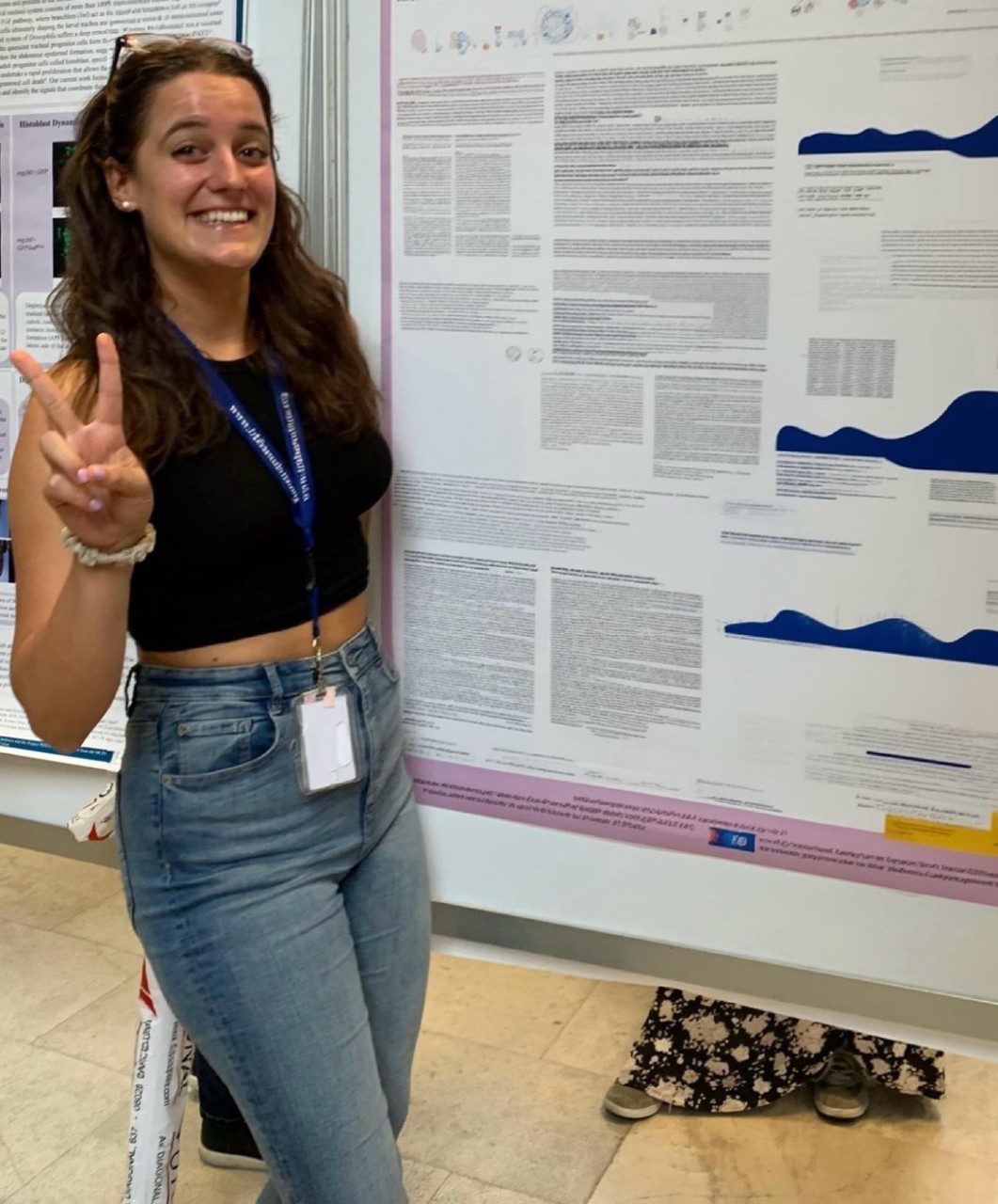
The Journey
I am Maria Guarini, from Italy, and I am currently a last-year PhD student at the Institute for Research in Biomedicine (IRB) Barcelona and the University of Barcelona. Regarding my expertise, I am a molecular biologist by training. After finishing my studies at the University of Padua (Italy), I moved to Vienna to work as a research assistant at the Center for Molecular Medicine (CeMM) where I found the motivation to pursue a PhD. That’s why in 2022, I moved to Barcelona, and I joined Dr. Alejo Rodriguez-Fraticelli's lab as a Marie Skłodowska-Curie Actions’ Co-Fund PhD fellow.
Marie Skłodowska-Curie Actions Scholarship Details
My fellowship is funded by the IRB Doctoral Fellowship Programme (IRB_DREAM), which is part of the Horizon2020, an innovation and research programme led by the European Union. The IRB DREAM funded 10 PhDs with a 4-year MSCA Co-Fund fellowship in the years 2021-2022. The fellowship includes salary, the fee for the university, an amount of money for travelling and conferences, and another amount of money for research consumables for the host lab.
Educational Background
My degree in molecular biology gave me a solid theoretical foundation in my field. However, when I applied for a PhD, the strongest part of my CV was not my university degree, but the laboratory experience I had gained during two years as a research assistant in Vienna. After finishing my studies, I consciously chose to invest two additional years in building strong experimental and research skills. This period was often seen as a sign of maturity and commitment when I applied for PhD positions. In biological research, spending extended time in well-established institutions and high-quality labs before starting a PhD can significantly strengthen your CV and improve your chances of securing a competitive fellowship.
How Did You Prepare to Apply to the University of Barcelona?
How Did You Find Information About the Marie Skłodowska-Curie Actions Scholarships and the University of Barcelona?
I found information about scholarships on this website: https://euraxess.ec.europa.eu/. Here, there are almost all the fellowships available in Europe and links to the institutions.
How Did You Prepare to Apply to the Marie Skłodowska-Curie Actions Scholarship?
The first step of most fellowship applications consists of submitting a CV and a motivation letter, and I personally found this to be the most challenging and competitive stage of the process. At this point, I think it is crucial to communicate clearly who you are, what you would like to do, and why you believe you are a suitable candidate for the position. In my case, it also made a big difference to spend time learning about the institution and the research group where I was applying to, and personalize the motivation letter for the specific call rather than relying on a generic version. When it comes to the CV, I don’t see it only as a list of degrees and technical skills. I think it can also be a space to show more of who you are as a person. For example, I chose to include extra jobs and volunteering activities, as I felt they helped to give a more complete picture of my background. Before submitting my application, I asked friends and colleagues in the field to read through my CV and motivation letter and share their feedback.
The second step usually involves in-person interviews. Candidates are often asked to prepare a presentation about their most recent research project or master’s thesis for a panel of evaluators. For this stage, I practiced my presentation many times with colleagues and friends from the field, and I found it especially helpful to get feedback from people who had already gone through a similar selection process. For the personal interviews with the PIs (Principal Investigators), I prepared by reading extensively about the research topics and ongoing work of the groups. I also think it is very important to show genuine interest during the interview, so I would strongly suggest having a few questions prepared to ask them.
What Do You Think Made Your Application Stand Out?
I believe that my previous experience as a research assistant in a highly competitive laboratory helped my CV stand out. During the in-person interviews, I also think I was able to demonstrate strong critical thinking skills, particularly during the panel presentations. Even when I did not know the exact answer to a question, I tried to reason through it out loud, showing my thought process and my willingness to engage with the problem rather than remaining silent.
In the one-to-one interviews with the research groups, I feel that my personality played an important role. I aimed to come across as confident but not arrogant, and open to learning rather than presenting myself as someone who already “knows everything.” In my view, research groups are not only looking for technical excellence, but also for people who can work well within a team. Being talented is important, but being collaborative, respectful, and easy to work with can make just as much of a difference.
Finally, I think that showing initiative also helped me stand out. During the one-to-one interviews, I only had about half an hour to speak with each PI, which was not enough for me to fully make up my mind. For this reason, I asked the organizers whether it would be possible to arrange an additional meeting with one of the PIs I was particularly interested in. I believe this demonstrated genuine interest and motivation, and it may have played a role in my eventual selection.
What Would You Have Done Differently if You Were Going Through the Process Again?
Looking back, I think I could have prepared better for the one-to-one interviews with the PIs. At the time, I focused mainly on impressing the evaluation panel during the presentation stage. I would spend more time studying the science behind each group I was interested in and reflecting on what specifically attracted me to their research. I would also approach these interviews not only as an opportunity to impress the lab, but as a chance to assess whether the group and the research were the right fit for me.
What Advice Would You Give Those Looking to Apply for a Similar Scholarship?
I strongly believe that the selection process for scholarships has an element of chance. Outcomes often depend on who is reviewing your application and on the overall pool of candidates in a given call. A friend of mine and I applied to two highly competitive fellowships at the same time: I was selected for one, she was selected for the other, and yet neither of us even passed the first evaluation stage of the fellowship that the other received.
For this reason, I think it is crucial not to experience the application process as a judgment of your personal or professional worth. Rather than treating it like an exam, I prefer to see it as an opportunity to convince the evaluators that you are the right fit for that specific position, and that you can bring both commitment and talent. Confidence plays an important role here — not arrogance, but a genuine belief that you deserve the opportunity. And if you don’t fully feel that confidence yet, it’s okay to “fake it until you make it.” 🙂
Want to submit your
scholarship journey?
Submit Your Story Here!
More Scholarship Recipients
My name is Hajiyev Sarkhan, and I am from Shemkir, Azerbaijan. My academic journey has been shaped by a strong belief that e .... Read more
My name is Nainsi Chauhan, and I am from Mumbai, India. I was born into an economically weak family and raised in an orthodo .... Read more
My name is Swaleha J. Khowaja, and I am from Karachi, Pakistan. I am currently pursuing the MSc in Global Mental Health, a j .... Read more
Leave A Comment