
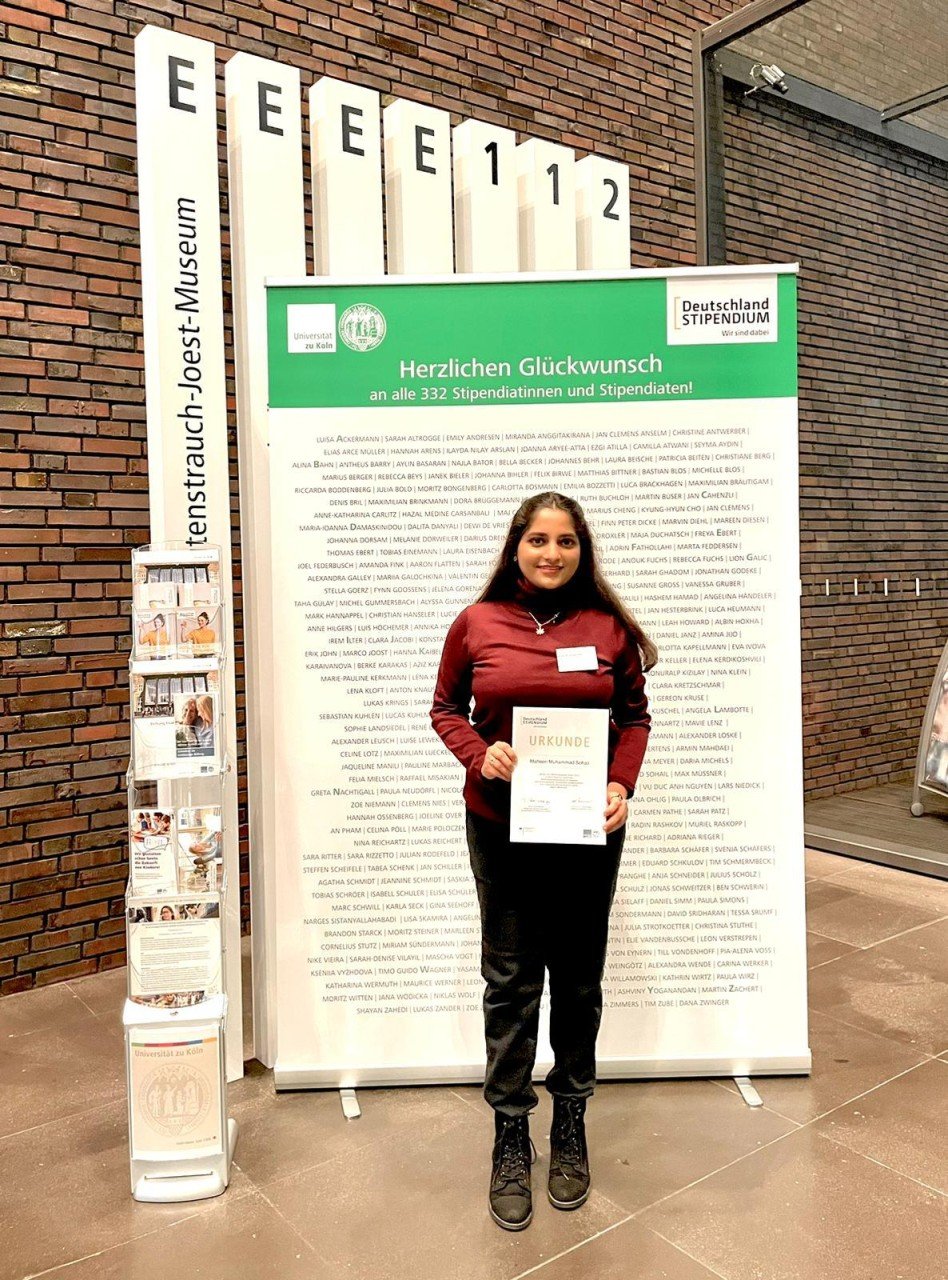
Deutschlandstipendium Scholar, Maheen Sohail from Pakistan, Shares the Story of How She Pursued Her Master’s in Business Analytics and Econometrics at the University of Cologne in Germany
University: University of Cologne, Germany
Degree: Master’s in Business Analytics and Econometrics
Previous Education: Bachelor of Science in Accounting and Finance – Bahria University, Karachi (GPA equivalent: 1.1, Magna Cum Laude, Silver Medalist)
Scholarship: Deutschlandstipendium – Partial Funding (€300 per month for one academic year)
Social Media
The Journey
My name is Maheen Sohail, and I am a 27-year-old female student from Karachi, Pakistan. I moved to Germany in October 2022 to pursue a Master’s degree in Business Analytics and Econometrics at the University of Cologne. I chose to study in this field because I have always been passionate about working with data, finance, and business decision-making. During my bachelor’s studies in accounting and finance, I discovered how powerful data analytics and quantitative methods are for solving real-world business problems and shaping strategic decisions. This motivated me to continue my education in a more specialized and technical direction by combining economics, statistics, and machine learning.
Coming from a modest background, education has always been my primary path toward professional growth and social mobility. My academic journey has been guided by strong discipline, scholarship support, and a desire to build expertise that could allow me to contribute to international business and analytics environments.
Educational Background
I completed my Bachelor of Science in Accounting and Finance at Bahria University, Karachi (2016–2020), graduating with a German-equivalent GPA of 1.1 (Magna Cum Laude). I received a Silver Medal for academic excellence and was awarded a 100% merit-based scholarship for the entire duration of my bachelor’s studies. My undergraduate education provided a strong foundation in financial accounting, corporate finance, auditing, economics, business research methods, and quantitative analysis.
Building on this base, I pursued a Master of Science in Business Analytics and Econometrics at the University of Cologne. I have completed my program, and my final results are currently awaiting official publication. My master’s training focused on statistics, econometrics, machine learning, time series forecasting, business intelligence, and applied data analytics. Through research projects, programming assignments (Python and R), and real-world industry applications, I developed advanced technical skills alongside strong analytical reasoning. This academic preparation equipped me well for professional roles in data analytics, business intelligence, and quantitative research.
How Did You Prepare to Apply to the University of Cologne?
To prepare for my application to Germany and the University of Cologne, I carefully followed all academic and immigration requirements. I completed the IELTS examination, achieving an overall score of 6.5, which met the English proficiency standards for admission. I obtained academic recommendation letters from professors at my bachelor’s university as well as professional reference letters from supervisors at organizations in Pakistan, where I gained practical experience.
I dedicated significant time to preparing a detailed motivation letter, academic transcripts, and credential evaluations required for German universities. I also researched visa requirements, financing rules, blocked account regulations, and housing procedures to ensure a smooth transition into student life in Germany. Additionally, I prepared a professional academic CV and portfolio highlighting coursework, research interests, and relevant technical skills.
Were You Offered Any Other Scholarships?
Yes, I received multiple scholarships:
- 100% Merit Scholarship – Bahria University, Karachi (2016–2020): Full tuition coverage for my entire Bachelor of Science degree based on academic performance.
- Deutschlandstipendium Scholarship – University of Cologne (2022–2023): Awarded €300 per month for one academic year during my Master’s program based on merit and financial need.
These scholarships played an essential role in enabling me to pursue higher education both nationally and internationally.
What Drew You to Choose Germany to Pursue Your Degree?
I chose Germany because of its globally respected education system, strong research culture, and emphasis on applied learning in analytical and technical fields. Public universities in Germany offer high academic quality with relatively affordable tuition, making it one of the most accessible destinations for international students seeking high-value education. Germany is also known for its strong labor market in analytics, data science, economics, and technology-driven business roles. The opportunity to study in a diverse international environment while benefiting from Europe’s economic ecosystem made Germany an ideal destination to pursue my academic and professional ambitions.
What Were Some of the Challenges You Faced as an International Student?
The primary challenges involved financial planning, visa procedures, and employment regulations. Monthly living costs typically range between €800 and €1,000, depending on housing location, city, and lifestyle. While students are permitted to work up to 20 hours per week, securing appropriate work authorization is often stressful. Work permits must be applied for several months in advance, and immigration procedures vary significantly by city. Another major challenge was the language barrier, especially in professional settings. Although my academic program was fully in English, most part-time and full-time job opportunities in Germany require German language proficiency. This can create difficulties for international students when seeking employment or completing administrative processes. Fortunately, I was able to secure relevant working-student positions aligned with my academic background, which allowed me to support myself without relying on unrelated short-term jobs.
Looking Back, Would You Recommend Studying Here for International Students Seeking Affordable Higher Education? Why or Why Not?
Yes, I would strongly recommend Germany as an affordable and high-quality study destination, especially for students in technical, analytical, and economic fields. German universities offer excellent education at comparatively low tuition costs, making advanced degrees accessible even to students from financially modest backgrounds.
However, I strongly advise incoming students to reach at least B1-level German proficiency before arrival. While English-taught programs make academic success possible without German, daily life and employment opportunities are much easier with basic German skills. Language preparation significantly improves both career prospects and social integration.
How Was Your Experience at the University of Cologne?
My experience at the University of Cologne has been academically enriching and professionally growth-oriented. The digital focus of the program, the availability of industry-linked projects, and the strong research environment allowed me to develop advanced analytical competencies. Faculty members were supportive and highly knowledgeable, and the curriculum was both demanding and relevant to real-world challenges.
How Do You Rate the University of Cologne Academically and Why?
I would rate the institution very highly academically. The curriculum focuses strongly on quantitative rigor, applied analytics, and business relevance, ensuring graduates possess both theoretical foundations and practical skills. The integration of coding, modeling, and business consulting applications created excellent career readiness.
How Does the University of Cologne Support International Students?
The University of Cologne provides structured international student support through orientation programs, visa and enrollment counseling, language courses, academic advising, and career services. Dedicated international offices guide students through administrative processes and help them adapt to academic expectations and cultural environments.
Are Your Classes Conducted in English or German?
My Master’s degree was fully taught in English.
Would Students Have Academic Problems Without Knowing German?
No — students do not face academic disadvantages if they do not speak German, as English-taught programs allow full participation in all coursework and assessments. However, professional employment and everyday integration become significantly easier with German language skills, especially at the B1 level or higher. Therefore, learning German is strongly recommended for long-term success in Germany.
Want to submit your
scholarship journey?
Submit Your Story Here!
More Scholarship Recipients

My name is Moses Besa. I was born and raised in a disadvantaged community called Chibolya in Mufulira, a small mining town i .... Read more

My name is Faiza Waseem Khan, and I was born and raised in Pakistan. My passion for education goes all the way back to the u .... Read more

I still remember the moment I left home for the first time. A suitcase in one hand, uncertainty in the other. I didn� .... Read more
- Bachelor's Scholarships
- Bangladeshi Nationality
- Biological Sciences
- Biomedical Science
- Fully Funded Scholarships
- India
- Indian Council for Cultural Relations (ICCR) Scholarships
- Japan
- Master's Scholarships
- MEXT Scholarship
- Osaka University
- Ph.D. Scholarships
- Pharmaceutical Sciences
- Shimane University
- University of Delhi
Leave A Comment