
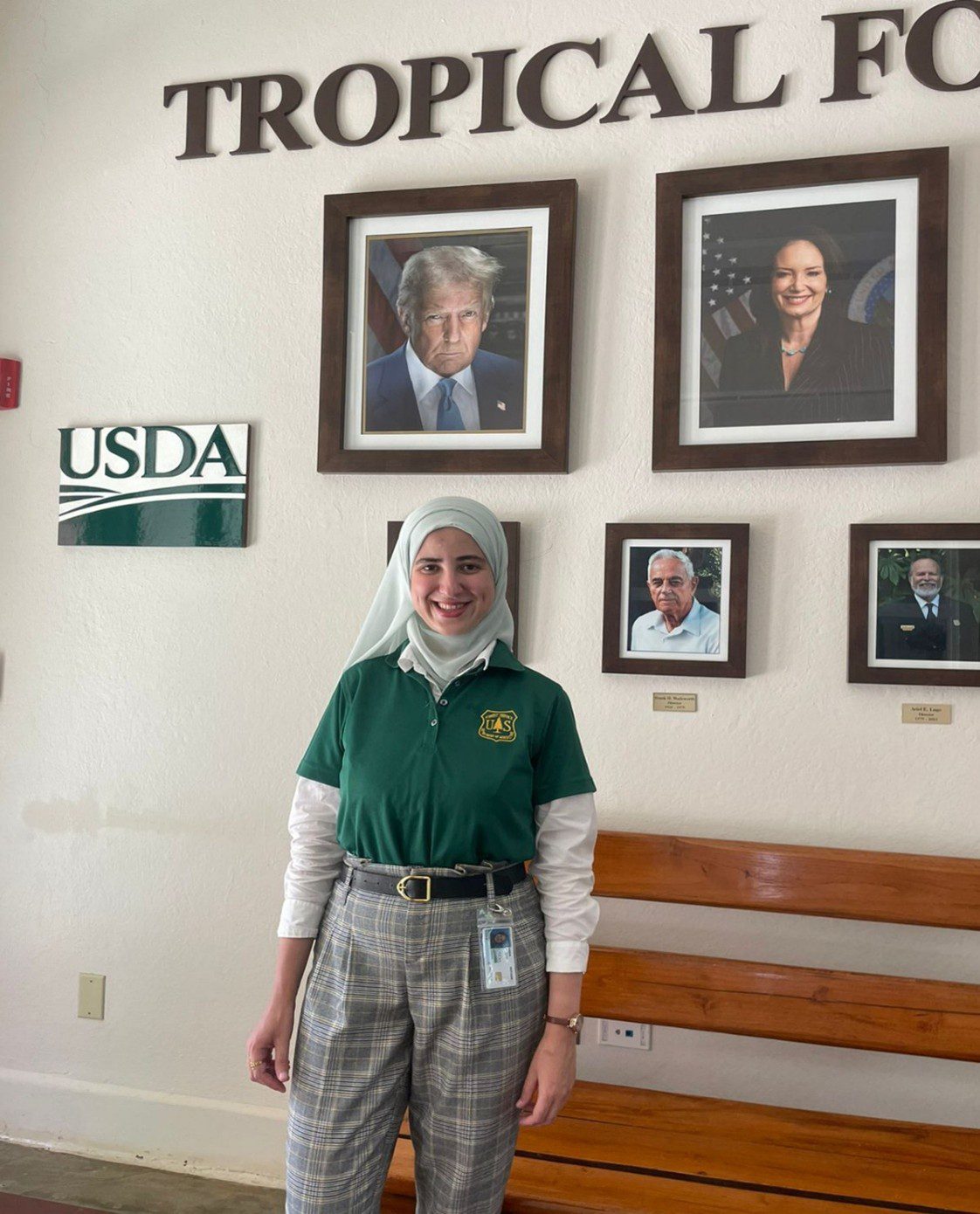
Fulbright Alumna and ORISE Fellow, Dr. Heba Bedair from Egypt, Shares Her Journey of Advancing Ecological Research at the USDA Forest Service in the United States
University: University of Wisconsin–Madison (Fulbright Research) & USDA Forest Service – International Institute of Tropical Forestry (ORISE Fellow), USA
Degree: Postdoctoral Fellowship in Spatial Ecology and Conservation Science
Previous Education: Ph.D. in Ecology – Tanta University, Egypt
Scholarship: ORISE Postdoctoral Fellowship – Fully Funded (U.S. Department of Energy, hosted at USDA Forest Service)
Other Offered Scholarships: Fulbright Scholarship (University of Wisconsin–Madison)
Social Media
The Journey
My name is Dr. Heba Bedair, and I’m originally from Egypt. I am an ecologist and spatial scientist passionate about understanding how ecosystems respond to environmental change through the lenses of GIS, remote sensing, and ecological modeling. Growing up near the Nile, I developed a deep curiosity about how landscapes shift and how biodiversity adapts to both natural dynamics and human pressures.
One of the most transformative experiences in my academic path was being awarded a Fulbright scholarship, which allowed me to conduct research at a leading spatial ecology lab at the University of Wisconsin–Madison, one of the top research universities in the United States. This Fulbright experience sharpened my scientific skills, deepened my cross‑cultural understanding, and prepared me extraordinarily well for competitive postdoctoral opportunities in the U.S., including the prestigious ORISE Postdoctoral Fellowship at the USDA Forest Service International Institute of Tropical Forestry (IITF). As a proud Fulbright alumna, I continue to carry forward the program’s mission of bridging cultures through science and scholarship.
ORISE Postdoctoral Fellowship Details
I currently hold an ORISE Postdoctoral Fellowship, awarded through the Oak Ridge Institute for Science and Education (ORISE) under an agreement with the U.S. Department of Energy (DOE). The fellowship is hosted at the USDA Forest Service, International Institute of Tropical Forestry (IITF) in San Juan, PR, USA. This highly competitive federal research fellowship provides full support for postdoctoral scholars to work directly with federal scientists on high‑impact environmental research.
The fellowship supports:
- A full postdoctoral stipend
- Research activities and scientific training
- Collaboration with federal researchers
- Professional development in applied ecology and conservation
Being selected for this program is a significant honor and represents a major step in my research career.
Were You Offered Any Other Scholarships?
Yes, Fulbright
Educational Background
I hold:
- Ph.D. in Ecology (Tanta University, Egypt)
- Two years of postdoctoral training across:
- University of Wisconsin–Madison (Fulbright scholar)
- USDA Forest Service (ORISE Fellow)
My Fulbright program was pivotal. Working at the UW–Madison SILVIS lab gave me:
- Advanced training in species distribution modeling
- Strong foundations in GIS, remote sensing, and computational ecology
- Experience collaborating with interdisciplinary teams
- Exposure to cutting‑edge conservation research in North America
This background is perfectly aligned with the goals of the USDA Forest Service, making the transition to an ORISE postdoctoral role both natural and impactful.
How Did You Prepare to Apply to Institutions?
Finding Information About Programs
I found opportunities through:
- Federal research program listings (USDA, ORISE, DOE)
- Academic networks and mentors
- Professional listservs
- Fulbright alumni circles and international scholar networks
- Different job boards
Standardized Tests
At the postdoctoral level, standardized tests were not required. My application focused on my Fulbright experience, research productivity, and technical skills.
How Did You Prepare to Apply for the ORISE Fellowship?
- I began by identifying mentors whose research aligned with my strengths in spatial ecology.
- I wrote a clear proposal connecting my previous Fulbright work with the USDA Forest Service’s mission.
- I emphasized how my Fulbright research prepared me for U.S. scientific environments and federal research culture.
- I highlighted my publication record, GIS skills, and commitment to conservation science.
Experience at the Institution
Working at the USDA Forest Service – IITF has been truly inspiring. The institute is a hub for tropical forestry research, climate resilience, and conservation innovation. The environment encourages independence, creativity, and meaningful scientific collaboration.
Institutional Support for International Scholars
Through ORISE and USDA, I received:
- Administrative and visa support
- Access to high-level scientific mentorship
- Training workshops and professional development
- A welcoming research environment
My Fulbright training also made it easier to navigate international research settings with confidence and adaptability.
What Made My Application Stand Out?
- My Fulbright background, a marker of academic excellence, leadership, and cross-cultural collaboration.
- Strong research alignment with USDA Forest Service priorities.
- Advanced spatial modeling skills needed for their projects.
- Clear, relevant project proposals connecting ecology, GIS, and conservation.
- Interdisciplinary experience across ecology, environmental modeling, and data science.
What Would I Have Done Differently?
I would have:
- Contacted potential mentors even earlier
- Tightened my project proposal earlier in the process
- Reached out to more Fulbright alumni in federal research roles for advice
Advice for Future Applicants
- Leverage your previous scholarships proudly.
Fulbright alumni are widely respected across federal agencies. Let it shine in your application.
- Align your proposal with agency needs.
Show how your skills solve real conservation problems.
- Highlight your interdisciplinary strengths.
Spatial ecology, modeling, data science, and field knowledge are valuable.
- Don’t hesitate to reach out to mentors.
A supportive mentor strongly strengthens your application.
- Believe in your story.
Your background, your journey, and your passion matter as much as your technical skills.
Want to submit your
scholarship journey?
Submit Your Story Here!
More Scholarship Recipients

I am Aleezay Anjum Ahmed from Pakistan, and I hold a bachelor’s degree in chemistry with a minor in mathematics. I was awa .... Read more
My name is Alhaji Alusine Kebe. I am an agronomist specializing in soil–plant–climate interactions, sustainable agri-foo .... Read more
My name is Sarbinaz Nagyzkhan, and I am originally from Kazakhstan. I am currently a Marie Skłodowska-Curie Doctoral Fellow .... Read more
Leave A Comment