
London School of Economics and Political Science Scholarships for International Students 2027
To help students manage tuition and living expenses, London School of Economics and Political Science connects to scholarships across different funding levels. Here are several top options to review first.
Among the university based funding routes linked to London School of Economics and Political Science, these scholarships tend to stand out for their level of support and overall value. LSE PhD Studentships is fully funded and typically covers 100% of tuition fees and a living stipend of £21,237. PhD Studentships on Analysing and Challenging Inequalities is commonly categorized as full tuition support, and coverage that often includes 100% of tuition fees and a living stipend of £18,000. With Graduate Support Scheme, students may receive partially funded support, and coverage frequently includes awards ranging between £5,000 to £15,000 depending on the students' needs. LSE Master’s Awards is a partially funded award, and the listed benefits often include partial tuition fee.
To broaden funding options beyond institutional awards at London School of Economics and Political Science, these external and government scholarships are commonly considered as well. Commonwealth Master’s Scholarships is a fully funded award, and the listed benefits often include full tuition fees, living allowance of up to £1,378 per month and £1,690, and clothing allowance. Commonwealth PhD Scholarships is usually considered fully funded, and typical coverage can include full tuition fees, roundtrip airfare ticket, and paid airfare ticket for mid-term visit to home country. A strong option is Commonwealth Shared Scholarships which is fully funded and often covers full tuition fees, thesis grant, and living allowance of up to £1,652 per month.
To see every scholarship associated with this institution and compare coverage and eligibility, browse the sections below.
London School of Economics and Political Science Scholarships for International Students
The scholarships at London School of Economics and Political Science can help fund your study expenses. There are currently 16 scholarships being offered to international students at the London School of Economics and Political Science, all with varying requirements, benefits, and application processes. We have compiled them in this list to help you find the scholarship that best fits you.
Undergraduate Scholarships
Graduate Scholarships
External Scholarships
There are many degrees that are open to international students right now — find yours.
London School of Economics and Political Science Admissions
Here are the official admission pages for London School of Economics and Political Science:
| Degree | Admissions Pages |
|---|---|
| Bachelor's | International Students Admissions Page |
| Master's | International Students Admissions Page |
Admissions and Scholarship Results at London School of Economics and Political Science
Here are some of the admissions and scholarship results from previous applicants to London School of Economics and Political Science, which you might find helpful. For more results to London School of Economics and Political Science, please see the London School of Economics and Political Science Admissions Profile Page .
| Nationality / Region | SAT/ACT | EFC | GPA | Scholarship | Status |
|---|---|---|---|---|---|
| Brazil | N/A | N/A | N/A | N/A | Accepted |
| USA | 1540 | N/A | 3.9 | N/A | Rejected |
| USA | 1560 | N/A | 4 | N/A | Rejected |
| Singapore | N/A | N/A | 4.0 | N/A | Rejected |
| India | 1530 | N/A | N/A | N/A | Rejected |
London School of Economics and Political Science Application Deadlines
| Degree | Admission Deadline |
|---|---|
| Bachelor's | January 13, 2027 |
| Master's | Accepts Applications All Year Different Master's programs have different deadlines |
Tuition Fees at London School of Economics and Political Science for International Students
Indicative annual tuition fee ranges for international students at London School of Economics and Political Science. Exact fees vary by program, so always confirm the current cost on the university's official tuition fee pages.
| Degree Level | Typical Annual Range |
|---|---|
| Bachelor's Tuition | 28,900 – 35,700 GBP |
| Master's Tuition | 30,400 – 43,000 GBP |
Please note that tuition fees can vary based on the specific program you choose. For the most accurate and current fee information, consult the official tuition fee pages linked above.
London School of Economics and Political Science Scholarship Recipients
International students who received scholarships to study at London School of Economics and Political Science, documented by Global Scholarships.

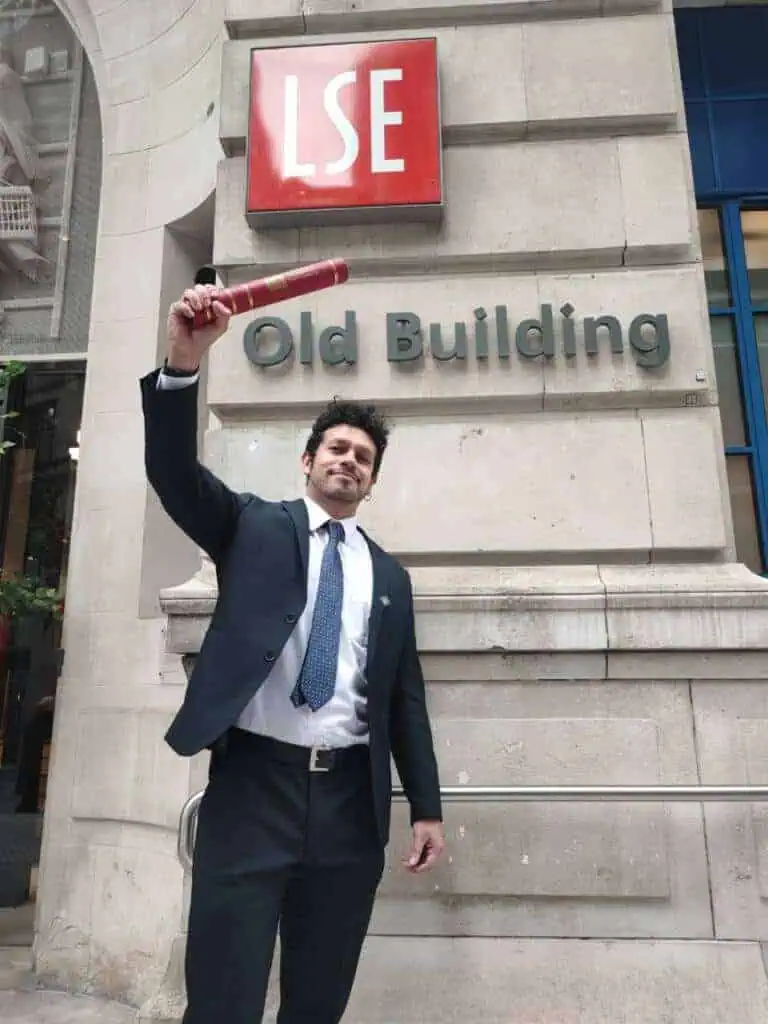



What Scholarship Recipients Say
Advice and insights from international students who successfully secured funding to study at London School of Economics and Political Science.
"The scholarship covered full tuition fees, return airfare to and from my home country, a thesis grant, warm clothing allowance, and living expenses in London."
"To prepare my application for the Master’s in Local Economic Development, I began the process quite early."
"I am currently pursuing an MSc in Global Health Policy at the London School of Economics and Political Science (LSE)."
"Receiving a Commonwealth Master’s Scholarship changed that trajectory: it turned possibility into access and allowed me to study at the London School of Economics (LSE)."
"My interest lies in understanding how clinical evidence, economic evaluations, and policy frameworks converge to shape access to innovative medicines."
"The African Endowment Scholarship at the London School of Economics and Political Science for the LLM – fully funded (declined)."
Frequently asked questions
Common questions about scholarships, admissions, and studying at London School of Economics and Political Science.
In the LSE scholarship-recipient stories on Global Scholarships, the funding was used for in-person study in London (not online). Expect most scholarships at LSE to be for in-person degrees.
LSE scholarships (and major external awards that LSE students use) most commonly support LSE’s core areas in the social sciences and policy. In the recipient stories, funded programmes included health and public policy (Ankur Nair – MSc Global Health Policy; Joyce Toh – MSc Health Policy, Planning and Financing), development (Saadia Sabir – Master’s in Development Studies; Muhammad Ashar – MSc Local Economic Development), and political economy (Falguni Lalwani – MSc International Political Economy).
Business subjects: LSE’s management/strategy/finance-related degrees can be scholarship-eligible, and recipients often come from quantitative or professional backgrounds. STEM subjects: LSE is not an engineering school, but it does have quantitative, data, and economics pathways that STEM applicants pursue (for example, Joyce’s work sits at the intersection of health, economics, and policy). Humanities: LSE is primarily social-science focused (with related fields like economic history and social policy). Medicine: LSE does not run an MBBS/medical school degree; however, LSE does offer health-policy and health-economics study (as Joyce put it, her programme covered “epidemiology, health economics, and social sciences”). Because there is no medical degree at LSE, “medicine” scholarships for international students at LSE generally mean health policy/public health policy programmes rather than training as a physician.
LSE scholarships vary by award, and many major funding routes are either open globally or targeted by nationality/residency. In the Global Scholarships LSE stories, recipients included scholars from India (Ankur Nair, Falguni Lalwani), Pakistan (Muhammad Ashar, Saadia Sabir), and Malaysia (Joyce Toh). Some awards are explicitly nationality/residency-linked (for example, Commonwealth-related routes), while others are broadly international.
Yes, it is. In these recipient stories, IELTS came up repeatedly. Ankur Nair said, “I took the IELTS,” and Falguni Lalwani explained that she “completed the IELTS Academic Test.” Timing can matter: Muhammad Ashar noted, “I was required to submit my IELTS score after receiving a conditional offer,” which is a common pattern where you can apply first and satisfy English conditions later.
Minimum academic requirements depend on the programme and are competitive in practice, so think of them as a baseline rather than a guarantee. In the recipient stories, admitted scholars often had strong academics: Joyce Toh reported an undergraduate CGPA of “3.80,” and Muhammad Ashar graduated with a CGPA of “3.78.” Falguni Lalwani also highlighted graduating “First Class with Distinction.” These examples show what successful profiles looked like in practice for scholarship recipients, even though exact “minimums” vary by department.
Based on these recipients’ experiences, competitive scholarship profiles combined strong academics with a clear purpose and fit. Joyce advised applicants to build a “coherent and compelling narrative,” and Ankur emphasized experience plus a strong academic record, saying his “strong academic record and tailored application essays were key.” Academically, the stories show high achievement (Joyce: “3.80” CGPA; Muhammad: “3.78” CGPA; Falguni: “First Class with Distinction”), while scholarship committees also looked for development impact and alignment; Falguni described framing plans around SDG-linked goals and building evidence of impact.
From the recipient stories, the recurring “must-haves” were transcripts, references/recommendation letters, a personal statement, and an academic CV/resume. Ankur said he “tailored my CV and personal statement” and asked mentors for “letters of recommendation.” Falguni described building a checklist for “transcripts, references, citizenship proof, IELTS,” and Muhammad emphasized getting everything uploaded early, saying he ensured “all boxes related to scholarship application… were checked and uploaded well before the deadline.”
- Academics: transcripts/mark sheets and degree certificates (as needed).
- References: usually two referees/recommendation letters.
- Core writing: personal statement/statement of purpose (Muhammad called it “more than just a formal requirement”).
- CV/resume: especially important when highlighting research/work experience.
- English evidence: IELTS/TOEFL if required or if your offer is conditional (Muhammad: “submit my IELTS score after receiving a conditional offer”).
Yes, there is an application fee for both undergraduate and graduate programs at LSE.
There are many degrees that are open to international students right now — find yours.
About the Author: Hyun Lee


Leave A Comment