
University of Strathclyde Scholarships for International Students 2027
Funding at University of Strathclyde can be easier to navigate when you start with the most generous options. Below is a shortlist prioritized by the level of support.
University scholarships associated with University of Strathclyde often form the core of an applicant’s funding plan. Here are a few notable options to review first. BBA International Scholarship is partially funded and typically covers 25% tuition reduction. Business School Dean’s Excellence Awards is commonly categorized as partially funded support, and coverage that often includes 25% tuition reduction.
In addition to university awards, students connected to University of Strathclyde may also consider government and external scholarships. Here are a few widely relevant options. Commonwealth PhD Scholarships is a fully funded award, and the listed benefits often include full tuition fees, roundtrip airfare ticket, and paid airfare ticket for mid-term visit to home country. Commonwealth Shared Scholarships is usually considered fully funded, and typical coverage can include full tuition fees, thesis grant, and living allowance of up to £1,652 per month. A strong option is Beit Trust Postgraduate Scholarships which is fully funded and often covers full tuition, living allowance, and UK visa fee.
You can find more university scholarships and external or government scholarships further down on this page.
University of Strathclyde Scholarships for International Students
The scholarships at University of Strathclyde can help fund your study expenses. There are currently 11 scholarships being offered to international students at the University of Strathclyde, all with varying requirements, benefits, and application processes. We have compiled them in this list to help you find the scholarship that best fits you.
Undergraduate Scholarships
External Scholarships
There are many degrees that are open to international students right now — find yours.
University of Strathclyde Admissions
Here are the official admission pages for University of Strathclyde:
| Degree | Admissions Pages |
|---|---|
| Bachelor's | International Students Admissions Page |
| Master's | International Students Admissions Page |
University of Strathclyde Application Deadlines
| Degree | Admission Deadline |
|---|---|
| Bachelor's | January 13, 2027 |
| Master's | Accepts Applications All Year |
Tuition Fees at University of Strathclyde for International Students
Indicative annual tuition fee ranges for international students at University of Strathclyde. Exact fees vary by program, so always confirm the current cost on the university's official tuition fee pages.
| Degree Level | Typical Annual Range |
|---|---|
| Bachelor's Tuition | 21,550 – 30,250 GBP |
| Master's Tuition | 21,550 – 33,450 GBP |
Please note that tuition fees can vary based on the specific program you choose. For the most accurate and current fee information, consult the official tuition fee pages linked above.
University of Strathclyde Scholarship Recipients
International students who received scholarships to study at University of Strathclyde, documented by Global Scholarships.

What Scholarship Recipients Say
Advice and insights from international students who successfully secured funding to study at University of Strathclyde.
"This scholarship is fully funded (flights, accommodation and course fees are included), to focus on achieving your professional goals and making the most of your life experience by studying in the UK for a year."
"For those looking to apply for a scholarship like Chevening, my main advice is to start with a thorough self-assessment, to know yourself very well. It's not just about meeting the requirements, but understanding how your background, aspirations, and values align with the mission of the scholarship."
"I am currently pursuing the MSc in Advanced Mechanical Engineering with Aerospace at the University of Strathclyde, Scotland."
Frequently asked questions
Common questions about scholarships, admissions, and studying at University of Strathclyde.
Yes—Strathclyde does offer scholarships for some online programmes (these are usually course- or faculty-specific rather than “one scholarship for everything”). For example, the Faculty of Science has offered an online masters scholarship for selected online Applied Statistics programmes; this is the kind of award you should look for if your plan is fully distance learning.
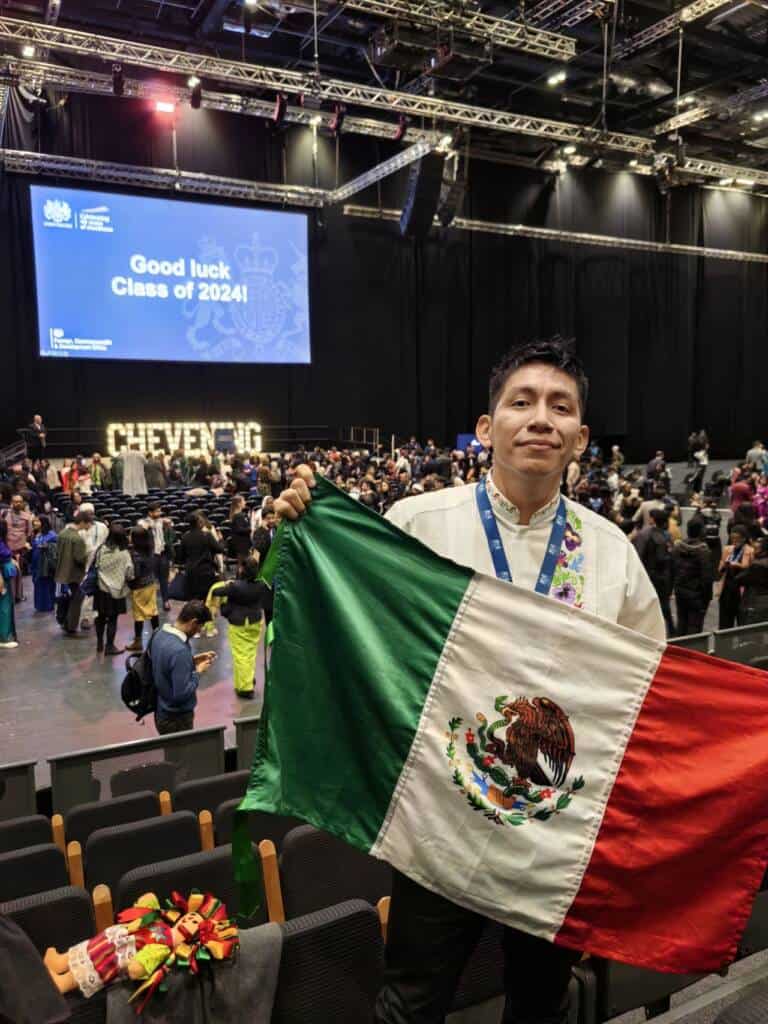
Strathclyde scholarships are offered across a wide range of subjects, often grouped by faculty (Engineering, Science, Business, and Humanities & Social Sciences). In recipient stories, Luis Ayil pursued engineering (Mechanical/Aerospace) and described being “fascinated by the engineering behind aircraft,” showing how STEM-focused programmes commonly align with major funding routes.
Common scholarship-covered areas include engineering (mechanical, aerospace, civil, electronic), business (MBA/MSc pathways), STEM fields (computer science, data, maths, statistics, physics, chemistry), and humanities/social sciences (education, policy, law, social work).
Many Strathclyde scholarships are framed around fee status (e.g., “international fee-paying” and sometimes “non-EU”) rather than listing specific passports, so eligibility can cover a wide spread of nationalities as long as you meet the fee-status and course criteria.
In addition, external/global awards can be nationality-based. Luis Ayil is from Mexico and received Chevening; he notes Chevening has “over 144 countries,” which is a good example of a scholarship where nationality is explicitly part of the eligibility rules.
Often, yes, especially if your prior education wasn’t taught/examined in English to the level Strathclyde accepts. Strathclyde publishes English language requirements and accepted tests (including IELTS and TOEFL), and individual programmes can have their own thresholds.
Luis Ayil shows how real this can be in practice: he called meeting the English requirement “one of the biggest challenges,” and shared that he took “11 English certification tests,” including IELTS and TOEFL, before hitting the required score.
Yes, Strathclyde commonly looks for the equivalent of at least a UK second-class honours degree (or higher) for postgraduate entry, though the exact standard varies by programme and department (some are more competitive, and some accept a broader range with relevant experience).
Recipient stories don’t always include a published GPA. Luis Ayil didn’t share a numeric GPA in his story, but he did describe a strong relevant background, writing, “I am a mechatronics engineer,” and highlighting interdisciplinary skills (mechanics, electronics, automation, programming) that fit an advanced engineering MSc.
A strong academic fit usually means: (1) meeting the course entry standard, (2) showing evidence you can thrive in that subject (relevant modules/projects/work), and (3) matching the scholarship’s selection criteria (often merit, impact, leadership, or a mix).
For major competitive awards, scholarship “fit” matters as much as grades. Luis Ayil explained his approach for Chevening: “Reading the requirements… carefully is the first step,” and he emphasised the essays stage by noting, “you must write 4 essays,” tying your leadership, plans, and university choices together.
Most Strathclyde applications (and many scholarship applications) ask for a core set of documents: academic transcripts/marksheets, degree certificate (if completed), passport ID page, CV/resume (especially for postgraduate), and a personal statement/supporting statement. References are commonly requested, particularly for postgraduate study.
Luis Ayil highlighted how structured preparation helps: he said external guidance was key for “preparing the necessary documents,” and his story also shows scholarship-specific extras; Chevening required essays (he said “4 essays”) and later an embassy interview stage.
If your course requires it, also be ready with English test results (IELTS/TOEFL or another accepted qualification). Luis’s experience, taking multiple tests before meeting the score, shows why it’s smart to plan language documentation early.
It depends on the level and route. Undergraduate applications submitted through UCAS require a UCAS application fee (set by UCAS for that cycle). For some postgraduate taught applications made directly to Strathclyde, there may be no application fee, but you should confirm on your specific course/application route.
There are many degrees that are open to international students right now — find yours.
About the Author: Hyun Lee


Thanks for the information. However, I have not seen tuition fees for a Ph.D. in Business Management.
Hello, for PhD studies, we don’t normally post this information because for some of the countries, there are no tuition fees for Ph.D. students. For University of Strathclyde Ph.D. in Business Management, the tuition fee is 17,400 pounds per year (3 years).
where can I find courses for PhD?
Here’s the PhD courses page.