
University of Birmingham Scholarships for International Students 2027
If you are planning your budget for University of Birmingham, these scholarships are a practical place to start. The list is prioritized by typical funding strength.
If you are focusing on university provided awards tied to University of Birmingham, the following scholarships are commonly among the most impactful options. PhD Scholarships in the School of Computer Science is a fully funded award, and the listed benefits often include whole cost of studies. Birmingham Business School MSc Scholarships is usually considered full tuition, and typical coverage can include £5,000 for 125th Anniversary Scholarships - for international students, £6,000 for Chancellor's Scholarships – for Indian Students, and £6,000 for Chancellor's Scholarships – for Chinese Students Excelling in Economics and Finance. A strong option is Harding International Legal Scholarship which is partially funded and often covers a tuition fee waiver of £5,000. Europe High Fliers Undergraduate Scholarships is partially funded, and coverage often includes £5,000 for study costs.
External and government scholarships can complement university funding for University of Birmingham students. The following options are often reviewed alongside campus awards. Commonwealth PhD Scholarships is fully funded, and coverage often includes full tuition fees, roundtrip airfare ticket, and paid airfare ticket for mid-term visit to home country. Commonwealth Shared Scholarships is fully funded and typically covers full tuition fees, thesis grant, and living allowance of up to £1,652 per month. Marie Skłodowska-Curie Actions is commonly categorized as fully funded support, and coverage that often includes living stipend, mobility allowance, and special needs, leave, and and/or family allowance (if applicable).
More scholarships connected to this institution are listed further down. Scroll to explore the full set of opportunities.
University of Birmingham Scholarships for International Students
The scholarships at University of Birmingham can help fund your study expenses. There are currently 15 scholarships being offered to international students at the University of Birmingham, all with varying requirements, benefits, and application processes. We have compiled them in this list to help you find the scholarship that best fits you.
Undergraduate Scholarships
Graduate Scholarships
External Scholarships
There are many degrees that are open to international students right now — find yours.
University of Birmingham Admissions
Here are the official admission pages for University of Birmingham:
| Degree | Admissions Pages |
|---|---|
| Bachelor's | International Students Admissions Page |
| Master's | International Students Admissions Page |
University of Birmingham Application Deadlines
| Degree | Admission Deadline |
|---|---|
| Bachelor's | January 13, 2027 Different Bachelor's programs have different deadlines |
| Master's | July 3, 2026 Different Master's programs have different deadlines |
Tuition Fees at University of Birmingham for International Students
Indicative annual tuition fee ranges for international students at University of Birmingham. Exact fees vary by program, so always confirm the current cost on the university's official tuition fee pages.
| Degree Level | Typical Annual Range |
|---|---|
| Bachelor's Tuition | 22,850 – 34,550 GBP |
| Master's Tuition | 24,130 – 42,770 GBP |
Please note that tuition fees can vary based on the specific program you choose. For the most accurate and current fee information, consult the official tuition fee pages linked above.
University of Birmingham Scholarship Recipients
International students who received scholarships to study at University of Birmingham, documented by Global Scholarships.

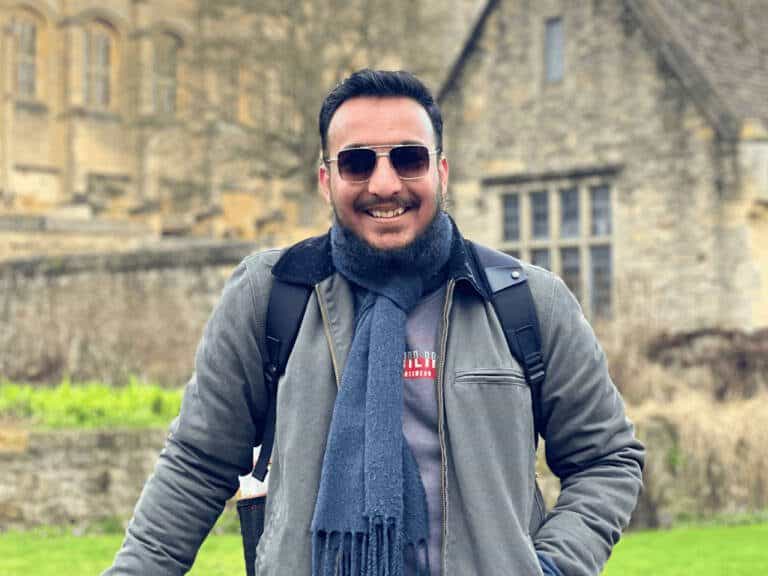
What Scholarship Recipients Say
Advice and insights from international students who successfully secured funding to study at University of Birmingham.
"This incredible opportunity covers my tuition, travel, and living expenses, allowing me to fully concentrate on my studies and professional development."
"Currently, I’m pursuing a Master’s in Health Care Policy and Management at the University of Birmingham in the UK."
Frequently asked questions
Common questions about scholarships, admissions, and studying at University of Birmingham.
Most major scholarships connected to studying at the University of Birmingham are geared toward on-campus study rather than fully online/distance learning
University of Birmingham scholarships span a wide range of subjects (and many are not restricted to one department), but the exact eligible programmes depend on the specific scholarship. In GlobalScholarships success stories, Laurent studied engineering (an “M.Sc. in Road Management and Engineering with Merit”), while Jiyda Zahaf pursued a Master’s in “Health Care Policy and Management,” showing funding can support STEM/engineering and health-related fields.
Beyond those examples, Birmingham’s scholarship listings commonly cover (among others): engineering and wider STEM, business/economics, health sciences, and humanities/social sciences, often at Master’s level (and sometimes undergraduate too) depending on the scheme. For business specifically, some scholarships are managed separately by Birmingham Business School, and eligibility rules can differ by scholarship.
Medicine: international students can apply to Medicine (MBChB) at Birmingham, but medicine admissions and English requirements can be stricter than many other courses, and some scholarship schemes may exclude MBChB or limit eligibility, so always check the scholarship’s “eligible programmes” section carefully.
It varies by scholarship. Some Birmingham-linked schemes are broadly open (for instance, the “Chevening & Birmingham Partnership Scholarships” are listed as open across many countries for Master’s study), while others are restricted to specific country lists.
From the GlobalScholarships University of Birmingham recipient stories, you can also see that funded students come from diverse nationalities, e.g., Laurent (Tanzania) and Jiyda Zahaf (Mauritania), which is a good sign that international eligibility is common, though still scholarship-dependent.
Often yes, but not always. Birmingham commonly requires proof of English (IELTS/TOEFL or alternatives) depending on your course and background, and some applicants may be exempt if they were taught and assessed in English at a recognised institution.
In GlobalScholarships stories, Jiyda Zahaf shared: “I took the IELTS exam… I scored 7.0, which met the requirements of my chosen universities.” Meanwhile, Laurent explained that “since the medium of instruction for my undergraduate studies over four years was English, the University of Birmingham waived the English language requirement,” showing an exemption route that can apply in some cases.
There isn’t one single universal minimum grade for every programme; requirements are course-specific, and competitive courses can be much higher. Birmingham’s general guidance for international undergraduate entry is that “all candidates must achieve appropriate grades in their examinations,” and offers can be conditional (for example, requiring a particular result or proof of English).
From GlobalScholarships recipients, you can see the kind of strong profile that can help: Laurent reported a Bachelor’s “Upper Class” result and graduating his Birmingham master’s “with Merit.” That said, those are examples and not universal cutoffs, so you should match your target course’s published entry requirements.
Minimum eligibility depends on the scholarship, but commonly includes: holding (or being on track to hold) an offer for an eligible programme, meeting academic requirements, and showing strong potential (often academic excellence and/or leadership). Birmingham also highlights that many international scholarships “recognise those who excel in their subject.”
The recipient stories show what “strong potential” can look like in practice. Jiyda Zahaf emphasized how she approached Chevening: “I spent a lot of time crafting my essays, making sure they reflected my leadership experiences, professional achievements, and future aspirations.” Laurent also described persistence (reapplying after an initial unsuccessful attempt) and aligning his programme choice with his career goals.
Document requirements vary by level and programme, but common items include academic transcripts/degree certificates, references, and a personal statement (and English test results if required). Birmingham’s postgraduate taught application guidance notes that they check “academic history, qualifications, references, personal statements and anything else provided as part of your application,” and applicants can upload scanned supporting documents during the process.
Recipient stories add a “real-world” view of what mattered in scholarship applications alongside admission documents. For example, Jiyda Zahaf said, “I spent a lot of time crafting my essays,” and sought feedback to refine them, so expect written statements/essays to be crucial for major external awards like Chevening. Laurent also highlighted that his prior English-medium degree helped him avoid an English test requirement, which can change what you need to upload.
For the University of Birmingham’s 2026 cycle, the Admissions Portal states: “Only our MBA programme has an application fee.” For many other programmes, there may be no university application fee; but if you apply for an undergraduate course, you apply through UCAS, and UCAS charges its own application fee (separate from the university).
There are many degrees that are open to international students right now — find yours.
About the Author: Hyun Lee


Dear Team,
I wanted to apply for the Master’s program in Management or Business Marketing for the Jan 2025 intake (1 year program). Please guide me.
Thank you
Hi Anu, please refer to this page for more information on the application process for the management program, and this page for the Marketing program