
Durham University Scholarships for International Students 2027
Durham University offers access to scholarships that can reduce tuition burden and sometimes support additional costs. Below are top options prioritized by funding level.
When reviewing university scholarships connected to Durham University, these are often the first awards worth checking due to the typical scale of support. Ruth First Educational Trust is fully funded, and coverage often includes 100% tuition fee discount, 12-month stipend, and one return air ticket from the home country to the UK and the cost of return travel between the UK airport and Durham City. Masters Achievement Scholarships is partially funded and typically covers an award of up to £12,500 tuition fee remission. Research Assistantships is commonly categorized as partially funded support, and coverage that often includes £300 to £500 stipend. With Undergraduate Inspiring Excellence Scholarships, students may receive partially funded support, and coverage frequently includes £5,000 to £10,000 annual tuition remission.
If you are building a wider scholarship strategy for Durham University, external and government programs can be important additions. Here are a few to consider. With Saïd Foundation Scholarship, students may receive fully funded support, and coverage frequently includes full tuition, living and maintenance costs, and arrival allowance. Chevening Scholarships is a fully funded award, and the listed benefits often include 100% of tuition fees, A monthly stipend covering accommodation fees and living expenses, and economy flight from and to your country of residence. Commonwealth Master’s Scholarships is usually considered fully funded, and typical coverage can include full tuition fees, living allowance of up to £1,378 per month and £1,690, and clothing allowance.
For more opportunities beyond these highlights, explore the scholarship listings below on this page.
Durham University Scholarships for International Students
The scholarships at Durham University can help fund your study expenses. There are currently 14 scholarships being offered to international students at the Durham University, all with varying requirements, benefits, and application processes. We have compiled them in this list to help you find the scholarship that best fits you.
Undergraduate Scholarships
Graduate Scholarships
External Scholarships
There are many degrees that are open to international students right now — find yours.
Durham University Admissions
Here are the official admission pages for Durham University:
| Degree | Admissions Pages |
|---|---|
| Bachelor's | International Students Admissions Page |
| Master's | International Students Admissions Page |
Admissions and Scholarship Results at Durham University
Here are some of the admissions and scholarship results from previous applicants to Durham University, which you might find helpful. For more results to Durham University, please see the Durham University Admissions Profile Page .
| Nationality / Region | SAT/ACT | EFC | GPA | Scholarship | Status |
|---|---|---|---|---|---|
| Singapore | N/A | N/A | 4.0 | N/A | Accepted |
| USA | 1600 | N/A | 3.9 | N/A | Accepted |
| USA | 1350 | N/A | 3.9 | N/A | Accepted |
Durham University Application Deadlines
| Degree | Admission Deadline |
|---|---|
| Bachelor's (September Intake) | January 13, 2027 |
| Master's | July 31, 2026 Different Master's programs have different deadlines |
Tuition Fees at Durham University for International Students
Indicative annual tuition fee ranges for international students at Durham University. Exact fees vary by program, so always confirm the current cost on the university's official tuition fee pages.
| Degree Level | Typical Annual Range |
|---|---|
| Bachelor's Tuition | 15,200 – 28,250 GBP |
| Master's Tuition | 28,000 – 34,000 GBP |
Please note that tuition fees can vary based on the specific program you choose. For the most accurate and current fee information, consult the official tuition fee pages linked above.
Durham University Scholarship Recipients
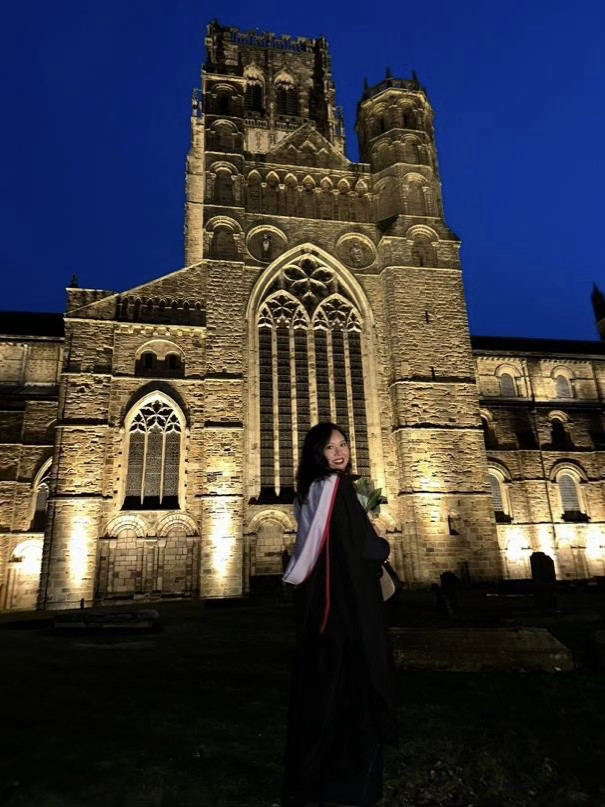
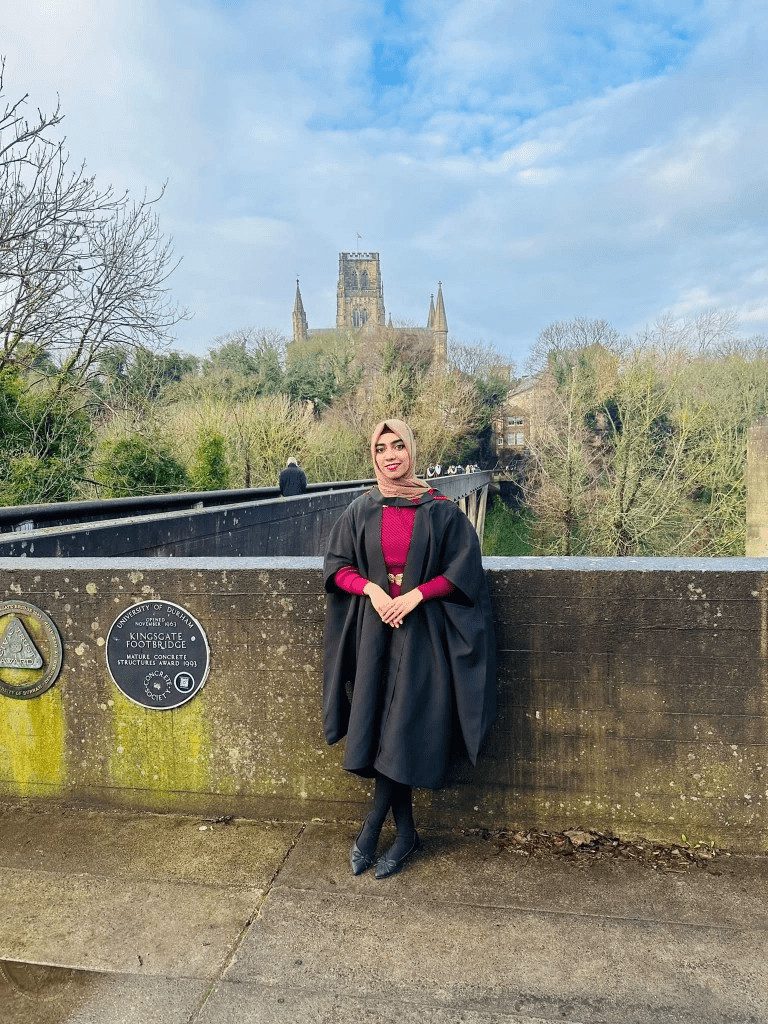
International students who received scholarships to study at Durham University, documented by Global Scholarships.


What Scholarship Recipients Say
Advice and insights from international students who successfully secured funding to study at Durham University.
"The scholarship provided 100% funding for my master’s degree at Durham University, including tuition fees and living expenses."
"It covered my tuition expenses, medical insurance, return flight tickets, and a stipend that took care of my accommodation and food."
"The MSc in Business Analytics offered a well-structured balance between technical rigor and business application."
"I completed Bachelor's in English Literature and went on to pursue an M.A. in Twentieth and Twenty-First Century Literary Studies at the University of Durham."
"To apply for the scholarship, all documents need to be prepared properly. The application needs to be written creatively and precisely, in a way that will make you stand out from the rest of the applicant pool."
"Durham University was a unique experience. At the beginning was challenging to adapt to a new culture, make new friends, and adapt to a new education system; however, I always remained positive, and after my first month, I was more adapted, and I really enjoyed studying there, especially in Durham, where they have this college system that allows you to make a lot of friends."
Frequently asked questions
Common questions about scholarships, admissions, and studying at Durham University.
Yes, Durham University Business School has scholarships for its Online MBA. However, most scholarships available at Durham University are for on-campus studies.
Durham scholarships and external scholarships used at Durham span a wide range of subjects, including business, STEM fields (including data and computing-heavy programs), engineering, social sciences, and humanities, often depending on the specific scholarship. The recipient stories show that range in practice: Shayan Rabbani studied Business Analytics, noting that “The MSc in Business Analytics offered a well-structured balance between technical rigor and business application,” while Maria Shawl pursued Twentieth and Twenty-First Century Literary Studies (humanities).
Medicine: Durham University does not currently have a Medical School, so scholarships for an undergraduate Medicine (MBBS) track at Durham are generally not applicable; however, Durham does have health-related study and research areas (for example, medical humanities and other health-focused disciplines). If you are specifically looking for an MBBS/MD route as an international student, you will likely need to target universities that actively run an accredited medical degree.
Many Durham-linked scholarships are open to international students from a broad set of countries, but nationality rules depend on the scholarship. In the GlobalScholarships.com Durham stories, Chevening funded students from Pakistan and India: Shayan Rabbani (Pakistan) and Maria Shawl (India).
Some funding is explicitly nationality- or region-specific (examples include scholarships aimed at eligible Commonwealth-country applicants), so the practical answer is: scholarships can be available for many nationalities, but you must filter by each scholarship’s eligibility rules.
Often, yes. Many applicants need to prove English proficiency, though waivers may apply depending on your prior education and program rules. In the Durham recipient stories, both students explicitly referenced IELTS: Shayan Rabbani said, “As part of the application process, I also took the IELTS exam,” and Maria Shawl shared, “I scored a 7.5,” adding that “since English was my academic background, I did not need to do extensive studying.”
Yes, but it is course-specific: Durham sets academic entry requirements by program, and some courses also require specific prior subjects. From the recipient stories, you can see the kind of academic profile that can be competitive: Maria Shawl reported a “GPA of 7.5” in her BA (Hons) in English before starting her MA at Durham, while Shayan Rabbani entered with a quantitative-and-business-oriented background (Economics plus analytics-relevant coursework) before starting his MSc in Business Analytics.
A strong academic record helps, but competitive scholarships are usually about more than grades: clear goals, fit with the program, and evidence you’ll create impact. Shayan Rabbani emphasized that “Chevening isn’t just about academics; it’s about demonstrating leadership potential, networking skills, and a vision for impact.”
In terms of “minimums,” treat them as scholarship-by-scholarship. For instance, Maria Shawl highlighted the importance of a compelling personal narrative and confidence, advising applicants to “Take chances with bolder choices and do not underestimate your potential.” A practical benchmark for scholarshisp especially is to aim for (1) meeting or exceeding your course’s entry requirements, and (2) producing scholarship materials that clearly connect your past work to your future plan.
Exact requirements depend on your course and whether you’re also applying for a scholarship, but common documents typically include academic transcripts/mark sheets, degree certificates (if completed), a personal statement or research proposal (where relevant), references, a CV (common for many postgraduate applications), passport ID details, and proof of English proficiency (if required).
The recipient stories underline how central the written materials can be: Maria Shawl said, “I worked hard on my essays,” and Shayan Rabbani described scholarship applications as requiring “careful reflection and precision” and recommended applicants “start your preparation early, build a strong and authentic story.”
It can depend on the level and department. Durham has an online payment portal specifically for postgraduate admissions application fees, and Durham guidance indicates some postgraduate routes (including certain Business School MSc programs) charge an application fee (for example, £60 is cited for Business School MSc applications in Durham’s postgraduate application guidance materials).
If you are applying for an undergraduate course, fees may also apply through the centralized application system used in the UK; always confirm the exact fee for your route and program before submitting.
There are many degrees that are open to international students right now — find yours.
About the Author: Hyun Lee


Leave A Comment