
How Ruth Mumpande, a Zimbabwean Scholar, Secured a Fully Funded Master’s Through the Chevening Scholarship
University: University of Sussex, United Kingdom
Degree: Master’s in Environment, Development and Policy
Previous Education: Bachelor of Science in Environmental Science and Health, National University of Science and Technology (NUST), Zimbabwe (Upper Second-Class Honours, 2.1); Special Honours Degree in Monitoring and Evaluation
Scholarship: Chevening Scholarship – Fully Funded (Tuition Fees, Monthly Living Allowance, and Travel Costs to and from the United Kingdom)
Social Media
LinkedIn: linkedin.com/in/ruth-mumpande/
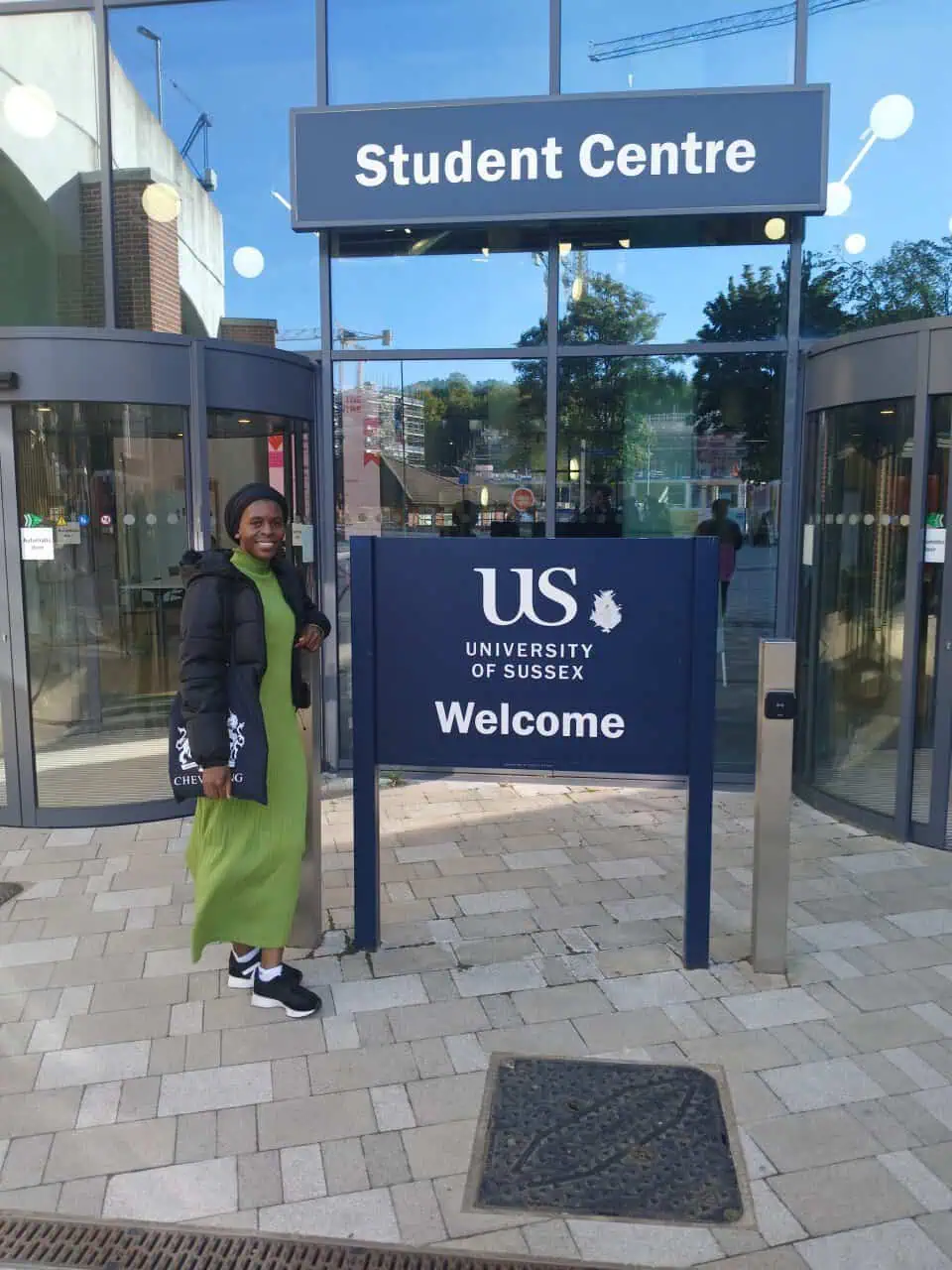
The Journey
My name is Ruth Mumpande, and I am from Victoria Falls, Zimbabwe. I am an environmental and development professional with a background in Environmental Science and Health and a strong interest in sustainable development, climate resilience, and inclusive development.
I pursued a Master’s degree in Environment, Development and Policy at the University of Sussex because I wanted to deepen my understanding of the relationship between environmental challenges, development policy and the institutions responsible for addressing them.
Through my work in local government, I gained practical experience in environmental management and protection. I wanted to complement that experience with a stronger understanding of the policies, political and economic factors, and financing mechanisms that influence development outcomes
Chevening Scholarship Details
I was awarded the Chevening Scholarship to pursue a one-year MA in Environment, Development and Policy at the University of Sussex in the United Kingdom.
Chevening is the UK government's international scholarship programme, which supports individuals with leadership potential to pursue postgraduate study at UK universities. Beyond academic qualifications, the programme provides an opportunity to develop leadership skills, build international networks and learn alongside people from diverse professional and cultural backgrounds.
The scholarship is fully funded and covered my university tuition fees, monthly living allowance and travel costs to and from the United Kingdom.
Receiving Chevening meant that I could pursue a postgraduate degree at my chosen institution while gaining access to a global network of scholars, professionals and alumni.
Educational Background
My academic background is rooted in Environmental Science and Health, a field that equipped me with an understanding of environmental management, public health, and the relationship between human well-being and the environment. I hold a Bachelor of Science degree in Environmental Science and Health from the National University of Science and Technology (NUST) in Zimbabwe, where I graduated with an upper second-class degree (2.1). My undergraduate studies provided the technical foundation for my interest in environmental protection, sustainable resource management and the environmental challenges affecting communities. I later obtained a Special Honours Degree in Monitoring and Evaluation, which complemented this background by strengthening my understanding of programme assessment and evidence-based decision-making.
Through my academic training and professional experience in local government, I became increasingly interested in understanding environmental challenges beyond their technical dimensions, particularly how development policies, institutions and financing mechanisms influence the solutions available to communities. This motivated me to pursue a Master’s degree in Environment, Development and Policy at the University of Sussex as a Chevening Scholar. The programme allowed me to build on my environmental science background while exploring the political, economic and institutional factors shaping environmental management and sustainable development, including climate change and access to climate finance.
How Did You Prepare to Apply to the University of Sussex?
How Did You Find Information About Chevening Scholarship and University of Sussex?
I began researching postgraduate scholarship opportunities while I was still completing my undergraduate degree. I knew that I wanted to study abroad, so I started exploring scholarships that aligned with my academic interests, professional goals, and aspirations for leadership and development.
I relied primarily on official scholarship and university websites to understand the eligibility requirements, application timelines, available courses, and expectations. I also followed Chevening alumni and engaged with online resources, including YouTube channels and platforms that discussed scholarships, university applications, and the experiences of previous scholars.
This preparation helped me become familiar with the process well before I submitted my application. It also enabled me to identify a course that genuinely aligned with my interests rather than choosing a university based on its name alone.
Did You Take Any Standardized Tests? If So, How Did You Prepare for Them?
I did not take any standardised tests for my application, as my existing academic qualifications met the requirements applicable to my application. Requirements can vary by university, course, and applicant, so I would encourage prospective students to check the specific requirements of their chosen institutions.
How Did You Prepare to Apply for the Chevening Scholarship?
My preparation for Chevening began well before I submitted my application. While completing my undergraduate degree, I researched postgraduate scholarships and identified Chevening as a strong fit because of its emphasis on leadership, networking, and the opportunity to study at a UK university of my choice.
I spent time understanding the scholarship's objectives and requirements, learning from previous scholars and following Chevening alumni whose experiences helped me better understand the application process. By the time I was ready to apply, I had already developed a good understanding of what the scholarship looked for in applicants.
I also benefited from having a Chevening alumnus in my network who reviewed my essays and provided feedback. That support helped me refine my responses and communicate my experiences and ambitions more clearly.
I was fortunate to receive the scholarship on my first application. Looking back, I believe early preparation, thorough research, seeking constructive feedback, and being intentional about my application all played important roles in that outcome.
How is Your Experience at the University of Sussex?
My experience at the University of Sussex was enriching both academically and personally. I had the opportunity to learn alongside students from different countries and professional backgrounds, which exposed me to diverse perspectives on environmental challenges, development and public policy.
The university community was welcoming, and I appreciated the opportunity to engage with lecturers and classmates who brought different experiences and ideas into discussions. Studying in such an international environment challenged me to question assumptions, think critically, and appreciate the complexity of development issues across different contexts.
One of the most valuable aspects of the experience was being able to connect academic debates with the realities I had encountered in Zimbabwe. My studies strengthened my interest in climate finance and the institutional factors that influence access to resources for climate action.
Overall, my time at Sussex helped me grow academically and personally, while giving me a broader perspective on the work I hope to contribute to in Zimbabwe.
What Did You Pursue After the Chevening Scholarship?
After completing my studies at the University of Sussex and submitting my dissertation, I returned to Zimbabwe and resumed my professional journey at Victoria Falls City Council, where I work in environmental health and municipal environmental management.
Returning to local government has given me an opportunity to reconnect with the practical realities of environmental management and consider how the knowledge and perspectives gained through my studies can inform my work.
My postgraduate studies also strengthened my interest in climate finance, development policy and research, particularly research that can inform decision-making and help address institutional barriers to climate action in Zimbabwe.
I am keen to explore research collaborations and opportunities to contribute to evidence-informed environmental and development policy, while continuing to support sustainable community development.
What Do You Think Made Your Application Stand Out?
I believe one of the most important strengths of my application was that I understood my own story and was able to communicate it authentically. Rather than trying to present myself as someone I thought the selection panel wanted to see, I focused on my experiences, the lessons I had learnt, the work I had contributed to, and the impact I hoped to make in the future.
I had also researched my chosen Master's programme thoroughly. I understood the modules I wanted to study, how they related to my professional interests and how the knowledge would support my longer-term goals. This enabled me to demonstrate a clear connection between my past experiences, my proposed studies and my future plans.
I also approached the application as an opportunity to reflect on my leadership journey and ambitions, rather than simply listing achievements. Having a Chevening alumnus review my essays helped me refine my responses and communicate my ideas more clearly.
Ultimately, I believe that authenticity, preparation, and a clear sense of direction helped strengthen my application. My experience taught me that a strong scholarship application is not only about what you have achieved; it is also about understanding why those experiences matter and how you intend to build on them.
What Would You Have Done Differently if You Were Going Through the Process Again?
I am satisfied with the preparation I put into my application and the outcome I achieved. Receiving the Chevening Scholarship on my first attempt was a significant milestone, and I appreciate the value of the preparation and support that contributed to it.
If I were to approach the process again, I would place even greater emphasis on documenting my experiences, reflecting on my leadership journey and seeking feedback early. These activities can help applicants identify the strongest examples from their experiences and communicate them more clearly.
My biggest lesson is that preparation should begin before the application window opens. The more you understand your own journey, your goals and the opportunity you are applying for, the better positioned you are to present a thoughtful and convincing application.
What Advice Would You Give Those Looking to Apply for a Similar Scholarship?
My first piece of advice is to start early. Do not wait until the application window opens to begin understanding the scholarship. Research the eligibility criteria, selection process, university options, and courses that align with your interests and career goals.
Second, take time to understand your own story. Reflect on the experiences that have shaped you, the challenges you have navigated, the initiatives you have contributed to, and the lessons you have learnt. Leadership does not always mean holding a senior position; it can also be demonstrated through taking initiative, mobilizing others, solving problems, and contributing to your community.
Third, research your chosen course thoroughly. Understand the modules, why the programme is relevant to your goals, and how you intend to use the knowledge after your studies. Your academic choices should connect logically with your professional journey and future ambitions.
Fourth, seek feedback. If possible, connect with Chevening alumni who can offer constructive advice, but remember that your application should reflect your own experiences and voice. Use feedback to strengthen your story, not to imitate someone else's.
Finally, be authentic and own your story. You do not need to have followed a perfect or extraordinary path to make a meaningful contribution. What matters is being able to reflect on your experiences, articulate what you have learnt, and explain how you intend to use the opportunity.
Prepare thoroughly, tell your story honestly, and be clear about the contribution you hope to make.
Want to submit your
scholarship journey?
Submit Your Story Here!
More Scholarship Recipients
My name is Van Nguyen, and I am from Vietnam. I hold a bachelor's degree in Data Science and am currently a master's student .... Read more
I am Dr. Tehmina Sheharyar, from Azad Kashmir, and I teach in the Department of Software Engineering at Mirpur University of .... Read more
My name is Idam Okechukwu Samuel, a 29-year-old Nigerian man. I hold a B.Sc. in Computer Science from the Federal University .... Read more
Leave A Comment