
How Hamed Tarboosh Secured a Fully Funded Master’s at JMU Würzburg Through a DAAD Scholarship
University: JMU Würzburg, Germany
Degree: MSc in Translational Neuroscience, DAAD 2026/27 award
Previous Education: Medicine, Latakia University, Syria (2025); GPA 90.06%, ranked 9th of 333
Scholarship: DAAD Master Studies for All Academic Disciplines Scholarship: full funding for two academic years, regular payment of €992 monthly, possible additional support, and a pre-master’s German course at IIK Düsseldorf
Other Offered Scholarships: Declined the fully funded Neurasmus Erasmus Mundus scholarship (€1,400 monthly throughout the master’s), with a proposed first year at the University of Bordeaux, France, and second year at Charité – Universitätsmedizin Berlin, Germany.
Social Media: LinkedIn
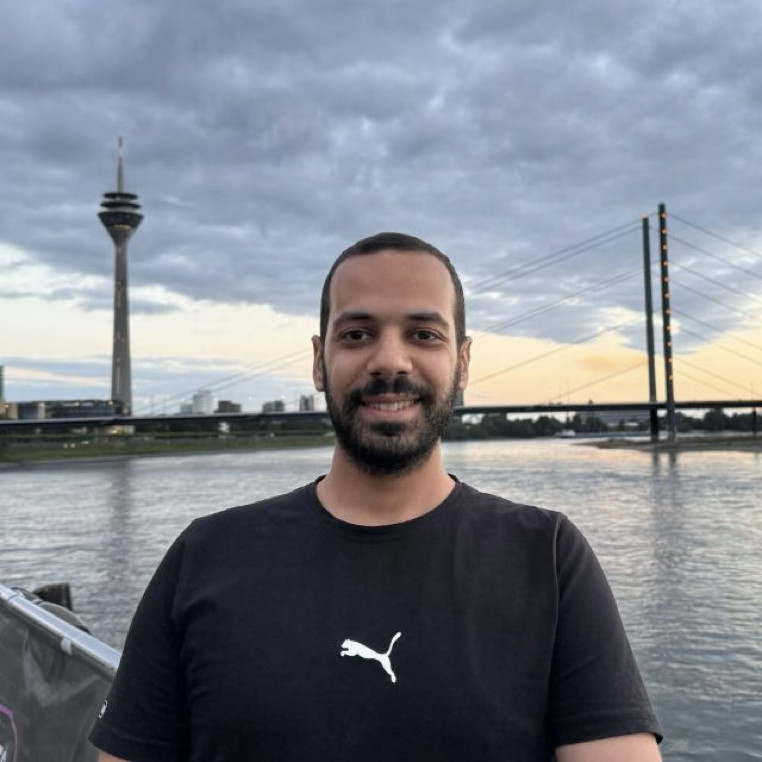
The Journey
My name is Hamed Tarboosh. I am a medical doctor who graduated from Latakia University, Syria, in 2025. I am a holder of the DAAD scholarship - Master Studies for All Academic Disciplines 2026/27 and am currently pursuing an MSc in Translational Neuroscience at JMU Würzburg, Germany. This master’s program is a patient-oriented research program with a broad focus on diagnostic, therapeutic, and basic aspects of neurological and psychiatric health and disease. As a neurology enthusiast planning for a career as an academic-clinician, this program was the logical step after my bachelor’s, as it is highly clinically relevant and enriching for neurologists/psychiatrists.
DAAD Master Studies for All Academic Disciplines Scholarship Details
The DAAD is short for Deutscher Akademischer Austauschdienst (The German Academic Exchange Service). It is a governmental office that is one of the largest scholarship-awarding bodies globally. The DAAD offers hundreds of different short- and long-term scholarships for both Master’s and PhD studies. My specific scholarship program is called “Master Studies for All Academic Disciplines.” This scholarship includes full funding for two academic years (the duration of most German Master’s programs).
The regular payment is €992 a month, but there are many opportunities for additional financial support (such as rent subsidy, partner/child allowance, etc.). On top of that, and depending on nationality, this program offers two to four months of free German language courses prior to the start of the Master’s program in an institution of DAAD’s selection (mine was IIK Düsseldorf).
Other Offered Scholarships
I was also offered the European Master of Neuroscience (Neurasmus) scholarship, which is part of the Erasmus Mundus Joint Master Degrees, where I would have studied my first year at the University of Bordeaux, France, and the second year at Charité – Universitätsmedizin Berlin, Germany. This is also a fully funded scholarship with a monthly allowance of €1,400 a month for the full duration of the Master’s program. The program is an amazing, highly rigorous academic experience, and my decision to prioritize the DAAD scholarship was based on personal reasons.
The Neurasmus programme’s partner universities are the University of Bordeaux (France); Charité – Universitätsmedizin Berlin (Germany); University of Galway (Ireland); UMG Universitätsmedizin Göttingen (University of Göttingen) (Germany); Université Laval (Canada); University of Coimbra (Portugal).
Educational Background
Prior to my master’s degree, I studied medicine at Latakia University, Syria, and graduated with a GPA of 90.06%, ranking 9th out of a cohort of 333 students. Since my current program is highly clinically oriented, studying medicine has not only taught me much about relevant topics (such as neuroanatomy/physiology, psychology, neurology, psychiatry, etc.), but it has also given me a clinician’s perspective, as I was in continuous contact with patients, listening to their complaints and understanding how neurological disease impacts their daily lives.
This perspective is invaluable and directly contributes to my research interests and focus. It is important to say, however, that medical studies do not prepare you enough for wet lab work, but it is very feasible to catch up with the support of peers and educators through lab rotations, internships, or even unofficial visits to the lab planned with the primary investigator.
How Did You Prepare to Apply for JMU Würzburg?
How Did You Find Information About DAAD Master Studies for All Academic Disciplines Scholarship and JMU Würzburg?
Information about institutions in Germany can be easily found using the search engine on the DAAD website. There you can find an extensive list of all available degree programs. After that, it is highly important to read the websites of those individual programs very closely to verify whether you meet their requirements, and to develop a better understanding of what the program has to offer and whether this goes in line with your goals. Other than that, a simple Google search using keywords often yields the same results (and sometimes, even more).
Did You Take Any Standardized Tests? If So, How Did You Prepare for Them?
During my application process, I had to take the IELTS exam to prove my English language proficiency. To prepare for that, I mainly used YouTube, specifically the channel IELTS Advantage. My English level was already good enough, so I only needed to focus on exam strategies. This approach may be irrelevant if you need to increase your English language level.
How Did You Prepare to Apply for the DAAD Master Studies for All Academic Disciplines Scholarship?
Preparing for scholarships is a lifelong process that begins with a motivation to always grow, learn more skills, and take every opportunity to become a better version of yourself (whether it was academically, professionally, socially, etc.). This may include work, volunteering, entrepreneurship, and many other areas that differ between people.
All of these experiences give you the raw data and material to create a powerful narrative that is able to convince a selection committee. Preparing the documents is highly variable depending on the scholarship, but relatively easy once you do the work of self-reflection and planning. In this process, getting feedback from previous scholarship holders, peers, and even family is incredibly important and should never be skipped.
It is also very wise to begin early; starting months before the deadline will give you a lot of time to perfect your application. In general terms, the motivational letter, for example, should follow a similar order: a personal anecdote on why you are interested in the field, your previous experience in the field, why you are applying for the program/scholarship, your future plans, and a short summarizing statement.
How Is Your Experience at JMU Würzburg?
My experience so far at JMU Würzburg is one of the best phases of my life. The program is very rich and builds on so many hard and soft skills in a very supportive environment designed to avoid burnout or overwhelming students. The cohort is very small, which gives you a real chance of building meaningful connections and learning from each one of your peers. The university also has a sports center where you can take part in various activities depending on your interests. On top of that, the city of Würzburg is a relatively small, lively student city with so much to do. The locals are friendly, and the Franconian history is very evident in every corner of the city’s architecture.
How Do You Rate JMU Würzburg Academically and Why?
JMU Würzburg (founded in 1402) is a university with a very old heritage and 15 Nobel Prize awardees to date. Researchers at this university have brought to the world so many inventions essential for our lives today, like X-rays. Prominent researchers have studied and worked at JMU Würzburg, such as Korbinian Brodmann, whose work on mapping brain cortices still influences neuroscientists to this day.
The university also has a lot of connections with German and international research centers and industry, offering its graduates countless professional prospects. My program “MSc Translational Neuroscience” is also part of the Elite Network Bavaria, which supports students and researchers of different institutions in the German state of Bavaria (Bayern).
How Does JMU Würzburg Support International Students?
In addition to the aforementioned support, JMU Würzburg has a dedicated International Office that is responsible for supporting international students with every single aspect of living in Germany (such as accommodation, work, bureaucratic processes, etc.). The university also offers free German classes to all interested international students through its Center of Languages (ZFS).
Are Your Classes Conducted in English?
The program MSc Translational Neuroscience, alongside many other degree programs in Germany, is taught completely in English.
What Did You Pursue After the Scholarship?
After my Master’s degree, I plan to pursue a PhD while also working as a medical doctor and pursuing a neurology residency.
Would Students Have Academic Problems Without Knowing German?
Fitting in the academic community without any German knowledge is possible. However, some degree of proficiency is highly recommended for daily life (such as groceries, making friends, understanding train announcements, etc.).
What Do You Think Made Your Application Stand Out?
I believe that having a very clear and feasible plan helped very much in making my application stand out. Throughout all of the documents, the selection committee could clearly see my short-term and long-term goals, my previous experience, and the skills I want to learn as a student in their program. Selection committees do not look for amazing, outstanding people who have already accomplished everything in life; rather, they are looking for highly motivated people who are self-aware and consistent: The degree to which you reflect that in your application is directly linked to higher chances of admission, or at least an invitation for an interview.
What Would You Have Done Differently?
I would have definitely been more focused during my bachelor's studies on gaining the skills that are particularly relevant for the field I plan to pursue. Having a broad skill set is of course a big advantage, but at some point, you have to be more selective regarding how and where you invest your time and energy. When it comes to scholarship applications, less is more. Focusing on what really matters helps you bind all your experiences together in a tightly coherent narrative that would be irresistible for evaluators.
What Advice Would You Give Those Applying for a Similar Scholarship?
- Trust yourself: The process of scholarship applications is a lengthy, lonely process full of self-doubt, disappointments, and rethinking everything. Nobody who was ever awarded a scholarship was sure that they would indeed get it. An idea that helped me in such moments of doubt is: If I apply, there is a very small chance I will get the scholarship, but if I don’t, I am 100% guaranteed not to get it. A small chance is a lot better than nothing.
- Compare yourself with yourself only: Your only goal is to be a better version of yourself every day. During your scholarship application process, you will meet a lot of other applicants who will seem a lot more advanced and accomplished than you are. It is very important not to let that discourage you, because you never know what selection committees are really looking for. Their advantages over yours might be a lot less significant in the eyes of evaluators than you think.
- Do not neglect the importance of self-reflection: I know documents are very important and preparing your personal statement, resume, etc. as soon as possible is highly appealing. But all of those documents are just words. The real work is getting to know yourself, asking yourself the deep questions, and facing your insecurities and knowledge/skill gaps. Being aware of all that will make the process of preparing documents incredibly easier.
Want to submit your
scholarship journey?
Submit Your Story Here!
More Scholarship Recipients

My name is Khola Aarif, and I'm from Pakistan. I completed a Master's in International Trade at Shandong University in China .... Read more
My name is Javier Ivan Batista Saturno, and I am from Chitré, a small town in the Panamanian countryside. For my undergradu .... Read more
My name is Issatay Jaxykeldinov. I’m from Almaty, Kazakhstan, and I’m a third-year Integrated BBA student at The Chinese .... Read more
Leave A Comment