
King’s College London Scholarships for International Students 2027
Funding at King’s College London can be easier to navigate when you start with the most generous options. Below is a shortlist prioritized by the level of support.
University scholarships associated with King’s College London often form the core of an applicant’s funding plan. Here are a few notable options to review first. A strong option is Global Health and Social Medicine Postgraduate Scholarship which is partially funded and often covers £11,760 tuition fee assistance.
In addition to university awards, students connected to King’s College London may also consider government and external scholarships. Here are a few widely relevant options. Marie Skłodowska-Curie Actions is commonly categorized as fully funded support, and coverage that often includes living stipend, mobility allowance, and special needs, leave, and and/or family allowance (if applicable). With Saïd Foundation Scholarship, students may receive fully funded support, and coverage frequently includes full tuition, living and maintenance costs, and arrival allowance. Commonwealth Master’s Scholarships is a fully funded award, and the listed benefits often include full tuition fees, living allowance of up to £1,378 per month and £1,690, and clothing allowance.
You can find more university scholarships and external or government scholarships further down on this page.
King’s College London Scholarships for International Students
The scholarships at King’s College London can help fund your study expenses. There are currently 9 scholarships being offered to international students at the King’s College London, all with varying requirements, benefits, and application processes. We have compiled them in this list to help you find the scholarship that best fits you.
Graduate Scholarships
External Scholarships
There are many degrees that are open to international students right now — find yours.
King’s College London Admissions
Here are the official admission pages for King’s College London:
| Degree | Admissions Pages |
|---|---|
| Bachelor's | International Students Admissions Page |
| Master's | International Students Admissions Page |
King’s College London Application Deadlines
| Degree | Admission Deadline |
|---|---|
| Bachelor's (September Intake) | January 13, 2027 |
| Master's | March 9, 2026 Different Master's programs have different deadlines |
Tuition Fees at King’s College London for International Students
Indicative annual tuition fee ranges for international students at King’s College London. Exact fees vary by program, so always confirm the current cost on the university's official tuition fee pages.
| Degree Level | Typical Annual Range |
|---|---|
| Bachelor's Tuition | 29,000 – 38,300 GBP |
| Master's Tuition | 30,000 – 43,000 GBP |
Please note that tuition fees can vary based on the specific program you choose. For the most accurate and current fee information, consult the official tuition fee pages linked above.
King’s College London Scholarship Recipients
International students who received scholarships to study at King’s College London, documented by Global Scholarships.




What Scholarship Recipients Say
Advice and insights from international students who successfully secured funding to study at King’s College London.
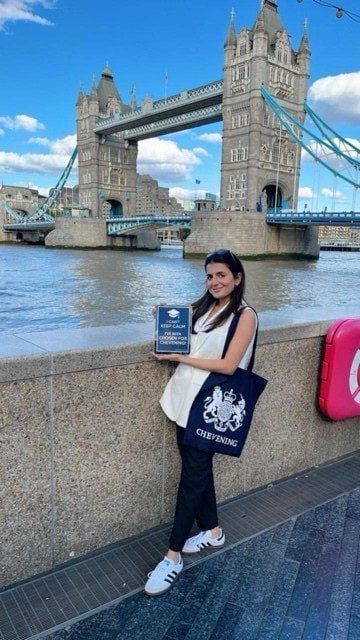
"In 2024, I was awarded the Chevening Scholarship, the UK government’s prestigious global scholarship funded by the Foreign, Commonwealth and Development Office (FCDO). The scholarship fully funded my Master of Public Health (MPH) at King’s College London in the UK, covering tuition fees, travel costs, visa fees, and a monthly stipend."
"Your uniqueness is your superpower! Don’t try to be someone else. Own your story and tell it with pride. Often, the smallest things you’ve done hold the biggest impact, and those are exactly what you should highlight in your application."
"Thanks to the prestigious Chevening Scholarship, I am pursuing my Master’s in Stem Cells & Regenerative Therapies: From Bench to Market at King’s College London."
"After ensuring I met all entry requirements, including IELTS (where I achieved an overall 7.5) and filtering my options, King’s College London stood out for its "Bench to Market" approach, blending stem cell research with commercialization that perfectly aligns with my goals."
"All these elements, academic achievement, clinical experience, and an interest in the social dimensions of health, ultimately led me to pursue postgraduate training in Public Health, where my Chevening-funded master’s programme allowed me to deepen my skills in epidemiology, research methods, health promotion, and global public health."
"Hello! I’m Nusyba Bushra. A proud Sudanese medical laboratory scientist, entrepreneur, and now a Chevening Scholar pursuing breakthroughs in Stem Cell Therapy at King’s College London."
Frequently asked questions
Common questions about scholarships, admissions, and studying at King’s College London.
Yes, King’s occasionally has scholarships that are explicitly tied to an online programme (for example, School of Security Studies & Public Policy “SSPP Online Scholarships” for an online MSc International Development, when available).
Across a wide range, medicine/health, engineering, business, STEM (computer science, AI, life sciences), humanities/arts, law, social sciences, and more. King’s funding database lists subject-area filters spanning everything from “Medicine” and “Engineering” to “Law,” “Management,” and “Arts, culture and media.”
To make it concrete, KCL scholarship recipients on Global Scholarships include Dr. Laeequa (Public Health/MPH) and Nusyba Bushra (Stem Cells & Regenerative Therapies—STEM/biomed), who chose King’s partly for its “Bench to Market” approach. For medicine specifically: international students can apply to the standard Medicine MBBS route, but some medicine pathways (e.g., Healthcare Entry Medicine MBBS) are restricted to Home-fee applicants only, so always check the exact medicine programme page before assuming eligibility.
- Medicine & health: Public health, nursing, therapeutic health, specialist medical training; Medicine MBBS (international applicants accepted on the main route, with course-specific conditions).
- Engineering & STEM: Engineering, computer science, AI, physics, maths, biomedical/life sciences and related PhD studentships.
- Business: Management, finance, and business-school scholarships (often with their own criteria).
- Humanities & social sciences: Arts & humanities studentships, law, policy, international affairs, languages, and more.
It depends on the scholarship: some are open to “Overseas” (international) students broadly, some are Home-only, and others target specific countries/regions. King’s funding database explicitly labels opportunities by eligibility such as “Home” vs “Overseas” and sometimes names a specific applicant residency (e.g., “Chile”).
Real examples from scholarship recipients: Dr. Laeequa (South Africa) and Nusyba Bushra (Sudan) both studied at King’s on the Chevening Scholarship; Chevening requires you to be a citizen of a Chevening-eligible country/territory and meet additional criteria such as a work-experience requirement.
Often yes, unless you meet King’s accepted exemptions/qualifications. King’s publishes English language requirements for both undergraduate and postgraduate entry and accepts major tests (including IELTS and TOEFL) with banded score requirements that vary by faculty/programme; results typically must be recent (within the stated validity period) and provided as a single test sitting.
This matches what recipients experienced: Dr. Laeequa said, “I was required to complete the IELTS Academic exam,” and Nusyba Bushra noted she met requirements with “IELTS (where I achieved an overall 7.5).”
Yes, minimum academic entry requirements exist, but they vary by programme and level. King’s academic regulations set baseline minima for taught postgraduate study (at least a UK second-class honours degree or equivalent), while competitive programmes can be higher and may include extra requirements (tests/interviews). And competitively, recipients often exceed minima: Nusyba Bushra shared, “I graduated top of my class with a 4.97/5.0 cGPA.”
In practice: (1) meet the course entry requirements, (2) show strong academics, and (3) demonstrate fit with the scholarship’s goals (leadership, impact, subject alignment). Many awards also require evidence like references, a strong personal statement, and sometimes interviews.
For Chevening specifically (used by KCL recipients above), eligibility includes being a citizen of a Chevening-eligible country/territory, committing to return home for two years, and meeting a work-experience threshold (2,800 hours). On the “what actually wins” side, Nusyba Bushra sums up the tone well: “Your uniqueness is your superpower!”
Undergraduate (via UCAS): King’s states your UCAS application includes a personal statement, full education history, and a reference; then you may need to upload extra items in King’s Apply such as transcripts (where applicable), official translations, and English test results (IELTS/TOEFL) depending on your case and course.
Postgraduate taught: King’s commonly asks for documents such as your degree certificate and transcripts and typically requires two academic references; exact requirements can vary by course (some ask for a CV, portfolio, writing sample, or other evidence).
From a recipient perspective, Dr. Laeequa described her prep as: “I gathered my academic documents, refined my personal statements,” and for Chevening, she emphasised writing “the four required Chevening essays.”
Undergraduate: Yes, UCAS charges a “small fee,” but King’s says it does not charge UCAS applicants an additional application fee.
Postgraduate: Often yes, King’s notes that most postgraduate courses require a non-refundable application fee (the amount depends on the programme)
There are many degrees that are open to international students right now — find yours.
About the Author: Hyun Lee


By Allah’s grace I will surely read medicine at King’s College London.
Best of luck!