
My British Council Women in STEM Scholarship Journey: From Pakistan to Research in the UK
University: Coventry University
Degree: PhD in Computational and Mathematical Modelling of Biological Systems
Previous Education: Master’s by Research, Coventry University; Bachelor’s in Biomedical Sciences, Pak-Austria Fachhochschule: Institute of Applied Sciences and Technology
Scholarship: British Council Women in STEM Scholarship – Fully Funded (Tuition Fees, Monthly Living Stipend, Return Travel, Visa and Health-Related Costs, English-Language Support)
Social Media
The Journey
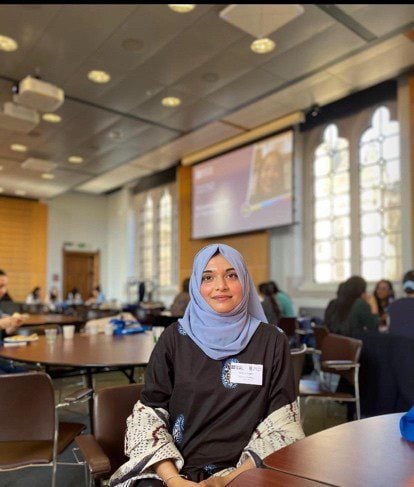
My name is Mashaal Nageen, and I am from Pakistan. My academic background is in Biomedical Sciences, and my main interests are healthcare, microbiology, research, and the use of science to solve real healthcare problems.
My interest in healthcare actually started with a dream of becoming a doctor. I attempted the MBBS admission test twice, but I narrowly missed the opportunity. It was disappointing at the time, but I did not want that setback to stop me from working in healthcare. I decided to study Biomedical Sciences because I wanted to understand human health and disease from a scientific and research perspective.
I completed my Bachelor’s degree in Biomedical Sciences from Pak-Austria Fachhochschule: Institute of Applied Sciences and Technology, Pakistan. During my degree, I became particularly interested in microbiology and the relationship between microorganisms and human health.
My final-year research project focused on the characterization of bioactive compounds from Periplaneta americana with potential to help tackle antibiotic resistance.
I also had exposure to areas such as bioinformatics during my undergraduate studies, as well as practical experience through internships and research. Outside academics, I was involved in activities including the Zindagi Prize, Hult Prize and the Fachhochschule Youth Entrepreneurial Society, which helped me develop communication, teamwork and leadership skills.
After my Bachelor’s degree, I wanted to continue developing my research skills. This led me to apply for a Master's by Research at Coventry University in the UK. My project was titled “Lowering the Cost of Healthcare: Analysis of Gastrointestinal Microbiome.”
The project interested me because it connected my existing knowledge of biomedical sciences and microbiology with computational and mathematical approaches. My research journey eventually continued beyond the MRes, as I progressed to a PhD at Coventry University.
Today, my research focuses on computational and mathematical modelling, particularly structural identifiability and its application to biological systems and gut microbiome interactions.
British Council Women in STEM Scholarship Details
I received the British Council Women in STEM Scholarship to study at Coventry University in the United Kingdom. The Women in STEM Scholarship programme was launchedbytheBritishCouncilin2020toincreaseopportunitiesforwomeninscience, technology, engineering and mathematics (STEM), particularly women who may not otherwise have the financial opportunity to study in the UK.
The scholarship supports one-year postgraduate study in the UK. It is a fully funded scholarship and covers major costs such as tuition fees, a monthly living stipend, return travel to the UK, visa and health-related costs, and English-language support such as IELTS where needed. Some rounds also cover other essential study-related costs.
The scholarship covers a wide range of STEM subjects rather than one specific field. Depending on the universities and projects available each year, these can include areas such as artificial intelligence, computer science, mathematical and computational modelling, engineering, healthcare-related research, climate change, sustainable energy and energy transition. The exact courses, universities and eligible countries can change from year to year.
Coventry University joined the programme to offer fully funded Master by Research (MRes) opportunities for women from South Asia. Its first cohort started in the 2023/24 academic year, with six scholars studying at Coventry. The research opportunities were based mainly within the Centre for Computational Science and Mathematical Modelling (CSMM) and other centres. For the 2024 round, eligible applicants included women from Bangladesh, India, Nepal, Pakistan and Sri Lanka, with the MRes programmes starting in September 2024.
My own scholarship was a fully funded MRes within CSMM. My research project was titled “Lowering the Cost of Healthcare: Analysis of Gastrointestinal Microbiome.” It was especially interesting to me because it connected my previous background in Biomedical Sciences and microbiology with new areas such as mathematical modelling and computational research.
For me, receiving this scholarship was extremely important because studying in the UK would have been financially very difficult for my family without full funding. My family had already made significant sacrifices for my education, including borrowing money to support my undergraduate studies.
I was also the first girl in my family to study abroad, so receiving the scholarship was not only an academic achievement but also a very meaningful personal milestone. It gave me the opportunity to continue my education in the UK, move into a new interdisciplinary area of research, and eventually progress from my MRes to a PhD.
Were You Offered Any Other Scholarships?
The British Council Women in STEM Scholarship was the scholarship through which I was funded for my postgraduate studies at Coventry University.
For future applicants, I would recommend not assuming that you need to have several scholarships or awards to be competitive. What matters more is how well your academic background, experience, motivation, and future plans fit the opportunity.
Educational Background
I completed my Bachelor’s degree in Biomedical Sciences from Pak-Austria Fachhochschule: Institute of Applied Sciences and Technology, Pakistan.
During my degree, I studied subjects including microbiology, immunology, human biology, clinical parasitology, host–pathogen interactions, and microbial physiology. These subjects gave me a strong foundation for understanding microorganisms, human health and disease.
I also became interested in the human microbiome through my academic studies, workshops and seminars. I was introduced to bioinformatics during my undergraduate degree as well, which gave me some early exposure to using computational tools alongside biological research.
My final-year research project gave me practical research experience. I worked on the characterization of bioactive compounds from Periplaneta americana and their potential antibacterial activity, with the wider aim of contributing to research related to antimicrobial resistance. Through this project, I developed laboratory skills, learned how to work more independently, and gained a better understanding of the research process.
I also completed internships in areas including biotechnology, pharmaceutical quality assurance, and medical diagnostics. These experiences helped me see how scientific knowledge can be applied to real healthcare and laboratory settings.
Overall, my undergraduate education prepared me for postgraduate research in two ways: it gave me the biological knowledge needed to understand the research problem, and it gave me my first experience of carrying out research independently. This made the gastrointestinal microbiome project at Coventry feel like a natural next step, even though the mathematical and computational side was completely new to me.
How Did You Prepare to Apply to Coventry University?
I started by researching universities and postgraduate opportunities that matched my academic background and interests. Because I wanted to do research, I did not look only at university rankings or the university name.
For each opportunity, I looked at:
- the research project itself;
- the research centre;
- the research interests of the potential supervisors;
- the university’s entry requirements;
- whether my previous degree was relevant to the proposed research; and
- whether the project fitted with my longer-term goals.
When I found the Coventry opportunity, the project immediately interested me because it focused on the gastrointestinal microbiome. I already had a background in Biomedical Sciences, microbiology, and human health, so I could see a clear connection with the biological side of the project.
The mathematical and computational side was completely new to me, but instead of seeing that as a reason not to apply, I saw it as an opportunity to develop new skills. I also looked into the research carried out by the supervisors and the Centre for Computational Science and Mathematical Modelling (CSMM) so that I could understand the environment I would be joining.
For a research degree, I think this is especially important. You are not only choosing a university; you are choosing a project, supervisors and a research environment that you may be working with very closely.
My advice to applicants would therefore be: do not choose a university only because it is in the UK or because of its ranking. Research the actual project and the people you may be working with.
Also, always check the scholarship information for your own year. Participating universities, eligible countries, available programmes and deadlines can change from one scholarship round to another.
Did You Take Any Standardised Tests?
Yes. I took the IELTS test as part of my preparation for studying in the UK.
I prepared for all four sections: listening, reading, writing and speaking. I used practice materials to understand the exam structure and to improve my performance.
I had already studied in English throughout my undergraduate degree, but IELTS was still useful because it required me to prepare specifically for an English-language proficiency examination. For my IELTS preparation, I mainly used online practice tests and mock exams. One resource that I personally found very helpful was IELTS Online Tests, because it allowed me to practise the different sections in a format similar to the actual test.
I did not take tests such as the SAT, ACT, GRE or GMAT because they were not required for my programme.
One useful point for future applicants is that English-language requirements can differ between universities and programmes. The British Council requires applicants to meet the English- language requirements of the university they are applying to.
The scholarship programme has also included support for IELTS costs in its funding arrangements, although applicants should check the rules for their particular year and country.
How Did You Prepare to Apply to the British Council Women in STEM Scholarship?
I think this was one of the most important parts of my application.
I first tried to understand what the Women in STEM Scholarship was actually looking for. I did not want to write an application that only talked about how much I wanted to study in the UK.
I focused on connecting four things: My past → my current interests → the programme I was applying for → my future goals.
For example, I had studied Biomedical Sciences and developed an interest in microbiology and healthcare. My undergraduate research gave me experience with scientific research. Then I found a postgraduate research project involving the gastrointestinal microbiome, which connected naturally with my background.
At the same time, I explained why I wanted to learn computational and mathematical approaches and how these could help me work on healthcare problems.
I also researched the subject before starting the project. Since differential algebra and structural identifiability were new areas for me, I used online resources and academic papers to begin understanding them.
This is something I would strongly recommend to applicants: do not wait until you are selected to learn about the subject you are applying for. You do not need to become an expert, but showing genuine curiosity and preparation can make your application much stronger.
The British Council’s own criteria show that the scholarship is not simply about academic results. Applicants are expected to demonstrate financial need, academic ability, active interest or experience in STEM, future contribution to their home country, and a plan to encourage other women and girls in STEM.
My Selection Process
For my application, the process did not end after submitting the application. I first tried to make sure that my application clearly explained not only my academic background, but also my financial circumstances, motivation, future goals and the wider impact I hoped to create through the opportunity.
I was then given an exercise to complete, which was related to the research opportunity.
Since the mathematical side of the project was new to me, this was also a chance to show that I was willing to learn and engage with a subject outside my original background. After completing the exercise, I was invited for an interview.
During the interview, I had the opportunity to discuss my academic background, my interest in the project, why I wanted to move into this area of research, and how the opportunity connected with my future goals. I also tried to show that the scholarship would not only benefit me personally, but would help me develop skills that I could later use to contribute to healthcare research and encourage other women to continue in STEM.
One thing I would also suggest, especially if you are applying for a project outside your main academic background, is to prepare for some technical questions during the interview. For example, if your background is similar to mine—mainly biological rather than mathematical or computational—you may be asked to work through a small mathematics problem, explain your reasoning, or complete a simple coding task during the interview.
I would not worry about already being an expert. It is more important to prepare the basic concepts related to the project, practise explaining your thinking clearly, and be willing to attempt the problem even if it is outside your usual area. The exact interview process can depend on the university, supervisors, and research project, so applicants should not assume that every interview will include a mathematics or coding test.
After the interview, I received the result and was offered the scholarship.
After receiving my offer, there were also some important administrative steps before coming to the UK. In my case, I had to apply for an Academic Technology Approval Scheme (ATAS) certificate. This was separate from the scholarship selection process and was required before I could begin my research in the UK.
I would recommend that international students check the requirements as soon as they receive their offer, because processes such as ATAS can take additional time. ATAS is only required for certain postgraduate courses and research areas, so whether you need it will depend on your particular programme.
How Was Your Experience at Coventry University?
My experience at Coventry University has been one of the biggest learning experiences of my academic life.
I came from a Biomedical Sciences background, so some parts of my research were completely new to me. I had to learn mathematical modelling, differential algebra, structural identifiability, and programming.
There were definitely challenging moments, especially when I was learning mathematical concepts that I had not studied deeply during my undergraduate degree. But it also taught me something very important: you do not have to already know everything before starting a research project. You need to be willing to learn. Another thing that made a big difference for me was the support I received from my supervisors and from everyone at CSMM. Since I was moving into an area that was quite different from my undergraduate background, having people around me who were willing to guide me, answer my questions, and help me learn made the transition much easier.
The centre has also been very supportive of my development outside my day-to-day research. For example, if there are opportunities to attend conferences, workshops or other academic activities, the centre encourages us to take part and helps us find ways to make those opportunities possible.
This has given me the chance to develop not only as a researcher, but also through presenting my work, meeting other researchers and becoming more involved in the wider research community.
My research allowed me to combine biology, healthcare, mathematics and computational science.
Another major development was that my journey did not end with the MRes. I progressed from the MRes to a PhD at Coventry University, allowing me to continue developing my research interests.
Coventry’s Women in STEM programme also provided scholars with opportunities for researcher development and access to the wider postgraduate research community. The university has highlighted its Doctoral College support, researcher development opportunities and research partnerships as part of the experience for its Women in STEM scholars.
How Do You Rate Coventry University Academically and Why?
Academically, I have had a very positive experience at Coventry University, particularly because of the interdisciplinary nature of the research.
I came from a mainly biological and biomedical background, but at Coventry I was able to combine this knowledge with mathematics, computational science, and programming. This completely changed the way I approached research. I learned that a healthcare problem does not always need to be studied from only one discipline.
Another important part of my development has been becoming a much more independent researcher. During a research degree, you have to learn how to read critically, identify problems, ask the right questions, try different approaches, and continue working when something does not immediately work.
At the same time, independence does not mean working completely alone. Having supportive supervisors and a good research environment has helped me develop the confidence to work independently while still knowing when to ask for guidance.
For me, this combination of independence, interdisciplinary research, and academic support has been one of the strongest parts of my experience at Coventry.
How Does Coventry University Support International Students?
Moving from Pakistan to the UK was a major change for me.
As an international student, I had to adjust not only to a different academic environment but also to a different country and culture.
Coventry has a diverse student community, which helped me meet people from different backgrounds. The university also provides student and academic support services that international students can use when adjusting to university life.
For me, academic support has been particularly important because my research involves areas that were new to me.
I would also advise international students not to be afraid to ask for help. Coming to another country does not mean that you are expected to know everything immediately. It takes time to adjust, and asking questions is part of the process.
What Did You Pursue After the Scholarship?
The scholarship became the beginning of a much longer academic journey for me.
I originally came to Coventry University for my Master's by Research. After the MRes, I progressed to a PhD at Coventry University.
My current research focuses on computational and mathematical approaches to biological systems, particularly structural identifiability and mathematical modelling of interactions within the gut microbiome.
One of the main ideas behind my research is that before researchers spend significant time and money conducting laboratory experiments, mathematical models can be analysed to determine whether the parameters of interest can actually be identified from the available observations.
This connects with my original motivation of wanting to contribute to more efficient and potentially lower-cost healthcare research.
For me, this is one of the biggest outcomes of the scholarship: it did not simply help me complete a degree. It helped me discover a research direction that I wanted to continue pursuing.
What Do You Think Made Your Application Stand Out?
Looking back, I think there were several things that helped my application.
1. I had a clear academic journey
My journey was not completely straightforward, but there was a clear connection between my experiences.
I started with an interest in medicine, moved into Biomedical Sciences, developed an interest in microbiology and research, worked on antibiotic resistance during my undergraduate project, and then moved towards microbiome research and computational modelling.
2. I had research experience
My undergraduate project showed that I already had experience working on a scientific problem rather than only studying theory.
3. I was willing to learn outside my background
I did not have a strong mathematics background, but I did not see that as a reason not to apply. I was interested in the healthcare problem and was willing to learn the mathematical and computational methods needed for the project.
As part of my preparation, my supervisor shared some resources with me to help me understand the mathematical side of the research, particularly topics related to differential algebra and mathematical modelling. One of the resources I studied was Brian Ingalls’ book Mathematical Modelling in Systems Biology: An Introduction. I also started reading about structural identifiability and how mathematical models can be used to study biological systems.
At that stage, many of these ideas were completely new to me, and I certainly did not understand everything. However, studying the material before starting the project helped me understand what the research involved and showed that I was genuinely interested and willing to learn outside my original background.
I think this is important for applicants to remember. You do not necessarily need to already know everything about the project. What matters is being able to show how your existing background connects to it and that you are willing to put effort into learning the skills you are missing.
4. I had experience beyond academics
I think my experiences outside my degree also helped strengthen my application. For example, my work at Quantum BioLabs gave me experience in science communication. I was also involved in activities such as the Zindagi Prize, Hult Prize and Fachhochschule Youth Entrepreneurial Society. Through these experiences, I developed skills in teamwork, communication, leadership, organisation and problem-solving.
I think this is useful for scholarship applicants to remember. Your application does not have to be based only on grades and academic achievements. Experiences outside the classroom can also show your initiative, communication skills, teamwork and willingness to contribute to a wider community. The important thing is not just to list these activities, but to explain what you actually learned from them.
5. I had a genuine financial need
Financial need was an important part of my application, and I tried to explain it honestly rather than simply saying that studying abroad was expensive.
Financial difficulties had been part of my educational journey for a long time. I had received fee support earlier in my education, and my parents worked very hard and made significant sacrifices to support my studies. At different stages, they also had to borrow money to help cover my educational expenses.
Because of this, pursuing postgraduate study in the UK would have been extremely difficult for my family without full funding. The British Council Women in STEM Scholarship therefore did not simply make studying abroad easier for me; it made the opportunity realistically possible.
I think applicants should be honest and specific when explaining financial need. You do not need to make your situation sound dramatic, but you should clearly explain why the funding matters and what difference receiving the scholarship would make to your education and future plans.
6. I had a reason for applying beyond “studying abroad”
I think another important part of my application was that I was not applying simply because I wanted to study in the UK. I had a clear reason for choosing this particular research opportunity.
My long-term interest has always been in healthcare and finding ways in which research can contribute to better and more affordable healthcare solutions. The gastrointestinal microbiome project gave me an opportunity to continue working toward that goal while developing completely new mathematical and computational skills.
I also tried to think beyond what the scholarship could give me personally. I wanted to use the experience to develop as a researcher, contribute to healthcare research, and encourage other women who may feel that they do not have the “perfect” background to continue in STEM.
I think applicants should therefore ask themselves not only “Why do I want this scholarship?”
but also “What will I do with the opportunity if I receive it?”
What Would You Have Done Differently?
If I were applying again, I would start preparing even earlier.
There are many parts of the process: researching universities, finding the right programme, understanding the scholarship requirements, preparing documents, taking IELTS if required, writing the application, and making sure everything is submitted correctly.
Starting early gives you time to improve everything rather than rushing near the deadline.
I would also spend more time researching the specific research project and supervisors. I would also prepare more specifically for the selection exercise and interview. For a research-based programme, especially one that is outside your main academic background, the selection process may test how you approach unfamiliar problems rather than only asking general interview questions.
If I were applying again, I would spend more time reviewing the basic concepts related to the project and practising how to explain my thinking clearly. For a mathematical or computational project, this could also mean doing some basic mathematics or coding practice before the interview.
At the same time, I would not try to learn everything before applying. My own experience taught me that selectors can also be interested in your willingness to learn, how you approach a problem, and how you respond when something is unfamiliar. For a research degree, I think this is extremely important.
I would also make my application even more specific.
It is easy to write sentences such as: “I want to help my country.”
But a stronger application explains how you want to help, what problem you want to work on, and what skills you need to achieve that.
Finally, I would remind myself not to compare my application too much with other applicants.
There is no single “perfect” scholarship profile. Your application should explain your own journey and why the opportunity makes sense for you.
What Advice Would You Give Those Looking to Apply for a Similar Scholarship?
My first advice would be: do not start with the application form. Start by understanding the scholarship.
Read the eligibility criteria carefully and understand what the programme is looking for. Then research the participating universities, available courses or research projects, and the requirements for your particular year.
Build a clear story
Your application should clearly connect: your background → your experience → the programme → your future goals.
Do not simply list your qualifications and activities. Explain how they connect and why they have prepared you for the opportunity you are applying for.
Be specific
Avoid very general statements such as: “I want to help my country.”
Instead, explain what problem you care about, what skills you want to develop, and how you hope to use those skills afterwards.
The same applies when discussing women in STEM. If you want to support or encourage other women, explain what that could actually look like, for example through mentoring, sharing opportunities, outreach or supporting younger students.
Do not underestimate your experiences
You do not need to have a perfect academic profile or a long list of major achievements. Research projects, internships, volunteering, competitions, leadership roles, work experience, and science communication can all strengthen an application.
What matters is explaining what you learned from those experiences and how they helped you grow.
Do not reject yourself because your background is different
My own background was in Biomedical Sciences, while the project involved mathematics, programming and differential algebra.
If a project is connected to your interests but contains areas that are new to you, do not automatically assume that you are not suitable. Research the topic, learn some of the basic concepts, and show that you are willing to develop the skills you are missing.
In my case, I did not have a strong mathematics background when I applied. However, I was given resources to study before starting the project, including material on differential algebra and mathematical modelling. One of the resources I studied was Brian Ingalls’ Mathematical Modelling in Systems Biology: An Introduction. This helped me begin understanding the mathematical side of the research before I formally started the programme.
Prepare for the whole process
For a research-based opportunity, preparation should not stop after submitting the application.
In my case, I was first given an exercise related to the research project and was then invited for an interview.
Depending on the project, the interview may also include some technical questions. For example, if you are moving from a biological background into a mathematical or computational project, you may be asked to work through a small mathematics problem, explain how you would approach a problem, or attempt a simple coding task.
I would not worry about already being an expert. It is more important to understand the basic ideas behind the project, practise explaining your thinking clearly, and show that you are willing to work through something unfamiliar.
The exact selection process can vary between universities, supervisors and projects, so applicants should prepare for their particular opportunity rather than assume that every scholarship interview will follow the same format.
Prepare the practical requirements early
Do not leave practical requirements until the last moment. If an English-language test such as IELTS is required, prepare for it early and check the exact requirements of the university and programme you are applying to.
After receiving my scholarship offer, I also had to apply for an Academic Technology Approval Scheme (ATAS) certificate. ATAS was separate from the scholarship selection process and was required for my research programme before I could begin my studies in the UK.
Not every student or course requires ATAS, so applicants should check the requirements for their particular programme as soon as they receive an offer.
Finally, think about impact
The scholarship is about more than receiving funding to study in the UK.
When preparing your application, I would suggest thinking about two questions: What will this scholarship give me?
And what will I be able to give back because I received it?
A strong application should show both. Think about how the knowledge, skills and opportunities you gain could contribute to your future career, your field, your home country and, where relevant, other women who want to continue in STEM.
For me, receiving the British Council Women in STEM Scholarship was genuinely life-changing.
I came to the UK from Pakistan as the first girl in my family to study abroad, originally for a one-year Master by Research. That opportunity eventually became much more than one degree: it introduced me to a completely new area of research and ultimately allowed me to continue from my MRes to a PhD at Coventry University.
When I applied, I did not have a strong mathematics background, and I certainly did not know everything about the research area. What I did have was a clear interest in healthcare, experience in Biomedical Sciences and microbiology, and a willingness to learn something new.
That is probably the main message I would like other applicants to take from my story. You do not need to have a perfect or completely straightforward journey. You need to understand why the opportunity makes sense for you, be honest about where you are starting from, show that you are willing to learn, and clearly explain what you hope to do with the opportunity afterwards.
The scholarship gave me an opportunity that would otherwise have been extremely difficult for me and my family to afford. More importantly, it changed the direction of my academic journey and showed me possibilities that I had not imagined when I first started studying Biomedical Sciences in Pakistan.
Want to submit your
scholarship journey?
Submit Your Story Here!
More Scholarship Recipients
My name is Shah Hussain, and I am from Khyber Pakhtunkhwa, Pakistan. I completed my Bachelor’s in Psychology at the Univer .... Read more
I am June from the Philippines. I am an educator for Social Sciences and Humanities. I recently earned my Master in Southeas .... Read more
Hi, my name is Abdul Hafeez, and I come from a small town called Nasirabad in Sindh, Pakistan. Currently, I am pursuing a ma .... Read more
Leave A Comment