
How Manh Tuan Do, a Vietnamese Scholar, Secured a Fully Funded Master’s in AI at Université Paris-Saclay Through the IDEX International Master’s Scholarship
University: Université Paris-Saclay
Degree: Master’s in Machine Vision and Artificial Intelligence
Previous Education: Bachelor’s in Mechatronics, Vietnam National University
Scholarship: IDEX International Master’s Scholarship – Fully Funded (Approximately €1,000 Monthly Stipend, 2024–2026)
Other Offered Scholarships (if any): Erasmus Mundus IFRoS Scholarship (100% Tuition Coverage); Korean Government Scholarship Program (GKS), Korea University and University of Ulsan; Luxembourg Government Scholarship; Université Grenoble Alpes IDEX Scholarship; MIAI Grenoble Alpes Scholarship
Social Media
LinkedIn: linkedin.com/in/manhtuando1608/
The Journey
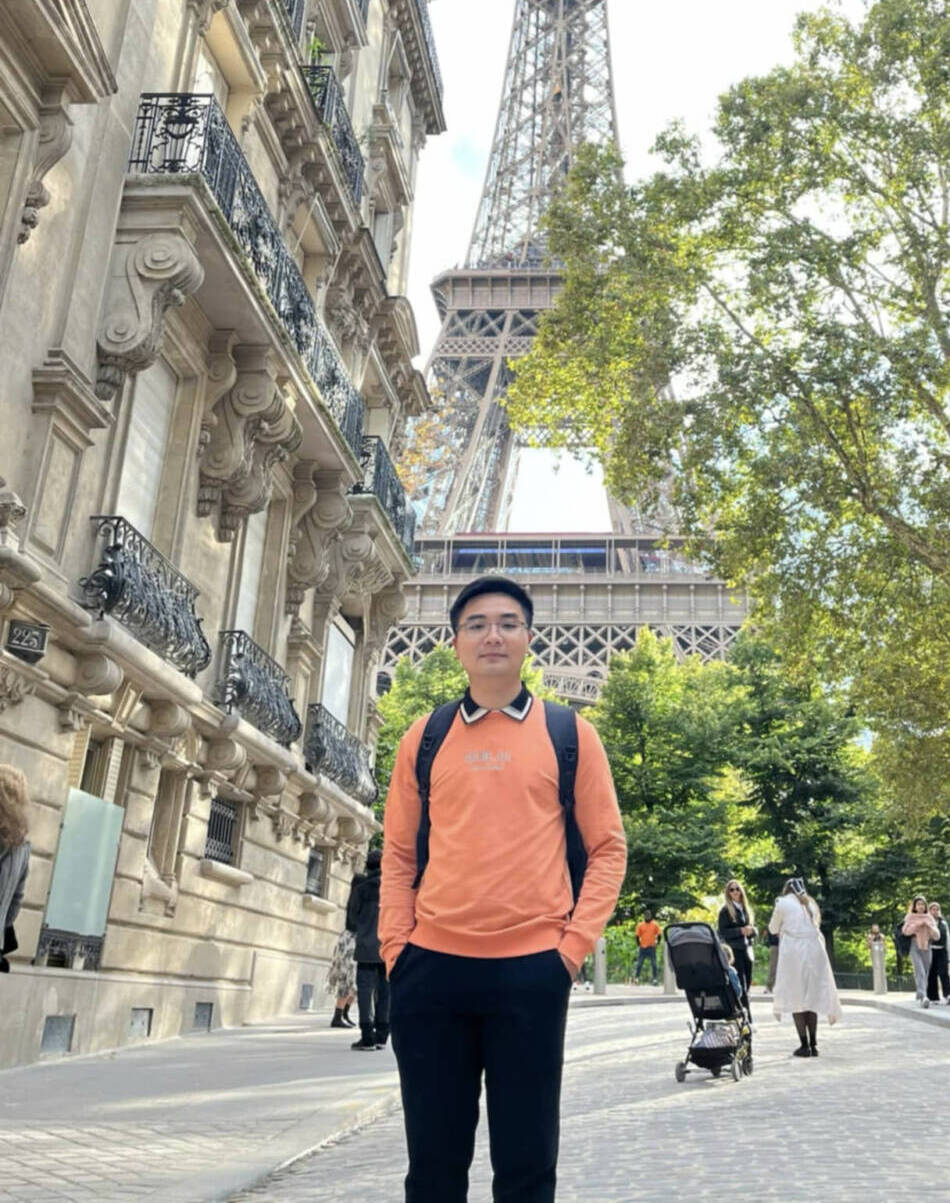
Hi everyone, my name is Manh Tuan Do. I recently graduated from Université Paris-Saclay, where I specialized in computer vision and artificial intelligence, and I am currently preparing to begin a PhD there. My research interests center on generative AI and its applications in augmented reality, including technologies that can support people with disabilities. My bachelor’s background is in mechatronics at Vietnam National University, which helped me understand how physical systems work and how AI can act as the ‘brain’ that makes those systems more intelligent. During my bachelor’s thesis, I developed and implemented AI algorithms on a drone and saw the system successfully fly and detect people who were partially hidden in grass. Seeing an AI-powered physical system work in the real world—and recognizing its potential for addressing social challenges—was a turning point for me. It motivated me to go deeper into AI and ultimately led me to pursue graduate study in France, focusing on computer vision.
IDEX International Master's Scholarship Details
IDEX International Master’s Scholarship (2024–2026) – Fully funded competitive scholarship for the Master’s in Machine Vision & Artificial Intelligence at Université Paris-Saclay, providing approximately €1,000 per month.
Were You Offered Any Other Scholarships?
Erasmus Mundus IFRoS Scholarship (2024–2026) – 100% tuition scholarship for the Joint Master’s in Intelligent Field Robotic Systems;
Korean Government Scholarship Program (GKS) 2024 – Selected/admitted for Master’s programs in Artificial Intelligence at Korea University and the University of Ulsan.
Luxembourg Government Scholarship – Scholarship offer for Master’s study in Luxembourg.
Université Grenoble Alpes IDEX Scholarship – Scholarship offer for Master’s study at Université Grenoble Alpes.
MIAI Grenoble Alpes Scholarship – Scholarship offer for an AI-focused Master’s program in Grenoble.
Educational Background
My previous degree was an important part of my scholarship applications. I studied mechatronics, while the programs I was targeting were more focused on AI and computer vision, so the match was not always obvious from coursework alone. However, through projects in embedded systems and IoT, I began integrating AI into physical systems. I often think of the physical system as the body, with computer vision as its eyes and AI as its brain; they are different parts, but they work together as one intelligent system. This connection became an important part of the story I presented in my applications. At the same time, I deepened my AI background through research with my professors, which gradually made my profile a stronger fit for computer vision rather than being seen as only a traditional mechatronics background.
How Did You Prepare to Apply to Université Paris-Saclay?
I prepared carefully by reviewing the requirements of each institution and making sure I understood every document and condition needed for the application. I tried to understand not only the formal eligibility criteria, but also what each program was actually looking for in a candidate before preparing my materials.
How Did You Find Information About IDEX International Master's Scholarship and Université Paris-Saclay?
At that time, in 2023, AI tools were not yet as capable or widely used for this kind of search, so I found opportunities manually on the internet. My process was usually: continent → country → university → scholarship page → program that matched my interests. It took a lot of time, but it gave me reliable information directly from official websites. It also helped me discover newly launched or less well-known scholarships that sometimes had lower competition while offering benefits comparable to more popular programs.
Did You Take Any Standardized Tests? If So, How Did You Prepare for Them?
I took IELTS and Aptis, achieving IELTS 5.5 and Aptis B2. I grew up in a rural area where I had relatively limited exposure to English, so language preparation was one of the more difficult parts of my journey. Once I decided to study abroad, I knew that an English-language certificate was essential. I spent time learning the test formats, practicing the different question types, and preparing consistently until I was able to obtain the scores I needed.
How Did You Prepare to Apply for the IDEX International Master's Scholarship?
The scholarship application process was quite stressful for me because I was working at the same time to support my living expenses while also researching and applying to many scholarship programs. Most of my application work happened after working hours: researching countries, universities, and programs, then gradually building my CV, essays, and recommendation letters. In the beginning, I did not even know what a strong academic CV should look like, so I learned by reading application experiences shared online and continuously refining my own version. Rejections also became part of the learning process; each unsuccessful application showed me what I could improve for the next one. For essays, I tried to stay very close to the scholarship criteria. I viewed each scholarship as a question or problem statement, and my job was to show as clearly as possible how my background, goals, and experiences matched what they were looking for. I was also fortunate to receive strong support from the professors I had conducted research with, who helped me develop meaningful recommendation letters. The process became a cycle of writing, revising, submitting, failing, learning, and trying again—until I eventually received my first fully funded scholarship offers.
How is Your Experience at Université Paris-Saclay?
Before applying for this major scholarship, I had already applied for several smaller and short-term scholarships. Those earlier attempts gave me valuable experience in writing essays and preparing application documents more carefully. At Université Paris-Saclay, the experience has been academically demanding but very rewarding, especially because I have been able to study in an international environment and move progressively toward research in AI and computer vision.
How Do You Rate Université Paris-Saclay Academically?
When choosing institutions, I used major rankings such as U.S. News, Times Higher Education, and ARWU as one reference point, particularly to identify universities that were among the strongest in each country. This helped me narrow down the search space and focus on academically strong institutions. However, rankings were only a first filter; I also looked closely at the curriculum, research environment, and how well each program matched my background and goals.
How Does Université Paris-Saclay Support International Students?
Most of the information international students need is already published on the university’s website. I found that reading the program pages and FAQ sections carefully usually answered most questions. Whenever something was still unclear, I contacted the university by email, and in my experience they were willing to respond and provide guidance.
Are Your Classes Conducted in English or French?
My classes in France were conducted entirely in English, with international students from many different countries.
What Did You Pursue After the IDEX International Master's Scholarship?
During my first semester, my main priority was adapting to a completely new environment, since it was my first time studying abroad. I gradually built a new routine, worked hard to improve my English, and strengthened my technical foundation in AI throughout the first year. I then had the opportunity to take part in a research internship in China, which broadened my perspective on what high-level research looks like. When I returned to France for my second year, I was more focused and determined. I achieved excellent academic results in the first semester, which was followed by another research internship opportunity and, eventually, a PhD offer.
Would Potential Students Have Any Problems Not Knowing French?
Yes, there can be some difficulties, especially outside the classroom. Even though my classes and research environment were mainly in English, not knowing French well at the beginning meant that everyday conversations, administrative situations, and occasional switches to French in the lab took more time and effort to understand. At first, unfamiliar vocabulary made listening difficult, but gradually I adapted and became more comfortable. Academically, it is manageable if the program is taught in English, but learning the local language still makes daily life and integration much easier.
What Do You Think Made Your Application Stand Out?
I think one of the strongest aspects of my application was the combination of excellent academic performance in mechatronics, research experience in AI, and a coherent story connecting the two fields. Rather than presenting my transition from mechatronics to AI as a weakness, I explained how my engineering background naturally led me toward intelligent systems and computer vision. Program selection was also very important. Pure AI programs may often prefer applicants with a computer science background, whereas programs in electrical engineering, machine vision, or computer vision can be a particularly strong fit for someone with a profile like mine. In my experience, standing out is not only about having a strong profile; it is also about choosing programs where your background genuinely makes sense.
What Would You Have Done Differently if You Were Going Through the Process Again?
If I went through the process again, I would focus even more on building each application around what the scholarship is actually looking for. I learned that scholarships are not necessarily searching for the “best” applicant in absolute terms; they are looking for applicants who are the strongest fit for their goals and selection criteria.
What Advice Would You Give Those Looking to Apply for a Similar Scholarship?
Research the scholarship as thoroughly as possible, understand what it values, and then reflect on your own journey. Tell your story honestly, but structure it so that the committee can clearly see why your background, goals, and experiences fit the opportunity. A convincing application is not about exaggerating achievements; it is about presenting the right parts of your story clearly and authentically.
Want to submit your
scholarship journey?
Submit Your Story Here!
More Scholarship Recipients
I’m Jose P. Romero Villalaz from Panama, and I am currently in my second year of a five-year integrated doctoral program .... Read more
My name is Arun Kumar Bhomi, and I am from Bhaktapur, Nepal. My journey into geospatial science was not intended, but being .... Read more
Hi, my name is Sat. I am from Astana, Kazakhstan, and I study at the Chinese University of Hong Kong (CUHK). My major is the .... Read more
- Bachelor's Scholarships
- Belt and Road Scholarship
- Bocconi University
- Business Administration
- Chinese University of Hong Kong
- Finance
- Free Tuition (Bocconi University)
- Hong Kong
- Kazakh Nationality
- Marketing
- Merit Scholarship (Northwestern University in Qatar)
- Northwestern University in Qatar
- Partially Funded Scholarships
- QF Financial Aid
- United Kingdom
Leave A Comment