
How Haneen Ahmad, a Jordanian Scholar, Secured a Fully Funded PhD in Urban and Rural Planning at Tianjin University, China Through the Chinese Government Scholarship (CSC Scholarship)
University: Tianjin University
Degree: PhD in Urban and Rural Planning
Previous Education: Bachelor of Architecture, Yarmouk University; Master’s in Urban and Rural Planning, Beijing Jiaotong University
Scholarship: Chinese Government Scholarship (CSC) – Fully Funded (RMB 3,500 Monthly Stipend, On-Campus Accommodation)
Other Offered Scholarships: MOFCOM Scholarship – Fully Funded (RMB 3,000 Monthly Stipend, On-Campus Accommodation)
Social Media
LinkedIn: linkedin.com/in/haneen-ahmad-589381219/
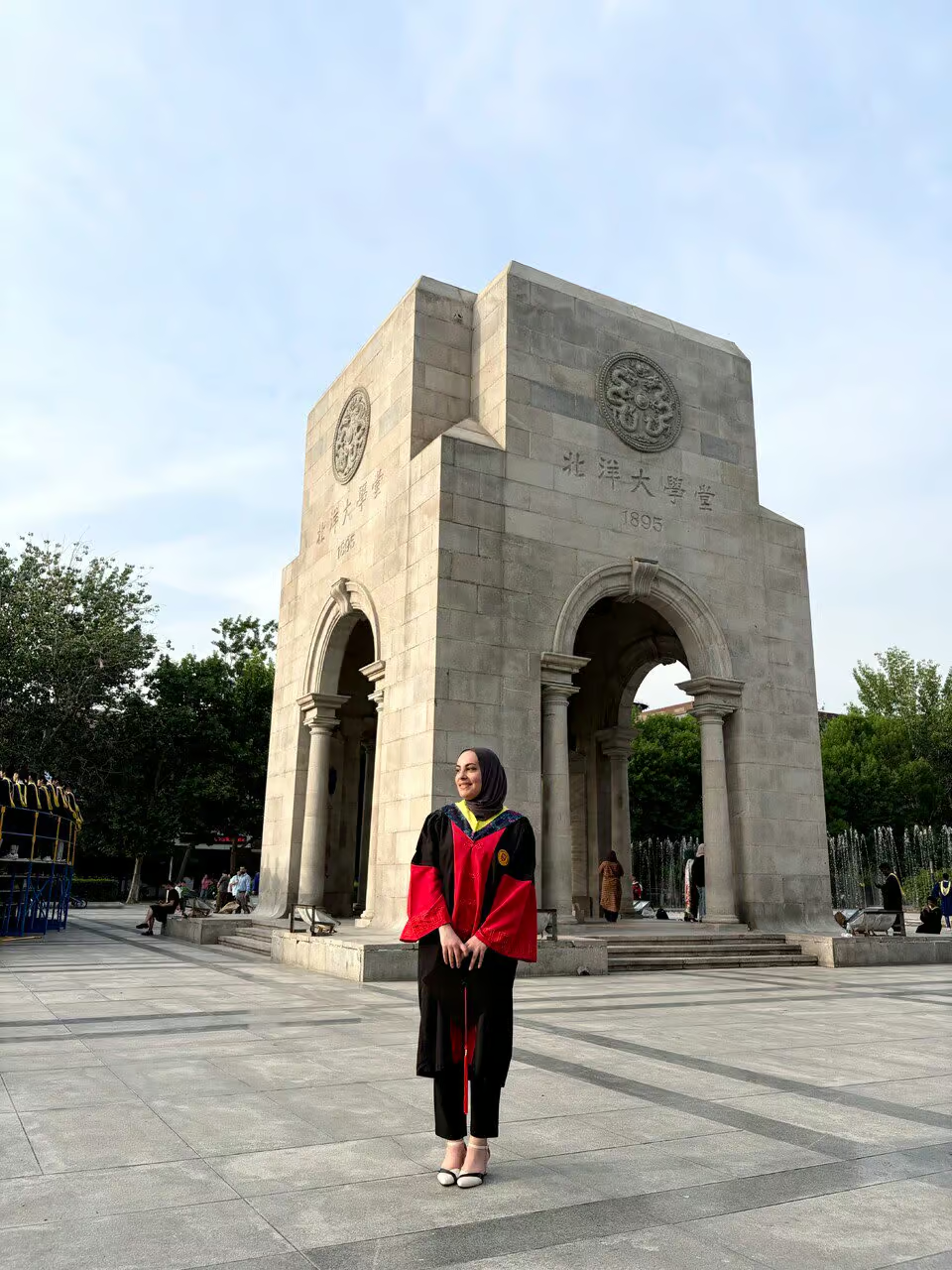
The Journey
My name is Haneen Ahmad, and I am from Jordan. My academic journey began with a Bachelor’s degree in Architecture from Yarmouk University, followed by a Master’s degree in Urban and Rural Planning at Beijing Jiaotong University and, most recently, a PhD in Urban and Rural Planning from Tianjin University in China.
My interest in further education developed from my architectural background and my growing interest in the relationship between people, cities, and the built environment. While architecture provided me with a strong foundation in spatial design, I became increasingly interested in broader urban issues, particularly how planning and public-space design affect people’s everyday experiences. During my doctoral studies, my research focused especially on women’s safety, gender-responsive planning, inclusive public spaces, and neighborhood parks.
Pursuing graduate education internationally allowed me to develop academically while also gaining experience in different research environments and cultural contexts.
Chinese Government Scholarship Details
For my PhD studies, I received the Chinese Government Scholarship (CSC Scholarship) to pursue a PhD in Urban and Rural Planning at Tianjin University, China. The scholarship was fully funded.
- Institution: Tianjin University
- Scholarship: Chinese Government Scholarship (CSC)
- Monthly stipend: RMB 3,500
- Accommodation: Funded on-campus housing
- Period: 2021–2026
Were You Offered Any Other Scholarships?
Yes. Before beginning my PhD, I received the MOFCOM Scholarship to pursue my Master’s degree in Urban and Rural Planning at Beijing Jiaotong University, China. The scholarship was also fully funded.
- Institution: Beijing Jiaotong University
- Scholarship: MOFCOM Scholarship
- Monthly stipend: RMB 3,000
- Accommodation: Fully funded single room on campus
- Period: 2019–2021
Educational Background
I completed my Bachelor of Architecture at Yarmouk University in Jordan in 2018. My undergraduate education provided me with a strong foundation in architectural design, spatial thinking, and understanding the relationship between people and the built environment.
I then completed my Master’s degree in Urban and Rural Planning at Beijing Jiaotong University in 2021. My master’s research examined the evaluation and optimization of health services from a resilience perspective in the post-epidemic era, using Amman, Jordan, as a case study.
I later pursued my PhD in Urban and Rural Planning at Tianjin University, which I completed in 2026. My doctoral research examined women’s safety perceptions in neighborhood parks in Amman using mixed methods. It allowed me to combine my background in architecture and planning with a more specialized interest in inclusive and gender-responsive urban environments.
How Did You Prepare to Apply to Tianjin University?
I focused on universities and programs that aligned with my academic interests and long-term goals, reviewing program requirements, faculty expertise, scholarship opportunities, and support for international students. For my PhD application, I contacted Professor Lijun Wang at Tianjin University in advance to ensure alignment between my research interests and the program. I also prepared my documents carefully to present clear academic progression from architecture to urban planning and doctoral research.
How Did You Find Information About Chinese Government Scholarship and Tianjin University?
I first learned about the MOFCOM Scholarship through a friend who was applying for her master’s degree. Seeing her go through the application process encouraged me to explore the opportunity and apply as well. By the time I was completing my master’s degree in China, I was already familiar with the Chinese Government Scholarship (CSC). I researched the PhD opportunity independently and prepared my own application.
I would advise applicants to use official university and scholarship websites as their main sources of information.
Did You Take Any Standardized Tests? If So, How Did You Prepare for Them?
I was not required to submit IELTS, TOEFL, GRE, GMAT, or similar standardized test scores for either scholarship application. However, the HSK Chinese-language examination was one of the graduation requirements. My graduate education involved both English and Chinese, so although a standardized English-language test was not required for admission, developing Chinese-language skills was still important during my studies.
How Did You Prepare to Apply for the Chinese Government Scholarship?
I treated the scholarship application as an academic application rather than simply a request for financial support. I focused on preparing my academic documents carefully, presenting a clear study and research direction, and ensuring that my previous education connected logically with the degree I wanted to pursue. For my PhD in particular, I believe that having a clear research direction and contacting a potential supervisor in advance helped strengthen the application.
How is Your Experience at Tianjin University?
My experience studying in China contributed greatly to my academic and professional development. At Tianjin University, I conducted independent research, worked closely with my supervisor and research team, and developed skills in urban planning, gender-responsive design, spatial and statistical analysis, and data-driven methods. I also had opportunities to publish research and participate in academic conferences. Living in China further strengthened my adaptability, independence, and international perspective.
How Do You Rate Tianjin University Academically?
I consider Tianjin University a strong academic institution, particularly in architecture, urban planning, engineering, and related built-environment disciplines. One of the aspects I valued most was the opportunity to work in a research-oriented environment and develop a doctoral project that combined theoretical, methodological, and practical dimensions. PhD experience encouraged independent research while also providing academic supervision, research resources, and opportunities for scholarly development.
How Does Tianjin University Support International Students?
Tianjin University provides academic and administrative support for international students throughout their studies. International students interact with both academic departments and university administrative offices regarding scholarship procedures, academic requirements, degree requirements, and graduation processes. At the same time, I would advise international students to remain proactive. University procedures can involve several departments and deadlines, so it is important to regularly check official notices, communicate with the relevant offices, and ask questions whenever requirements are unclear.
Are Your Classes Conducted in English or Chinese?
My graduate studies involved both English and Chinese. The language used could vary depending on the course, academic activity, or administrative context, so being comfortable working in an international and multilingual academic environment was useful.
Would Potential Students Have Any Problems Not Knowing Chinese?
It is possible for international students to study successfully in China without being fluent in Chinese at the beginning, particularly when their academic program includes English instruction. However, learning Chinese can make both academic and everyday life significantly easier.
Chinese is useful for administrative communication, daily activities, transportation, and interacting more fully with the local community. I would therefore encourage international students to learn at least basic Chinese during their studies, even if they are not fluent when they first arrive.
What Do You Think Made Your Application Stand Out?
I believe one of the strongest aspects of my application was the continuity of my academic background and research interests, progressing from architecture to urban planning and then to more specialized doctoral research.
I also believe that my previous experience studying in China, having a clear academic direction, contacting my future PhD supervisor, and securing an acceptance letter from Tianjin University strengthened my application. Together, these elements helped demonstrate a clear and logical progression in my academic development.
What Would You Have Done Differently if You Were Going Through the Process Again?
If I were going through the process again, I would focus more on building my professional and academic experience before starting the PhD. I would try to gain relevant work experience and take on a teaching assistant or research-related position so that I could strengthen my academic profile and build my career alongside my research experience.
I would also learn more Chinese before moving to China and try to understand the university system in greater detail, especially what is expected at each stage of the degree as an international student. I think it would also be very helpful to speak with current or former international students before arriving and ask about their experiences with research, supervision, academic requirements, and everyday university life.
What Advice Would You Give Those Looking to Apply for a Similar Scholarship?
My main advice is: do not reject yourself before applying. Fully funded scholarships can seem very competitive, but applicants should not assume they are not qualified before giving themselves the opportunity to apply.
At the same time, applicants should be strategic. Do not choose a scholarship only because it is fully funded. Consider whether the university, program, supervisor, and academic environment truly align with your goals.
Prepare your documents carefully, explain your academic progression clearly, and make your study or research plan specific rather than generic. Try to show not only what you have achieved, but also why the next degree is a logical step in your academic journey and what you hope to contribute through it.
I would also recommend applying broadly where possible and being patient with the process. Scholarship applications can involve uncertainty and waiting, but persistence can lead to opportunities that significantly shape your academic and professional path.
Want to submit your
scholarship journey?
Submit Your Story Here!
More Scholarship Recipients
My name is Shah Hussain, and I am from Khyber Pakhtunkhwa, Pakistan. I completed my Bachelor’s in Psychology at the Univer .... Read more
I am June from the Philippines. I am an educator for Social Sciences and Humanities. I recently earned my Master in Southeas .... Read more
Hi, my name is Abdul Hafeez, and I come from a small town called Nasirabad in Sindh, Pakistan. Currently, I am pursuing a ma .... Read more
Leave A Comment