
How Pakistani Scholar Abdul Moeed Won a Fully Funded Commonwealth Shared Scholarship
University: University of Surrey
Degree: MSc in Entrepreneurship and Innovation Management
Previous Education: BSc in Economics, minor in Education, Lahore University of Management Sciences
Scholarship: Commonwealth Shared Scholarship – Fully Funded (full tuition, return airfare, monthly living stipend, and other allowances)
Other Offered Scholarships (if any): University of Exeter Merit Scholarship (£10,000, offered); Newcastle University Future Leader Award (£15,000, offered); other UK university admission offers
Social Media
LinkedIn: linkedin.com/in/moeed-abdul/
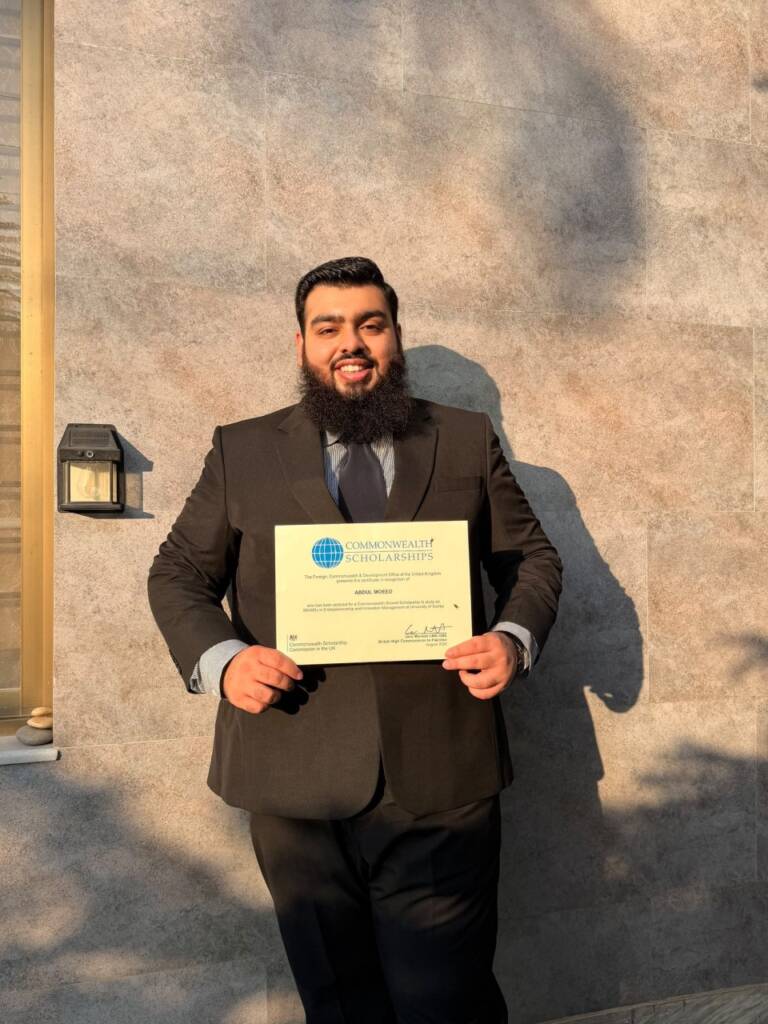
The Journey
Before I sat in my first economics lecture, I was already running two small businesses.
My name is Abdul Moeed, and I am from Lahore, Pakistan. I grew up in a family with a business background, so trade was always part of the conversation at home. As a teenager, I turned my love of cars into my first venture: importing car modification accessories and selling them. Later, as a student, I taught private tuition, which paid well and fitted around my studies.
Neither business was big. But both taught me something I have never unlearned: a small business, run well, gives you a kind of independence that very little else can.
At university, I learned the other side of that story. Pakistan’s 2023 Economic Census counted more than 7 million business establishments, and 95% of them employ fewer than 10 people. Most small businesses in Pakistan stay small. Understanding why, and what would help them grow, is the work I’ve chosen.
That is why I am now reading for an MSc in Entrepreneurship and Innovation Management at the University of Surrey as a Commonwealth Shared Scholar. Economics taught me how to diagnose the problem. This degree is about learning how to build the solutions.
One more thing makes this chapter special. My wife, Amna, was my course mate at LUMS. We applied in the same cycle, read every draft of each other’s essays, and were both selected as Commonwealth Scholars. She is now reading for an MSc in Economics and Data Science at the University of Bristol.
Commonwealth Shared Scholarship Details
- Scholarship: Commonwealth Shared Scholarship 2026-27, jointly funded by the UK Foreign, Commonwealth and Development Office (through the Commonwealth Scholarship Commission) and the University of Surrey.
- Institution and course: University of Surrey, Surrey Business School. MSc Entrepreneurship and Innovation Management.
- What it covers: Full tuition fees, a return airfare between Pakistan and the UK, a monthly living stipend (the CSC’s standard rate outside London is currently £1,712 a month), and additional allowances such as a study and travel grant. It also covers your IHS health surcharge and Visa Fee.
Each Shared Scholarship is attached to a single course at a single university, with one award per course. Surrey selected two Commonwealth Scholars for 2 different programs this year, and I am one of them.
Other Offered Scholarships
Yes. Alongside Surrey, I received admission offers from more than a dozen UK universities, including the University of Bristol, Imperial College London, the University of Warwick, the University of Exeter, the University of Sheffield, Newcastle University, the University of Nottingham, SOAS University of London and the University of Sussex.
Several came with partial funding, including:
- Merit Scholarship, University of Exeter: £10,000
- Future Leader Award, Newcastle University: £15,000
Educational Background
I graduated from the Lahore University of Management Sciences (LUMS) in 2025 with a BSc in Economics and a minor in Education, with a CGPA of 3.74/4.00.
Economics gave me the tools: econometrics, policy analysis, and working with data in R, Python, and STATA. The education minor gave me a lens I still use. Real change usually comes from building people’s capacity, not just handing them resources.
During and after my degree, I put both to work. I worked on research into internal migration and poverty, mapped harassment hotspots for the Government of Punjab, and studied access to clean water in peri-urban Lahore. After graduating, I worked as a research assistant in development research, did consulting research at Atheneum Partners, and worked as an independent consultant with Pakistan’s Ministry of Finance on tax-bracket and tax-reform analysis for Punjab.
Every one of those projects taught me the same lesson from a different angle. Data could show me where women felt unsafe, which families were moving from villages to cities, and which neighbourhoods were going without clean water. On its own, it couldn’t fix any of it. Fixing things needed something economics hadn’t taught me: how to build an organisation, a product or a partnership that actually reaches people.
That is the gap this degree is for. I had spent years analysing problems from the outside. Now I want to learn how to build from the inside.
How Did You Prepare to Apply to the University of Surrey?
I chose universities with one question in mind: where could I learn to build solutions for the kind of businesses I grew up around?
Surrey stood out for its focus on innovation ecosystems in emerging markets, research that mirrors problems I had watched play out in Pakistan’s small business sector. The course is also built around practice: the Surrey Hatchery (the business school’s in-house incubator), the B-Clinic, where students work on live projects with real companies, and research centres such as the Centre for the Digital Economy and the Centre for Social Innovation Management. I wanted a degree where I would be building, not just reading.
I applied to Surrey in October.
How Did You Find Information About the Commonwealth Shared Scholarship and the University of Surrey?
I first heard about the Commonwealth Shared Scholarship at Surrey through an FCDO advertisement, shared through the Commonwealth alumni network and on LinkedIn. I mention that because many people assume opportunities like this are hidden. Mine came through my feed.
From there, the official CSC website and Surrey’s own scholarship page were my reference points for eligibility, eligible courses and deadlines.
Did You Take Any Standardized Tests? If So, How Did You Prepare for Them?
Yes, I took IELTS and scored 8.0 overall. It wasn’t a requirement for the scholarship itself, but some of the universities I applied to required it for admission, so check each university’s English requirement separately.
I prepared on my own, using the British Council preparation resources you get access to once you register for the test. They were all I used, so you don’t need an expensive course to do well.
How Did You Prepare to Apply for the Commonwealth Shared Scholarship?
The Commonwealth Shared Scholarship works in two steps, and understanding them early made everything easier.
First, you apply to the university for an eligible course. I applied to Surrey in October. Second, you complete the scholarship application on the CSC’s online system, CSC Central. I submitted mine in November. The university then nominates its candidates, and the CSC confirms the awards. This was my first attempt.
Applications are assessed on academic merit, the quality of your proposal, and its potential impact on your home country’s development. I built my application around one specific problem: small businesses in Pakistan that never grow, rather than a general wish to help my country, and I showed the evidence that I had already started working on it.
For references, I asked three people to write for me, two academics and one professional, and I chose them the way you would build a team: each one covering something the others couldn’t.
My first academic referee vouched for my character and integrity. My second was my supervisor for my final-year senior project (SPROJ) at LUMS, who had seen up close how I handle research: the rigour, the deadlines, and the integrity good research depends on. My professional referee had worked with me alongside my studies, so he could speak to the quality of my impact analysis and how I work in a professional setting.
Together, they told one story from three directions: who I am, how I think, and how I work. Three referees saying different true things about you are far more convincing than three saying the same thing more loudly.
How Was Your Experience at the University of Surrey?
I am in my first term, and it has been full from the first week.
In Lahore, your family name walks into a room before you do. Here, I started at zero. Nobody knew who I was. Within a few weeks, my cohort elected me as Course Representative for MSc Entrepreneurship and Innovation Management, which meant a group of people I had only just met trusted me to speak for them. I still think about that.
The role has become one of the best parts of my year. I sit on the Student-Staff Liaison Committee, and I led and moderated our first networking evening, bringing undergraduate and postgraduate entrepreneurship students into one room. We ran Founders Bingo and Problem Speed Dating, and by the end of the night, people who had arrived as strangers were swapping ideas.
Beyond the role, I am leading a student team on a live project with a real founder through the Surrey B-Clinic. I am developing my own business idea in the Surrey Hatchery, where it has been tested in roundtables with Surrey Venture Studios and one-to-one clinics with experienced founders. And I am taking the Sustainable Future Award, taught by a UN trainer from the CIFAL network.
The honest part: home is five hours ahead, so most calls with my family happen somewhere between a lecture and dinner. In November it gets dark before half past four, Guildford is far quieter than Lahore, and Amna is in Bristol, so we are a train ride apart. Some evenings that quiet feels like peace. Some evenings it’s just quiet.
Moving has also taught me that asking for help is a skill you relearn. At home, there was always someone who knew someone. Here, you have to say “I don’t know how this works” out loud. At Surrey, someone has always answered.
How Do You Rate the University of Surrey Academically and Why?
I would give it 9/10, for two reasons: the faculty and the autonomy.
The faculty are understanding, approachable, and generous with their time. Daniel S. Cho, our programme lead, agreed to supervise an independent research project I wanted to take on alongside the course. Thomas Fackler and Senmao Xia teach in a way that ties theory to real businesses and current cases rather than leaving it in the textbook. And through Jim Sears and the B-Clinic, students work on live projects with real companies, which is where some of the most valuable learning happens.
The autonomy matters just as much. You are given room to shape the degree around your own goals. For the final project, you choose between a business plan and a consultancy project with a local company. In modules such as Entrepreneurship and Digital Innovation Management and Digital Economy, I have been able to apply ideas to the market I care about most, which is Pakistan.
How Does the University of Surrey Support International Students?
Surrey’s support for international students started long before I landed, and it hasn’t stopped since.
The International Student Recruitment team stayed in steady contact through every stage of the process. Ryan Miles, from that team, was the person who told me I had been selected, a message I won’t forget.
In November, Surrey hosted an International Scholar Reception for scholars across different scholarships. We received certificates of recognition, and for the first time I put faces to the names who had supported me for months. My Commonwealth Programme Officer, Aymen Belkacem, was there too, and I had the chance to thank him in person and ask for his guidance on the year ahead.
For an international student, that matters more than it sounds. You arrive knowing almost no one. Knowing that both your university and the Commonwealth Scholarship Commission are actively looking out for you makes a new country feel a lot less new.
What Did You Pursue After the Scholarship?
I am still mid-degree, so this is a plan rather than a record.
Alongside the MSc, I am developing an independent research project with my programme lead on how climate requirements reach small businesses in Pakistan through global supply chains, compared with policy-led approaches in the UK. It’s also preparation for a possible PhD- who knows, maybe down the line sometime in life.
After that, I am going home. I want to work on building the capacity of Pakistan’s small businesses through research, policy, and a venture of my own.
What Do You Think Made Your Application Stand Out?
Honestly, I can’t know exactly what the selection panel saw. But looking back, I think it came down to three things.
First, I wrote about a problem, not a dream. It’s easy to say you want to give back to your country, and almost every applicant does. I tried to be specific instead: most businesses in Pakistan employ fewer than 10 people and stay that way, and I wanted to understand why and what would help them grow. A specific problem gives the reader something concrete to believe in.
Second, I could show that I had already started. I didn’t discover entrepreneurship in a brochure. I had been selling things since before university, first car accessories, then my time as a tutor. My research and policy work showed that I understood the wider system those businesses operate in, from tax policy to public services. So the application wasn’t a promise about who I might become. It described someone already on the way.
Third, everything pointed the same way. My background, my choice of course and my plan after the degree told one story, and each referee confirmed a different part of it. When a reader can follow the line from where you have been to where you are going without filling in any gaps, you make their decision easier.
What Would You Have Done Differently?
On the application itself, I wouldn’t change much. It was my first attempt, and it worked.
What I would do differently is prepare for the degree itself, not just for getting in. I would arrive with more business consulting experience behind me and plan my module choices around consulting from day one. I would also plan, before landing, how to use everything around the course: the Hatchery, live client projects, and London, which is about 35 minutes away by train and is the centre of the UK’s startup and consulting world.
I am still mid-degree, so this isn’t hindsight. It’s what I am doing now.
What Advice Would You Give Those Looking to Apply for a Similar Scholarship?
- Understand the two steps. A Shared Scholarship needs both a university application and a CSC Central application, and the university’s deadline can be earlier than the CSC’s. For 2027-28, CSC Central closes at 16:00 GMT on 8 December 2026.
- Choose the course, not just the university. Each Shared Scholarship is attached to one course at one university listed on the CSC website, and you are competing for that one award per program being advertised. Apply where your story fits the course best.
- Name a problem, not a passion. Development impact is a selection criterion. “I want to help my country” isn’t a plan. “Most businesses in Pakistan employ fewer than 10 people, and here is what I want to learn to help them grow” is.
- Show you have already started. A side business, a class project, unpaid research: it all counts if it points the same way as your plan.
- Pick referees who have seen you work. Three referees who each speak to a different side of you are worth more than three big names who say the same thing.
- Never pay anyone who promises selection. The CSC warns applicants against anyone asking for payment in exchange for an application or a guaranteed place.
I started out selling car parts. If that could lead here, so can whatever you have already started. Write about it like it matters, because it does.
Want to submit your
scholarship journey?
Submit Your Story Here!
More Scholarship Recipients
My name is Md Imamul Islam, and I come from Jamalpur, Bangladesh. I am an electrical engineer and researcher working on the .... Read more
My name is Hriti Parekh, and I am from Raipur, Chhattisgarh, India. I am a law graduate from Hidayatullah National Law Unive .... Read more
My name is Muhammad Ali Asad, and I am from Pakistan. I am currently pursuing a Master’s degree in Information and Communi .... Read more
Leave A Comment