
Newcastle University Scholarships for International Students 2027
To help students manage tuition and living expenses, Newcastle University connects to scholarships across different funding levels. Here are several top options to review first.
Among the university based funding routes linked to Newcastle University, these scholarships tend to stand out for their level of support and overall value. Studentships and Research Assistantships is commonly categorized as fully funded support, and coverage that often includes full tuition fees and living stipend. With Vice-Chancellor’s International Scholarships, students may receive partially funded support, and coverage frequently includes £7,000 scholarship award. Vice-Chancellor’s Excellence Scholarships is a partially funded award, and the listed benefits often include up to 50% tuition fee discount.
To broaden funding options beyond institutional awards at Newcastle University, these external and government scholarships are commonly considered as well. Chevening Scholarships is usually considered fully funded, and typical coverage can include 100% of tuition fees, A monthly stipend covering accommodation fees and living expenses, and economy flight from and to your country of residence. A strong option is Commonwealth Master’s Scholarships which is fully funded and often covers full tuition fees, living allowance of up to £1,378 per month and £1,690, and clothing allowance. Commonwealth PhD Scholarships is fully funded, and coverage often includes full tuition fees, roundtrip airfare ticket, and paid airfare ticket for mid-term visit to home country.
To see every scholarship associated with this institution and compare coverage and eligibility, browse the sections below.
Newcastle University Scholarships for International Students
The scholarships at Newcastle University can help fund your study expenses. There are currently 12 scholarships being offered to international students at the Newcastle University, all with varying requirements, benefits, and application processes. We have compiled them in this list to help you find the scholarship that best fits you.
Undergraduate Scholarships
Graduate Scholarships
External Scholarships
There are many degrees that are open to international students right now — find yours.
Newcastle University Admissions
Here are the official admission pages for Newcastle University:
| Degree | Admissions Pages |
|---|---|
| Bachelor's | International Students Admissions Page |
| Master's | International Students Admissions Page |
Admissions and Scholarship Results at Newcastle University
Here are some of the admissions and scholarship results from previous applicants to Newcastle University, which you might find helpful. For more results to Newcastle University, please see the Newcastle University Admissions Profile Page .
| Nationality / Region | SAT/ACT | EFC | GPA | Scholarship | Status |
|---|---|---|---|---|---|
| India | N/A | N/A | 71.1 (UK Grade System) | GBP 4000 | Accepted |
| USA | 1350 | N/A | 3.9 | N/A | Rejected |
| Middle East | 1480 | N/A | 3.7 | N/A | Accepted |
| Spain | 1410 | N/A | 4.0 | N/A | Accepted |
Newcastle University Application Deadlines
| Degree | Admission Deadline |
|---|---|
| Bachelor's (September Intake) | January 13, 2027 |
| Master's | Different Master's programs have different deadlines |
Tuition Fees at Newcastle University for International Students
Indicative annual tuition fee ranges for international students at Newcastle University. Exact fees vary by program, so always confirm the current cost on the university's official tuition fee pages.
| Degree Level | Typical Annual Range |
|---|---|
| Bachelor's Tuition | 24,500 – 29,850 GBP |
| Master's Tuition | 25,900 – 31,950 GBP |
Please note that tuition fees can vary based on the specific program you choose. For the most accurate and current fee information, consult the official tuition fee pages linked above.
Newcastle University Scholarship Recipients
International students who received scholarships to study at Newcastle University, documented by Global Scholarships.


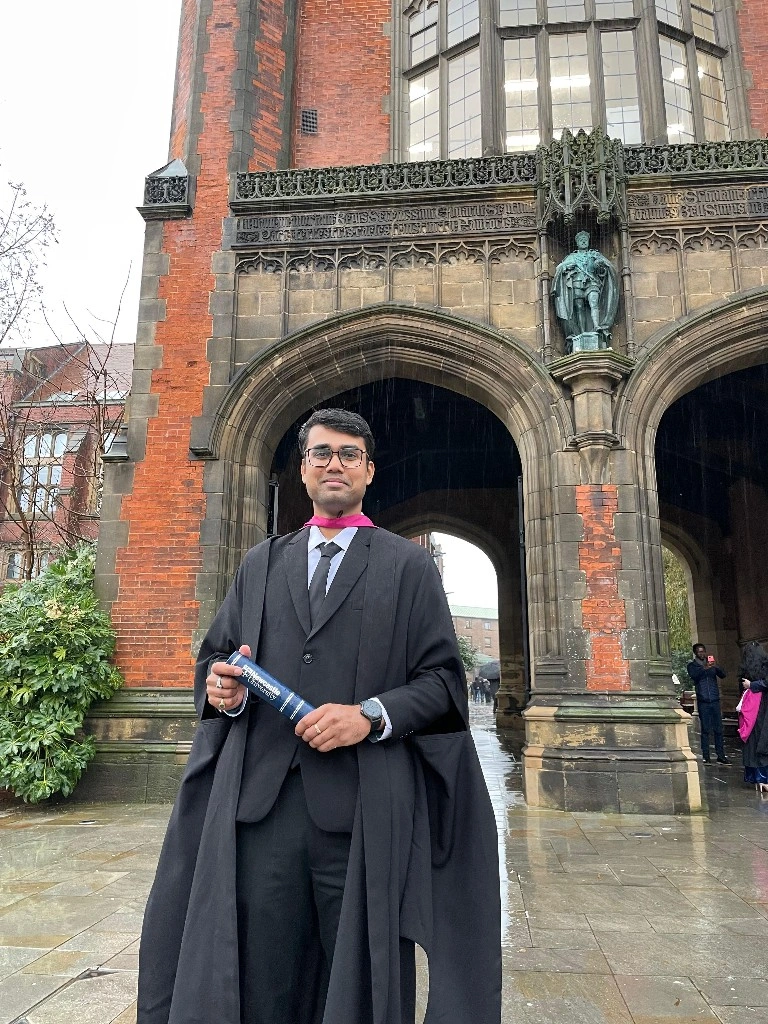



What Scholarship Recipients Say
Advice and insights from international students who successfully secured funding to study at Newcastle University.
"I settled for the Commonwealth Shared because it was fully funded, including the costs of a visa, air tickets."
"apply early and ensure you have a clear and compelling reason for pursuing your chosen course"
"I’m currently pursuing an MA in International Development and Education at Newcastle University in the UK."
"My experience at Newcastle was nothing short of transformative. The rigorous curriculum sharpened my analytical thinking and research skills, while interactive discussions with faculty and peers from different cultural and legal backgrounds expanded my worldview."
"My experience at Newcastle University has been truly enriching. My experience at Newcastle University has been truly enriching. The university offers strong academic support and provides exposure to a highly international environment, which has enhanced my global perspective."
"My personal journey has given me incredible opportunities."
Frequently asked questions
Common questions about scholarships, admissions, and studying at Newcastle University.
Many major Newcastle scholarship schemes are explicitly written around full-time, campus-based study. If you’re considering an online/distance-learning route, treat scholarships as course-specific and double-check the funding rules for your exact programme before applying.
Newcastle University funding can apply across a wide range of subjects, and recipients’ stories show that scholarships have supported everything from engineering/STEM to business, humanities, and social sciences. For example, Aritraa Dhar pursued an LLM in International Commercial Law (law/humanities), Rohith Tirupapuli studied supply chain (business/management), Alfred Navokhi Apaji completed Environmental Engineering (STEM/engineering), and Sonya Murray pursued International Development and Education (humanities/social sciences).
- Engineering / STEM: Environmental Engineering (example: Alfred Navokhi Apaji).
- Business: Operations, Logistics, and Supply Chain Management (example: Rohith Tirupapuli).
- Humanities / Social Sciences: International Development and Education (example: Sonya Murray).
- Law: International Commercial Law (example: Aritraa Dhar).
- Medicine: Newcastle does offer medicine programmes, but some large scholarship schemes can exclude specific professional degrees (for instance, some Vice-Chancellor scholarship regulations exclude MB BS/BDS routes), so international applicants for medicine should expect fewer university-wide options and may need to rely more on programme-specific or external awards.
In practice, Newcastle University scholarships fall into a few common patterns: (1) scholarships open broadly to “international” (and sometimes “EU”) applicants, (2) scholarships restricted by domicile/region lists, and (3) major external/government scholarships tied to nationality eligibility (e.g., Chevening; Commonwealth routes). The recipient stories show a mix of nationalities succeeding at Newcastle, including India, Nigeria, and Jamaica.
- Examples from recipients: Aritraa Dhar (India), Rohith Tirupapuli (India), Alfred Navokhi Apaji (Nigeria), Sonya Murray (Jamaica).
It depends on your background, nationality, and programme. Some Newcastle recipients needed IELTS, while others used exemptions or alternatives. Aritraa Dhar said, “To meet language requirements, I took the IELTS.” Similarly, Rohith Tirupapuli shared that he “took the IELTS exam and scored a 7.5.”
But it’s not universal: Alfred Navokhi Apaji explained, “I did not take the IELTS… I got a letter of English proficiency… and it did the trick,” while Sonya Murray noted, “Fortunately, I didn’t need to take any standardised tests like the IELTS or GRE.”
Minimum grade expectations vary by course and level, but the scholarship recipients’ profiles show that strong academics are common, especially for competitive funding. For example, Rohith Tirupapuli described graduating “with a 2:1 Merit,” and Alfred Navokhi Apaji highlighted, “My high CGPA (4.65/5.00) played an important role in my being selected for the scholarships.”
That said, “minimum grade” is not one universal number across Newcastle: different programmes (and scholarship schemes) can have different thresholds, and selection can also weigh your experience and fit.
A strong academic record helps, but recipients repeatedly show that scholarships are often awarded based on the whole package: grades, leadership, clarity of goals, and persuasive writing. Sonya Murray shared that for Chevening, “they don’t require a First Class Honours degree — what mattered most was passion, leadership,” while Rohith Tirupapuli emphasized crafting a strong “Statement of Purpose (SOP).”
- Strong academics: High CGPA / strong classification (examples: Alfred and Rohith).
- Clear goals + strong writing: Rohith focused on a strong SOP; Aritraa described submitting a “motivational letter” for a selection process.
- Leadership and impact: Sonya leaned into leadership; Alfred highlighted leadership and volunteering alongside grades.
Documents vary by programme, but recipients’ stories align closely with the standard UK postgraduate checklist: transcripts, passport, English proof (if required), and strong written materials. Alfred Navokhi Apaji put it plainly: “You need to have all required documents, including: passport, academic transcripts, letters of recommendation, statements of purpose, Academic CV.”
- Academic records: degree transcripts (and degree certificate if completed).
- Identity: passport copy (explicitly mentioned by Alfred).
- English proof: IELTS/TOEFL/PTE, or an English proficiency letter (example: Alfred used a letter; Rohith and Aritraa used IELTS).
- Written materials: Statement of Purpose / personal statement (example: Rohith), plus scholarship-specific essays or motivational letters (example: Aritraa submitted a motivational letter for a selection process).
- References: letters of recommendation (explicitly mentioned by Alfred)
It depends on what you apply for and how. Undergraduate applicants typically apply through UCAS, and UCAS charges an application fee (set by UCAS and subject to change each cycle). For postgraduate applications, Newcastle’s guidance indicates that some courses may require a fee (because it can ask you to provide “a receipt of your application fee, if your course requires one”), so you should check the specific course’s “How to Apply” details before submitting.
There are many degrees that are open to international students right now — find yours.
About the Author: Hyun Lee


Hi there, I am interested about scholarships for bachelor’s degree
Hello, there are plenty of scholarships for Bachelor’s degree in the scholarships section.
My daughter is currently studying at the University of Manchester as an international student and granted 4 thousand pounds scholarship tuition fee as ambassador for international students in her foundation year. I’m afraid she can’t continue for her proper course anymore because we cannot afford the tuition fee because the scholarship is not full. The money that we paid (25,000 pounds) for her foundation year is from her step dad and he said he can no longer afford for the next following years. Is there any fully funded scholarship for international students from Philippines ?
Hello, if she is currently studying, then the options are limited I’m afraid