
Karlsruhe Institute of Technology Scholarships for International Students 2027
Funding at Karlsruhe Institute of Technology can be easier to navigate when you start with the most generous options. Below is a shortlist prioritized by the level of support.
In addition to university awards, students connected to Karlsruhe Institute of Technology may also consider government and external scholarships. Here are a few widely relevant options. DAAD Scholarships is commonly categorized as fully funded support, and coverage that often includes €992 for master's and €1,300 for Ph.D. students, health insurance, and one-time research allowance. With PTDF Overseas Postgraduate Scholarship Scheme, students may receive fully funded support, and coverage frequently includes full tuition fees for approved programmes, research bench fees and where applicable, and return flights. Deutschlandstipendium is a partially funded award, and the listed benefits often include a monthly stipend of 300 EUR.
You can find more university scholarships and external or government scholarships further down on this page.
Karlsruhe Institute of Technology Scholarships for International Students
The scholarships at Karlsruhe Institute of Technology can help fund your study expenses. There are currently 7 scholarships being offered to international students at the Karlsruhe Institute of Technology, all with varying requirements, benefits, and application processes. We have compiled them in this list to help you find the scholarship that best fits you.
External Scholarships
There are many degrees that are open to international students right now — find yours.
Karlsruhe Institute of Technology Admissions
Here are the official admission pages for Karlsruhe Institute of Technology:
| Degree | Admissions Pages |
|---|---|
| Bachelor's | International Students Admissions Page |
| Master's | International Students Admissions Page |
Karlsruhe Institute of Technology Application Deadlines
| Degree | Admission Deadline |
|---|---|
| Bachelor's (Winter) | July 15, 2026 |
| Bachelor's (Summer) | January 15, 2027 |
| Master's (Winter) | July 15, 2026 Different Master's programs have different deadlines |
| Master's (Summer) | March 15, 2027 Different Master's programs have different deadlines |
Tuition Fees at Karlsruhe Institute of Technology for International Students
Indicative annual tuition fee ranges for international students at Karlsruhe Institute of Technology. Exact fees vary by program, so always confirm the current cost on the university's official tuition fee pages.
| Degree Level | Typical Annual Range |
|---|---|
| Bachelor's Tuition | 3,000 Euros |
| Master's Tuition | 3,000 Euros |
Please note that tuition fees can vary based on the specific program you choose. For the most accurate and current fee information, consult the official tuition fee pages linked above.
Karlsruhe Institute of Technology Scholarship Recipients
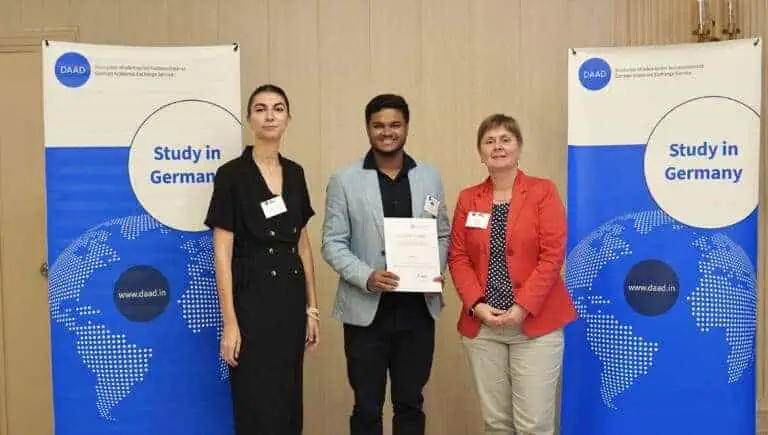
International students who received scholarships to study at Karlsruhe Institute of Technology, documented by Global Scholarships.

What Scholarship Recipients Say
Advice and insights from international students who successfully secured funding to study at Karlsruhe Institute of Technology.
"This prestigious scholarship provides 1,000 euros per month, along with additional research funds and travel allowances to support academic and professional development."
"KIT is exceptional. It is a premier institute in Germany that stands among the globally top research institutes."
"Well, throughout my research stay at KIT, I have received a warm, welcoming support, such as technical, administrative, and financial support, from the IAP Department,"
Frequently asked questions
Common questions about scholarships, admissions, and studying at Karlsruhe Institute of Technology.
Most well-known KIT-linked funding is tied to being enrolled in a regular KIT degree program (and often to being on campus in Karlsruhe), so fully “online-only” scholarships are uncommon.
Both, many programs are German-taught, but KIT also lists several degree programs “completely offered in English” (including multiple master’s programs and the Mechanical Engineering (International) bachelor’s track).
This matches what recipients experienced in research settings: Subhadip Saha said, “Research is primarily conducted in English,” and Kirti Patil shared that her academic communication had no barrier because there were “all meetings, discussions, and correspondence in English.”
Even if your degree is German-taught, you may still find English-taught modules (for example, KIT’s economics/business area notes that while programs are overall in German, a number of courses are taught in English).
It depends on the scholarship, but some major options explicitly have no age cap. For instance, KIT’s Deutschlandstipendium FAQ answers the age-limit question with “No.” Other funding (especially some external programs) may be framed around career stage (e.g., early-career researchers) rather than a strict age number, so always check the call text.
Many scholarships connected to KIT are subject-flexible (open across faculties) as long as you are enrolled in an eligible KIT program; Deutschlandstipendium, for example, is not restricted to one subject and is awarded via faculty selection committees.
In terms of what you can study, KIT offers a broad portfolio, especially engineering and STEM (e.g., computer science, mechanical/electrical engineering, physics), but also business/economics/management and humanities/social-science options.
The recipient stories tagged to KIT are STEM-heavy too: Kirti Patil pursued structural/engineering research, while Subhadip Saha was in physics research.
It varies by funding source, but some major scholarships are explicitly nationality-inclusive. KIT states that the Deutschlandstipendium is open to students “of all nationalities.”
KIT also runs/supports funding aimed specifically at international students in need at the final stage of their studies.
In the Global Scholarships stories connected to KIT, Indian nationals have been awarded DAAD funding connected to KIT experiences, see Kirti Patil and Subhadip Saha, showing that eligibility commonly includes international applicants.
It depends on the program language. For programs fully taught in English, KIT says “sufficient knowledge of the English language has to be provided,” which typically means submitting an accepted English proof (often IELTS/TOEFL or equivalent per the program’s rules).
For German-taught programs, you’ll usually need an accepted German proof (commonly TestDaF/DSH or recognized equivalents), and KIT even provides guidance around TestDaF logistics for applicants.
Practical reality from recipients: Kirti Patil said she did not face academic challenges without German because communication was in English, and Subhadip Saha noted DAAD supported a German course while “Research is primarily conducted in English.”
Admission thresholds depend on the degree program and faculty evaluation; KIT’s application workflow indicates that once an application is “Complete,” the faculty checks academic suitability as the next step.
For scholarships, requirements vary. Notably, KIT’s Deutschlandstipendium says there is “No specific grade point average” tied to awarding (applications are judged in overall context), while KIT’s IStO Graduation Grant lists an academic-performance criterion (at least 2.5) among other conditions.
Real examples from recipients show strong academics helped: Kirti Patil reported master’s CGPAs of 8.73 and 9.00 (and 8.88/10 in her bachelor’s), and Subhadip Saha reported an MSc CPI of 8.1.
A strong fit between your background and the program/research group matters as much as raw grades, especially for research-heavy funding. Subhadip Saha emphasized the “scientific impact/relevance” of his proposal and said a coherent “Letter of Motivation” and an eye-catching “CV/Resume” are key early on. Kirti Patil similarly described proactively emailing professors and showing alignment between her research interests and the host group to build a credible application. For broader merit/leadership scholarships like Deutschlandstipendium, KIT also weighs social commitment and overcoming biographical hurdles alongside academic performance.
Exact documents depend on your program, but common items include transcripts/degree certificates, CV, motivation letter/statement of purpose, and language certificates (English or German depending on the program), plus any country-specific verification requirements.
In recipient stories, research-focused applications were document-heavy: Kirti Patil said she attached “my CV, academic transcripts, and a brief research proposal,” and she also highlighted needing a formal invitation letter from a professor as a critical requirement for her scholarship application.
Subhadip Saha similarly pointed to a strong proposal plus a “Letter of Motivation/Cover Letter,” an “eye-catching CV,” and a strong recommendation from his supervisor.
For standard degree applications, multiple admissions-information sources report “no application fee,” and KIT’s own process focuses instead on paying semester contributions after admission/enrollment (and, if applicable, tuition fees for certain student groups).
There are many degrees that are open to international students right now — find yours.
About the Author: Hyun Lee


Leave A Comment