
How Ahmed Ridoy, a Bangladeshi Scholar, Secured a Fully Funded PhD Through the DAAD Doctoral Scholarship
University: Karlsruhe Institute of Technology (KIT)
Degree: PhD (Research in Silicon Solar-Cell Processing)
Previous Education: M.Sc. in Optics and Photonics, Karlsruhe Institute of Technology (KIT); Bachelor’s in Mechanical Engineering, Islamic University of Technology (IUT), Bangladesh
Scholarship: DAAD Doctoral Scholarship – Funding for Four and a Half Years (Monthly Stipend of €1,000–€1,200, Family and Child Allowances, Rent Subsidy, Health Insurance, Research Support, Travel Allowance)
Other Offered Scholarships: Karlsruhe School of Optics & Photonics (KSOP) Scholarship – €800 Monthly Stipend for One Year (2011–2012)
Social Media
LinkedIn: linkedin.com/in/ahmedridoy/
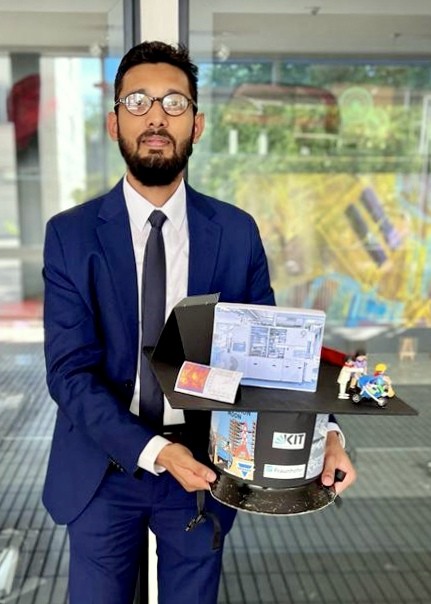
The Journey
My name is Ahmed Ridoy, and I am originally from Bangladesh. I came to Germany in 2011 to pursue an M.Sc. in Optics and Photonics at the Karlsruhe Institute of Technology (KIT), supported by a scholarship from the Karlsruhe School of Optics & Photonics (KSOP).
My Bachelor’s degree was in Mechanical Engineering from the Islamic University of Technology (IUT), Bangladesh, where I graduated with a GPA of 3.45/4.00. Moving from mechanical engineering into optics and photonics was therefore a change of direction, but the interdisciplinary nature of the program at KIT made this transition possible for students from different engineering backgrounds.
What began as a Master’s degree in Germany eventually became a much longer journey. After my Master’s, I worked in research in Germany and Italy, returned to Germany with a DAAD doctoral scholarship, completed my PhD at KIT and Fraunhofer ISE, and later moved into the semiconductor industry.
From a Master’s Scholarship to a DAAD-Funded PhD
For my Master’s, I received the KSOP Scholarship, which provided €800 per month for one year, from 2011 to 2012. I completed my M.Sc. with a German grade of 1.9, including my Master’s thesis at Fraunhofer ISE, which received a grade of 1.0.
I found the Master’s program through internet searches. In 2011, English-taught Master’s programs in Germany aimed at international students were less common than they are today. I submitted my academic documents and TOEFL score and was first admitted to the program. A smaller group of admitted students was then selected for the KSOP scholarship. There was no separate scholarship interview.
After completing my Master’s thesis, I worked for another six months at Fraunhofer ISE before moving to Pisa, Italy, where I spent two years in research. My experience in Italy was valuable, but being away also made me appreciate my previous experience in Germany more. During this period, I decided that I wanted to return to Germany for my PhD.
I contacted my former Master’s thesis supervisor at Fraunhofer ISE, and together we developed a PhD research project. I then contacted my former professor at KIT, who agreed to supervise the doctorate academically. By the time I applied for the DAAD Doctoral Scholarship, my research topic, institute, Fraunhofer supervisor, KIT professor, and university were already arranged.
DAAD was already very well known to me as one of Germany’s major scholarship organizations, supporting international students and researchers globally across many disciplines.
My application included academic records, a motivation letter, two recommendation letters, and a detailed four-to-five-page research proposal. After the initial document selection, I was invited to an interview in Dhaka. At the time, I was still working in Italy, so I returned to Bangladesh about a week before the interview.
The interview lasted around 20–25 minutes and focused on my research proposal, motivation, preparedness, and the feasibility of the project. I cannot know exactly what determined the committee’s decision, but I believe having a well-developed and realistic PhD plan strengthened my application. My Fraunhofer supervisor and KIT professor already knew my work because they had supervised my Master’s thesis.
I received the DAAD scholarship and returned to Germany in October 2016. The basic scholarship was around €1,000–€1,200 per month, with additional support such as family and child allowances, rent subsidy, health insurance coverage, research support, and travel allowance. The scholarship was renewed annually based on my progress and ultimately covered four and a half years, including a six-month extension during the COVID-19 pandemic.
PhD and Career in Germany
I carried out my doctoral research at Fraunhofer ISE in Freiburg while completing my doctorate through KIT. My research focused on silicon solar-cell processing and gave me extensive practical experience in cleanroom fabrication, process development, characterization, and process integration.
Academically, English was fully sufficient. Fraunhofer also supported German evening courses, and I attended courses up to C1 level, although the formal German examination I completed was B1. During my PhD, I also participated in the KSOP doctoral program and had the opportunity to complete a six-week MBA Fundamentals program at the Hector School at KIT.
After my PhD, I moved from academic research into the semiconductor industry. I currently work at Vishay Siliconix Itzehoe GmbH as an R&D Process Integration Engineer, working on power MOSFET semiconductor technology. As of October 2026, I have been with my first industrial employer for nearly five years and continue to enjoy the work.
Although solar cells and power MOSFETs are different applications, the foundation from my PhD transferred very well into my current work. My experience in silicon processing, cleanroom fabrication, experimentation, process development, and process integration became particularly relevant when I moved into the semiconductor industry.
What I Would Do Differently
Looking back, there are two things I would do differently. I would try to shorten the roughly two-year period between completing my Master’s and starting my PhD, and I would start learning German already during my Master’s rather than waiting until later.
Apart from these, I would not change much. I was fortunate with my supervisors, university, research institute, and research topic, and the overall setup worked very well for me.
Suggestions for Future Applicants
My experience needs to be seen in its time context. I started my Master’s in 2011 and my PhD in 2016, and I understand that studying abroad, particularly from Bangladesh, has become considerably more competitive since then.
If someone already knows during their Bachelor’s that they are interested in higher studies abroad, I think it can be helpful to start exploring universities, scholarships, and possible research areas from the second or third year, rather than waiting until graduation.
For those considering Germany for the longer term, I would also suggest learning German early. This is something I personally wish I had started during my Master’s.
I was never an extraordinary student, and my own journey taught me that academic results are only one part of the picture. Being sincere about your work, having good fundamentals, communicating well, and being consistent and professional can also make a difference.
In my DAAD application, I was fortunate to have a research project, institute, supervisors, and university already in place. Having worked successfully with my supervisors before also helped me considerably. Every applicant’s situation will of course be different, but in my case, being well prepared before applying was probably one of the most important factors.
Want to submit your
scholarship journey?
Submit Your Story Here!
More Scholarship Recipients
My name is Vanessa Desidério, and I'm from Brazil. I earned my law degree from the Federal University of Sergipe in 2021. I .... Read more
Hi, My Name is Seán Radcliffe, and I am an Economics Undergraduate student at Trinity College Dublin. I am from Dublin itse .... Read more
My name is Naomi Gonzalez Cantu, and I am from Monterrey, Mexico. I love reading, swimming, and dancing, and I have a dog an .... Read more
Leave A Comment