
How Ushna, a Pakistani Scholar, Secured a Funded PhD in Germany Through the Helmholtz HITEC Fellowship
University: Tianjin University
Degree: PhD in Computational Catalysis
Previous Education: Bachelor’s in Chemistry at Government College University Faisalabad; Master’s in Chemistry at Tianjin University
Scholarship: Chinese Government Scholarship (CSC)
Other Offered Scholarships: Helmholtz HITEC Fellowship – Research Funding (€3,569.53 per month for 3 years) PhD research at Forschungszentrum Jülich, Germany; CAS-ANSO Scholarship at University of Science and Technology of China (offered); Chinese Government Scholarship (CSC) at Tsinghua University (offered)
Social Media
LinkedIn: linkedin.com/in/ushna-saleem-a012b8247/
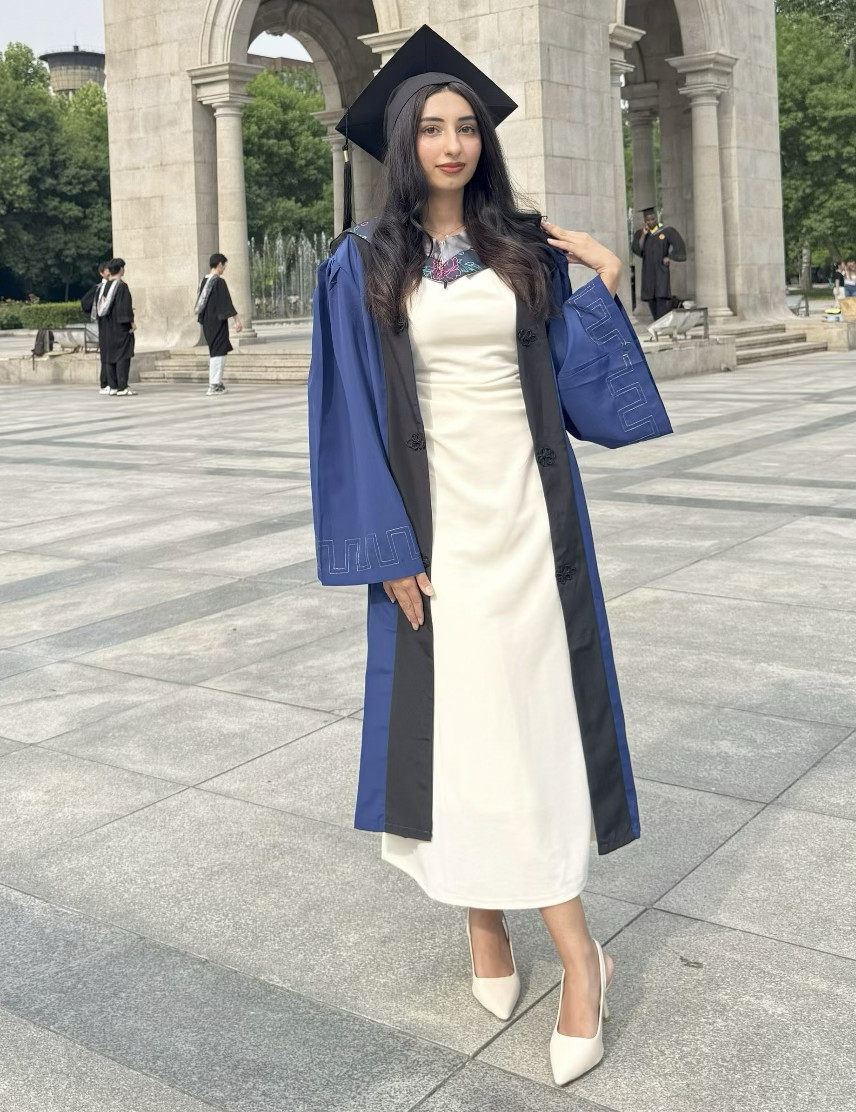
The Journey
Hi, I'm Ushna from Pakistan. I recently completed my M.Sc. in Chemistry at the School of Science, Tianjin University, China, and I'm now starting my PhD in Germany. My research is in computational catalysis: I use DFT simulations, interpretable machine learning (SISSO), and ReaxFF force-field development to understand Fischer-Tropsch synthesis, a process that turns syngas into fuels and chemicals. I'm passionate about green energy, and that is the field I want to keep working on in the years ahead. I chose chemistry because it lets me work on real energy problems at the atomic level, and computational catalysis lets me turn that curiosity into tools that can help design cleaner energy technologies.
Chinese Government Scholarship Details
Chinese Government Scholarship (CSC) for my M.Sc. in Chemistry at Tianjin University, China. In addition to a full tuition fee waiver, It provided a monthly stipend of ¥3,000 plus a ¥700 monthly living allowance (¥3,700 per month in total), which comes to about ¥133,200 over a 3-year duration.
Were You Offered Any Other Scholarships?
Yes. Before finishing my master's, I received several PhD offers from different institutes. Three of them came with funding:
• Forschungszentrum Jülich (Germany) – HITEC Fellowship, Helmholtz: €3,569.53 per month, about €128,500 in total over 3 years. This is the one I chose.
• University of Science and Technology of China (USTC) – CAS-ANSO Scholarship (ANSO Fellowship): ¥6,000–7,000 per month for PhD students, depending on the qualification test, for up to 4 years. That is about ¥288,000–¥336,000 in total.
• Tsinghua University – Chinese Government Scholarship (CSC): a monthly stipend of ¥3,500 plus a ¥1,000 monthly living allowance, with full tuition covered. The total value of the scholarship is about ¥376,000 over 4 years..
Educational Background
I completed my bachelor's at Government College University Faisalabad (GCUF) with a GPA of 3.93/4.0. Before finishing my bachelor's, I received an offer from Tianjin University for my master's, where I graduated with a CGPA of 3.91. My bachelor's gave me a solid foundation in chemistry, and my master's let me specialise in computational catalysis. That combination of strong fundamentals and focused research training is what prepared me to apply for PhD positions in this field.
How Did You Prepare to Apply to Tianjin University?
I always started looking for scholarships about 8-9 months before graduating. My goal was to secure funding without taking a gap, so starting early was essential. For Chinese scholarships, I contacted supervisors who had a similar research background to mine. For the Helmholtz fellowship, I applied to a specific project that matched my interest and expertise, so my application was about a real fit rather than a general interest.
How Did You Find Information About Chinese Government Scholarship and Tianjin University?
I used scholarship databases and websites to find opportunities. Then I researched professors in detail: I read their pages on the university websites and went through their publications on ResearchGate, so I understood their work before I wrote to them or applied.
How Did You Prepare to Apply for the Chinese Government Scholarship?
Two documents mattered most: my academic CV and my research statement. An academic CV is different from a regular CV. It is usually 2-3 pages, clean and precise, and it should still show your research expertise clearly. A research statement, or anything you write for a scholarship, should never read like a generic template. It should be personal to you. I used it to tell the committee what I had done in the past and how that connected to the scholarship I was applying for.
Are Your Classes Conducted in English or Mandarin?
English. My classes were conducted in English, and communication within my research group was also in English.
What Did You Pursue After the Chinese Government Scholarship?
After my master's, I chose to start my PhD research in Germany, at Forschungszentrum Jülich. My goal is to work on sustainable energy solutions, and that is what I will be working on in my PhD and beyond.
Would Potential Students Have Any Problems Not Knowing Mandarin?
Not academically. Since my classes and group communication were in English, I could focus fully on my studies and research.
What Do You Think Made Your Application Stand Out?
I think the biggest factors were a strong academic record and clear research direction. But what I believe mattered most was communication. I wrote my research statement personally, and I told my story in a way that made supervisors and committees interested in me.
What Would You Have Done Differently if You Were Going Through the Process Again?
I would keep the same strategy: start early and apply with a clear goal. I would stop giving myself a hard time and be confident in myself even if I don’t get the replies or the offers that I expected, because building these things takes time; just never lose hope.
What Advice Would You Give Those Looking to Apply for a Similar Scholarship?
Start early and be consistent. Give your scholarship journey some time every single day. It doesn't matter how small, but do it every day. I have seen many people with excellent profiles and publications who still don't receive as many offers, so a strong profile alone is not enough. Never fear that something is too good for you: aim high and have confidence in yourself. Communication is the key. If you can tell your story in a way that makes people interested in you, nothing can stop you. Keep going, keep believing in yourself, and your effort will pay off.
Want to submit your
scholarship journey?
Submit Your Story Here!
More Scholarship Recipients
I chose my university major for a surprisingly simple reason: I realized I really didn't like numbers. When I was trying to .... Read more
Oftobkhon Akhadjonova, 24 years old, from Uzbekistan. Work experience: Intern at the Centre for Professional and Lifelong E .... Read more
I am Provakar Baruri, and I am from Durgapur, West Bengal, India. I am currently pursuing my Master's in Materials Science a .... Read more
Leave A Comment