
How Toheeb Lekan Jolaosho, a Nigerian Scholar, Secured a Fully Funded Double-Degree Research Master’s in Islands and Sustainability and Spatial Sciences at the University of Groningen and Universidad de Las Palmas de Gran Canaria Through the Erasmus Mundus Scholarship
Universities: University of Groningen (Netherlands) and Universidad de Las Palmas de Gran Canaria (Spain)
Degree: Double-Degree Research Master’s in Islands and Sustainability and Spatial Sciences
Previous Education: BSc in Fisheries, Lagos State University (First-Class Honours; Best Departmental Graduate); National Diploma in Fisheries Technology
Scholarship: Erasmus Mundus Scholarship – €33,600 Living Stipend over 24 Months plus Tuition; Approximate Total Value €70,000–€80,000
Other Offered Scholarships: University of Alabama PhD Assistantship; McGill Thesis-Based Master’s Funding (Tuition and CAD 2,300 Monthly for 24 Months); Later PhD Offers at Vienna, Melbourne, Emory and Notre Dame; Accepted Nord University PhD Funding
LinkedIn: Toheeb Lekan Jolaosho
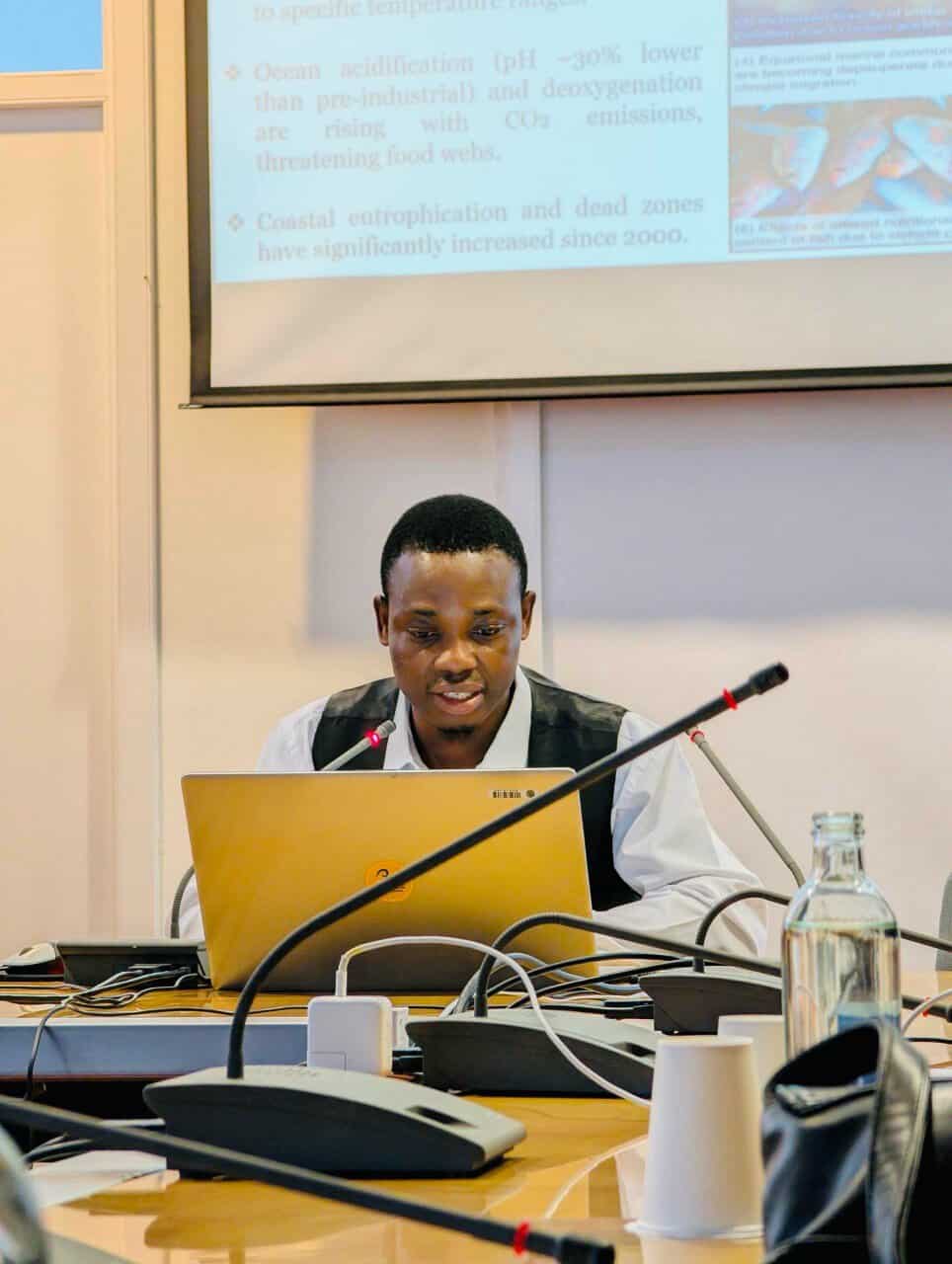
The Journey
My name is Toheeb Lekan Jolaosho, and I am from Lagos, Nigeria. I am a marine ecologist and interdisciplinary researcher working across fish and spatial ecology, marine biogeochemistry, aquatic pollution, and ocean sustainability. I am completing an Erasmus Mundus double-degree research Master’s in Islands and Sustainability and Spatial Sciences between the University of Groningen and the Universidad de Las Palmas de Gran Canaria. I chose this programme because it combines spatial analysis with fisheries management and marine ecology, which lets me study how coastal and island systems can be managed sustainably. I pursued further education out of a long-standing passion for research and a commitment to environmental sustainability and conservation through science that informs policy. I also enjoy communicating research clearly.
Erasmus Mundus Scholarship Details
I was awarded the Erasmus Mundus Scholarship, a fully funded European Union scholarship for a double-degree research Master’s programme delivered across two universities: the University of Groningen in the Netherlands, a top 100 institution, and the Universidad de Las Palmas de Gran Canaria in Spain. At Groningen, I studied Spatial Sciences with a focus on Islands and Sustainability. At Las Palmas de Gran Canaria, I studied Biology with a focus on fisheries management and marine ecology. The scholarship provides a monthly stipend for 24 consecutive months, amounting to €33,600 in total. Including tuition fees covered at both universities over the two years, the total value of the award is approximately €70,000 to €80,000.
The ISLANDS consortium comprises the University of Groningen (Netherlands), the University of the Aegean (Greece), the University of Iceland (Iceland), and the University of Las Palmas de Gran Canaria (Spain). Toheeb attended Groningen and Las Palmas de Gran Canaria; the other two institutions are consortium partners.
Other Offered Scholarships
Yes. In the same year I received the Erasmus Mundus Scholarship, I was offered two other fully funded opportunities:
PhD in Biological Sciences, University of Alabama, Tuscaloosa (USA): The funding package covers tuition support and a stipend through teaching and research assistantships. The exact amount depends on assistantship type and supervisor funding.
McGill Scholarship, McGill University (Canada): I was offered admission to a thesis-based Master’s programme, with tuition covered and a monthly stipend of CAD 2,300 for 24 months, totaling approximately CAD 55,200. I was recommended for this opportunity by Prof. Ibiyemi Olatunji Bello, then Vice Chancellor of Lagos State University.
Educational Background
I hold a Bachelor of Science in Fisheries from Lagos State University, where I graduated with First Class Honours as the best graduating student in my department. Before that, I completed a National Diploma in Fisheries Technology. My Master’s grades are 8.3/10 at the University of Groningen and 9.2/10 at the Universidad de Las Palmas de Gran Canaria. This foundation prepared me well for my current field.
My undergraduate and diploma training gave me a strong grounding in fish biology, aquatic ecology, and fisheries science, while my research experience introduced me to ecological risk assessment, aquatic pollution analyses via AAS, ICP-MS, and so on, stable isotope analysis, Bayesian modelling, water quality analyses, Monte Carlo CMSY catch-based fish stock assessment indices, and life cycle assessment. My Master’s added advanced ecological, quantitative, and spatial skills, including statistical modelling in R, habitat suitability modelling, univariate and multivariate statistical analyses, and ArcGIS, qualitative research practices, population projection, and demographic data analyses.
I recently got a PhD position at Nord University in the MPA4Fish project funded by the EU Horizon Europe programme, a project worth USD/EUR 1.9 million under Professor Mark John Costello. Together, these allow me to approach marine biodiversity and environmental sustainability questions from both an ecological and a spatial planning perspective.
How Did You Prepare to Apply to the University of Groningen and Universidad de Las Palmas de Gran Canaria?
How Did You Find Information About Erasmus Mundus Scholarship and University of Groningen and Universidad de Las Palmas de Gran Canaria?
I found opportunities by searching institutional and scholarship portals and through LinkedIn advertisements. For my PhD applications, I identified potential supervisors by sending targeted cold emails introducing my research background and interests before I was accepted.
Did You Take Any Standardized Tests? If So, How Did You Prepare for Them?
I took the GRE in 2022 and scored 332, which really helped me secure the University of Alabama scholarship at the time. I prepared on my own by studying the official test format, working through past questions, and practicing regularly under timed conditions to build speed and accuracy.
How Did You Prepare to Apply for the Erasmus Mundus Scholarship?
My motivation letter was the most important part of my preparation, along with a concise and clear CV in academic format. For the interviews, I prepared by practicing my answers repeatedly and watching many YouTube videos on interview techniques.
What Did You Pursue After the Erasmus Mundus Scholarship?
Shortly after my Erasmus Mundus Master’s degree, I won fully funded PhD scholarships at the University of Vienna, Austria (Aquatic Ecology and Limnology); Nord University, Norway (Biosciences and Fisheries); the University of Melbourne, Australia (Food and Ecosystem Science); Emory University, United States (Environmental Science); and the University of Notre Dame, United States (Biological Sciences). I chose Nord University because the research aligns closely with my Master’s thesis on marine protected areas, fish spillover, refugia, and morphofunctional systems. It also offered the best technical support package of all the universities, provided through the Biodiversa+ and Horizon Europe-funded MPA4Fish project.
What Do You Think Made Your Application Stand Out?
Three things made my application stand out.
- First, my overall CGPA, graduating with First Class Honours.
- Second, before I won my first set of scholarships, I had already published about 12 papers in Q1-indexed journals, including 7 as first author.
- Third, my other credentials supported these strengths: an outstanding GRE score, a strong performance at the interview, where the interviewers commented on my confidence and the diligent way I responded, and a well-prepared motivation letter and CV highlighting my skills.
What Would You Have Done Differently If You Were Going Through the Process Again?
Choosing just one among the scholarships I was first awarded was a difficult task, but I believe I made a good choice. If I were to go through the process again, I would start my applications earlier and give myself more time to refine each motivation letter for the specific programme and supervisor. I would also contact potential supervisors even sooner, since early conversations helped me understand which research environments were the best fit. Finally, I would keep a simple tracker of deadlines, requirements, and funding details across all applications, which would make comparing offers easier.
What Advice Would You Give Those Looking to Apply for a Similar Scholarship?
I would advise a prospective candidate to apply early and build a strong research profile before applying. In my experience, publishing, even in small steps, and gaining hands-on experience with collaborators set me apart.
I also recommend reaching out to potential supervisors with a short, targeted email that shows how your background fits their work, because many opportunities are won through those early conversations. I wrote a motivation letter specific to each programme and kept my CV concise and in academic format. I prepared for interviews by practising my answers and speaking with confidence about my research and goals.
I applied to several programmes, since funding decisions can be competitive, and compared offers carefully on research fit, supervision, and the financial and technical support provided. Above all, I stayed persistent and kept my long-term vision clear.
Want to submit your
scholarship journey?
Submit Your Story Here!
More Scholarship Recipients
My name is Madison Fitzpatrick, and I am from the Bay Area, California. I studied International Security and Conflict Resolu .... Read more
My name is Dr Simon Okomo Aloo. I am a Kenyan interdisciplinary food and biomedical scientist working at the intersection of .... Read more
- Australia
- Australian Government Research Training Program (RTP) Scholarship
- Biology
- Brain Korea 21 (BK21) Fellowship
- Food Science
- Fully Funded Scholarships
- Global Korea Scholarship
- Kangwon National University
- Kenyan Nationality
- Master's Scholarships
- Monash Graduate Scholarship
- Monash University
- Ph.D. Scholarships
- South Korea
- University of Wollongong
My name is Stanley Hau. I grew up in the Netherlands and have lived in several places since, which taught me to adapt quickl .... Read more
Leave A Comment