
How I Secured a Fully Funded Master's at the University of Coimbra, Portugal Through the Erasmus Mundus Scholarship
University: University of Coimbra
Degree: Erasmus Mundus Joint Master in Planetary Geosciences
Previous Education: BSc in Space Science, Institute of Space Technology
Scholarship: Erasmus Mundus Scholarship (GeoPlaNet Erasmus Mundus Joint Master) – Full Funding (Tuition and Monthly Living Allowance)
Other Offered Scholarships (if any): MASS Erasmus Mundus Joint Master in Astrophysics and Space Science – Partial Scholarship
Social Media
LinkedIn: linkedin.com/in/syed-zeeshan-abid/
The Journey
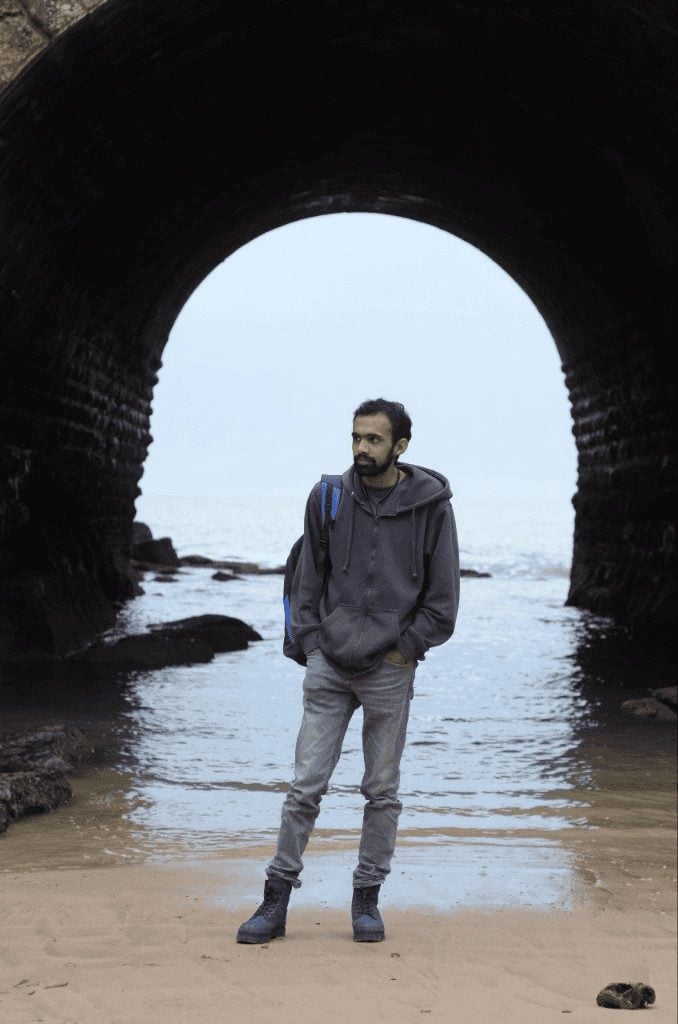
My name is Syed Zeeshan Abid, and I come from Mandi Bahauddin, a small city in Punjab, Pakistan. I studied Space Science at the Institute of Space Technology in Islamabad, then joined the GeoPlaNet Erasmus Mundus Joint Master in Planetary Geosciences from 2024 to 2026. My first year ran between Coimbra in Portugal and Chieti-Pescara in Italy. The programme normally sends students to Nantes in France for the third semester, but France refused my visa, so I returned to Coimbra and finished the second year there.
I work on the computational side of planetary science: celestial mechanics, tidal evolution, and direct N-body simulation. Prof. Alexandre Correia supervised my master’s thesis at Coimbra, where I studied how close-in planets, the so-called hot Jupiters, form inside dense stellar clusters.
Educational Background
I graduated from the Institute of Space Technology in 2022 with a BSc in Space Science, a GPA of 3.56 out of 4.00, and cum laude honours. The degree covered far more ground than its name suggests. I took astronomy and astrophysics, classical and quantum mechanics, special relativity, computational physics and numerical analysis on one side, and GIS, remote sensing, digital image processing, spatial databases, meteorology and atmospheric chemistry on the other. For my final year thesis, I simulated the eccentricity evolution of massive black hole binaries in non-rotating galactic nuclei, running GPU-accelerated direct N-body models on ten datasets of roughly two million particles each and writing the whole analysis pipeline in Python. After graduating, I worked for two years in Pakistan, first as a computational physicist at NaqCoDE and then as an R&D associate at the Space Technology Applications Research Lab, where I also supervised eight research interns.
That breadth prepared me academically. GeoPlaNet mixes geology, physics, data analysis, and remote sensing, and I had already met most of those pieces somewhere in my bachelor’s. Teaching myself tools and running simulations on remote clusters helped just as much, because in a joint master's you change university, computing system, and supervisor every few months and nobody walks you through it.
Nothing prepared me for the rest. Before this, I had never lived outside Pakistan for longer than two months. I made friends from all over the world, and they taught me to stay curious instead of judging whatever I did not recognise. I also handled an enormous amount of bureaucracy: visas, residence permits, enrolments, bank accounts. That forced me to become independent much faster than I expected. Living abroad also opened me to the idea that morality is subjective and depends a great deal on where you stand.
How Did You Prepare to Apply to the Universities?
Honestly, I did not prepare much. I was working full time when a friend told me to apply. I read the GeoPlanNet website properly, checked the course structure and the mobility path, and sent the application in. The motivation statement took the only real effort. I wanted it to connect my actual background to what the programme teaches, rather than sound like every other applicant.
How Did You Prepare to Apply for the Erasmus Mundus Scholarship?
I applied to two Erasmus Mundus programmes and nothing else: MASS, in Astrophysics and Space Science, and GeoPlaNet. Erasmus Mundus treats admission and scholarship as a single application, so no separate preparation exists. I did not expect either one to work out.
Both came back with an offer. MASS admitted me on a partial scholarship, while GeoPlaNet awarded the full Erasmus Mundus package, which covers the tuition and pays a monthly living allowance. That settled the choice, because a partial award would have left a gap I had no realistic way to cover. GeoPlaNet also suited my mixed background better and pointed my simulation work towards planetary systems instead of keeping me on black holes.
I have no glorified story here. A friend asked, I applied, and the result surprised me. The competition is real, though. These programmes draw hundreds of applications from every continent for a small number of funded places, and shortlisted candidates sit an interview before the consortium decides.
Looking back, I think my bachelor’s stood out because it was multidisciplinary in the same way GeoPlaNet is. I had studied GIS and remote sensing alongside astronomy and environmental science, so the curriculum did not look alien to me. A research thesis with real computational results, two years of work experience in scientific software, and letters from supervisors who knew my work probably counted too.
Were You Offered Any Other Scholarships?
Yes. MASS, the Erasmus Mundus Joint Master in Astrophysics and Space Science, offered me a place with a partial scholarship. The consortium behind it consists of the University of Rome Tor Vergata, the University of Belgrade, the University of Bremen and the Université Côte d’Azur. I turned down the award for the full GeoPlaNet scholarship. Worth knowing: these programmes hand out partial awards as well as full ones, so an application that misses the top of the ranking can still come back with money attached.
Could You Briefly Discuss the Erasmus Mundus Program You Pursued and the Specific Field of Study It Focused On?
GeoPlaNet-EMJM awards a joint master’s degree in Planetary Geosciences across two years and 120 ECTS. Nantes Université coordinates it together with the University of Coimbra in Portugal and the University of Chieti-Pescara in Italy, and a wider consortium of about twenty partners, including space agencies and research centres, backs the programme. The mobility path is fixed: semester one in Coimbra, semester two in Chieti-Pescara, semester three in Nantes, and semester four for a research internship inside the partner network. All teaching happens in English.
The programme builds its teaching around research. Courses cover planetary geology and planetary materials, planetary dynamics, Earth and planetary magnetism, reflectance spectroscopy of asteroids, image processing and analysis, remote sensing and spatial modelling, mapping and data processing, and computational methods applied to geophysics. Within that, I chose the computational and dynamical side. My thesis simulated how hot Jupiters form in dense stellar clusters, coupling gravity, post-Newtonian corrections, tides, and spin dynamics in a single N-body integration.
What Did You Pursue After the Erasmus Mundus Scholarship?
I am writing my thesis up as a first-author paper for Astronomy & Astrophysics and expect to submit it shortly. Alongside that, I continue an independent project on estimating planetary magnetic dipoles and designing the orbits that measure them best, and I am applying for PhD positions in planetary and stellar dynamics.
How Did the Cost of Living Vary Across the Countries You Studied In? Which Country Was the Most Affordable or Expensive, and How Did You Manage Financially?
I only lived in Portugal and Italy, and I managed comfortably in both. Portugal cost less, particularly rent, eating out, and the university canteens. Italy asked for a little more, though the difference never worried me. The Erasmus Mundus scholarship pays the tuition and a monthly living allowance, and I saved roughly half of that allowance. The expenses that actually bite come at the start: flights, the first month of rent with a deposit, and the visa and residence permit fees. Arrive with a buffer for those, and the rest sorts itself out.
Did You Face Any Language Barriers, and if so, How Did You Overcome Them? Did the Language of Instruction Change from One Country to Another?
English carried all the teaching, so lectures never caused trouble. Daily life in Italy did. Outside the university, shops, offices, and appointments often ran only in Italian, so I leaned on Google Translate and took an Italian-speaking friend with me whenever something mattered. Portugal felt easier, and I picked up basic Portuguese along the way.
My third semester turned into a special case. France rejected my visa, so I went back to Coimbra instead of Nantes, and two of the courses there ran in Portuguese. I got through them with translation tools and with help from classmates and lecturers.
Would You Recommend the Erasmus Mundus Program to Others?
What Advice Would You Give to Someone Considering This Scholarship?
What Advice Would You Give Those Looking to Apply for a Similar Scholarship?
Prepare for the interview, because the decision happens there. Know your own CV and motivation letter well enough to talk about them without notes. Explain your past research so that someone outside your subfield can follow it. Give a concrete reason why this programme and this mobility path fit you, which means reading the actual curriculum before you apply. Start your documents early as well, and take the visas and paperwork as seriously as the academic side. Mine went wrong and cost me a semester in France.
What Would You Have Done Differently if You Were Going Through the Process Again?
I would go out more. The mobility makes travelling and meeting people easy, and I spent much of that time working instead. Beyond that I have no regrets.
Want to submit your
scholarship journey?
Submit Your Story Here!
More Scholarship Recipients
My name is Shah Hussain, and I am from Khyber Pakhtunkhwa, Pakistan. I completed my Bachelor’s in Psychology at the Univer .... Read more
I am June from the Philippines. I am an educator for Social Sciences and Humanities. I recently earned my Master in Southeas .... Read more
Hi, my name is Abdul Hafeez, and I come from a small town called Nasirabad in Sindh, Pakistan. Currently, I am pursuing a ma .... Read more
Leave A Comment