
How Rassula Arone Dzimba, a Mozambican Scholar, Secured a Fully Funded Master’s in Medical Biosciences and Bioinformatics at the University of Bradford, United Kingdom Through the Chevening Scholarship
University: University of Bradford
Degree: MSc in Medical Biosciences and Bioinformatics
Previous Education: Undergraduate Degree in Biomedical Laboratory Technology, Higher Institute of Health
Scholarship: Chevening Scholarship – Full Funding (Tuition Fees, Monthly Living Stipend, Return Economy Flights, Visa Application Fee, Arrival Allowance, Thesis/Dissertation Grant)
Other Offered Scholarships: Calouste Gulbenkian Foundation Scholarship – Funding for a Master’s Degree in Portugal
Social Media
LinkedIn: linkedin.com/in/rassula-dzimba-a1a9221b3
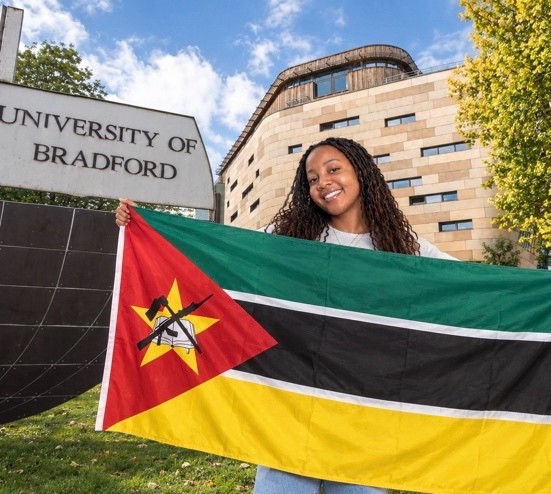
The Journey
My name is Rassula Arone Dzimba. I am from Mozambique, where I worked as a data manager at the National Institute of Health for nearly four years, on surveillance of respiratory diseases and emerging diseases such as COVID-19 and dengue. My role involved processing and analysing large volumes of epidemiological data to support public health decision-making, including tracking how diseases spread across regions and ensuring surveillance reports reached decision-makers quickly.
Over time, I became increasingly interested in the biological mechanisms underlying the patterns I was observing in the data, for example, why certain viral strains spread more effectively than others. Surveillance data could tell me what was happening, but not why it was happening at a genetic level. This gap led me toward bioinformatics, a field that combines biology and computational analysis to study genomic data directly. I am currently pursuing an MSc in Medical Biosciences and Bioinformatics at the University of Bradford, as a natural next step from my public health data background into more advanced computational biology.
Chevening Scholarship Details
I am a Chevening Scholar. Chevening is the UK government's global scholarships and fellowships programme, funded by the Foreign, Commonwealth & Development Office (FCDO) and partner organisations. It funds emerging leaders from over 160 countries and territories to complete a one-year, fully funded taught master's degree at any UK university, with no restriction on subject area.
The scholarship covers full tuition fees for my MSc at the University of Bradford, a monthly living stipend, return economy flights between Mozambique and the UK, my UK visa application fee, an arrival allowance, and a thesis/dissertation grant. The total value for a one-year programme typically ranges between £30,000 and £50,000, depending on the course and location.
The programme is highly competitive. For the 2025/2026 cohort, Chevening received more than 100,000 applications globally for approximately 1,500 available places worldwide, an acceptance rate of roughly 1.5%.
Were You Offered Any Other Scholarships?
If so, please state the name of the scholarship, the amount of the scholarship, and the institution name.
Yes. Before accepting Chevening, I was also offered a scholarship from the Calouste Gulbenkian Foundation to pursue a Master's degree in Portugal. Both were strong offers. I ultimately chose Chevening and the University of Bradford because the programme structure and the institution's research profile aligned more closely with my career plan.
Educational Background
I hold an undergraduate degree in Biomedical Laboratory Technology from the Higher Institute of Health. This gave me a laboratory-based foundation in biomedical science. Combined with my subsequent professional experience managing epidemiological surveillance data at the National Institute of Health, this background positioned me well to pursue bioinformatics, a field that sits at the intersection of biological science and data analysis.
How Did You Prepare to Apply to the University of Bradford?
I began by identifying the gap I wanted to close professionally: what skills I already had, what skills I needed to develop, and what expertise was lacking in my home country that I could contribute toward. From there, I shortlisted master's programmes that would close that gap, and researched each one in depth, covering specific modules, teaching methods, research facilities, faculty and research groups, industry links, and graduate employability outcomes.
I selected the University of Bradford primarily for its research profile. The School of Pharmacy and Medical Sciences has a strong international research reputation, with the majority of its research output rated internationally excellent or world-leading in the most recent national Research Excellence Framework assessment, and its Pharmacy and Pharmacology programme has repeatedly ranked among the top 200 globally in the QS World University Rankings. Given my laboratory background, I prioritised a programme grounded in active research rather than teaching alone, and the course structure at Bradford aligned closely with my career plan.
How Did You Find Information About Chevening Scholarship and University of Bradford?
Primarily through chevening.org, including the eligibility checker, country-specific application pages, and published alumni stories. Reviewing past scholars' profiles in related fields helped clarify what a competitive application looked like in practice, beyond the official guidance.
Did You Take Any Standardized Tests? If So, How Did You Prepare for Them?
Yes, I took IELTS. I prepared using British Council materials and supplementary YouTube resources, working consistently through practice tests and speaking and writing exercises over an extended period rather than close to the exam date.
How Did You Prepare to Apply for the Chevening Scholarship?
Chevening's application centres on four supporting essays: leadership, networking, studying in the UK, and career plan, each limited to 100–300 words.
For the leadership essay, I listed all relevant leadership experiences, academic, workplace, community, and informal instances of influence, then evaluated each against five criteria: impact, influence, initiative, complexity, and available evidence. This helped identify the three strongest examples rather than defaulting to generic ones. Each was written using the STAR method (Situation, Task, Action, Result), concluding with a reflection on the outcome and its relevance to my future goals.
For the networking essay, I identified professional relationships I had built and maintained, then selected two to three examples that demonstrated initiation, ongoing engagement, and measurable outcomes, along with a section on how I planned to build my professional network in the UK.
For the career plan essay, I worked from a 10–15-year professional objective, then broke this into immediate (0–2 years), mid-term (3–5 years), and long-term (5–10+ years) plans, linked to specific organisations and institutions relevant to my field.
The essay-writing process took several weeks and required multiple rounds of revision for each essay. This was completed alongside full-time employment.
How is Your Experience at the University of Bradford?
My experience at Bradford has been positive both academically and socially. The university has societies representing a wide range of nationalities and regularly organises cultural, social, and academic events. A dedicated wellbeing team is also available to support students with academic or personal matters, which was valuable in adjusting to studying abroad.
How Do You Rate the University of Bradford Academically?
I would rate the University of Bradford highly, primarily due to its research profile. The School of Pharmacy and Medical Sciences has a strong research reputation, with the majority of its output rated internationally excellent or world-leading in the most recent Research Excellence Framework, and its Pharmacy and Pharmacology programme consistently ranks among the top 200 globally. This research depth was a key factor in my decision, given my background in laboratory science.
How Does the University of Bradford Support International Students?
Beyond the societies and wellbeing services mentioned above, the university offers free, optional English language lessons for international students. This reflects a broader approach to supporting students from different academic and linguistic backgrounds.
What Did You Pursue After the Chevening Scholarship?
I am currently completing the MSc, with a thesis focused on identifying functional regulatory elements of the human DAZL promoter using luciferase reporter assays and site-directed mutagenesis. I plan to continue on to a PhD following the completion of this degree.
What Do You Think Made Your Application Stand Out?
I attribute this to four factors: a consistent narrative across all four essays, an authentic rather than overly polished tone, specific and measurable examples of impact, and a study plan clearly connected to a defined need in my home country.
What Would You Have Done Differently if You Were Going Through the Process Again?
I would allocate more time earlier in the process, particularly for essay writing and course research, which took longer than anticipated. I would also plan further in advance for IELTS preparation and the costs associated with the mandatory TB test, both of which required more time and budgeting than I initially accounted for.
What Advice Would You Give Those Looking to Apply for a Similar Scholarship?
Begin preparing before the application portal opens. Maintain an ongoing record of leadership, community, and networking experiences, with measurable outcomes where possible. Identify references early and provide them with sufficient lead time, along with your essays, CV, and career plan, so they can write specific and informed recommendations. Focus on presenting an authentic account of your experience rather than anticipating what selectors want to hear.
Want to submit your
scholarship journey?
Submit Your Story Here!
More Scholarship Recipients
My name is Shah Hussain, and I am from Khyber Pakhtunkhwa, Pakistan. I completed my Bachelor’s in Psychology at the Univer .... Read more
I am June from the Philippines. I am an educator for Social Sciences and Humanities. I recently earned my Master in Southeas .... Read more
Hi, my name is Abdul Hafeez, and I come from a small town called Nasirabad in Sindh, Pakistan. Currently, I am pursuing a ma .... Read more
Leave A Comment