
How I Secured a Partially Funded Master's at the University of Bristol, UK Through the GREAT Scholarship for Justice and Law 2024
University: University of Bristol
Degree: LLM in International Law
Previous Education: Undergraduate honours degree in Law and Political Science
Scholarship: GREAT Scholarship for Justice and Law– Partial Funding (50% of Tuition Fees, £13,000)
Other Offered Scholarships: Think Big Scholarship, University of Bristol – 50% Tuition Fee Scholarship and £3,000 Bursary
Social Media
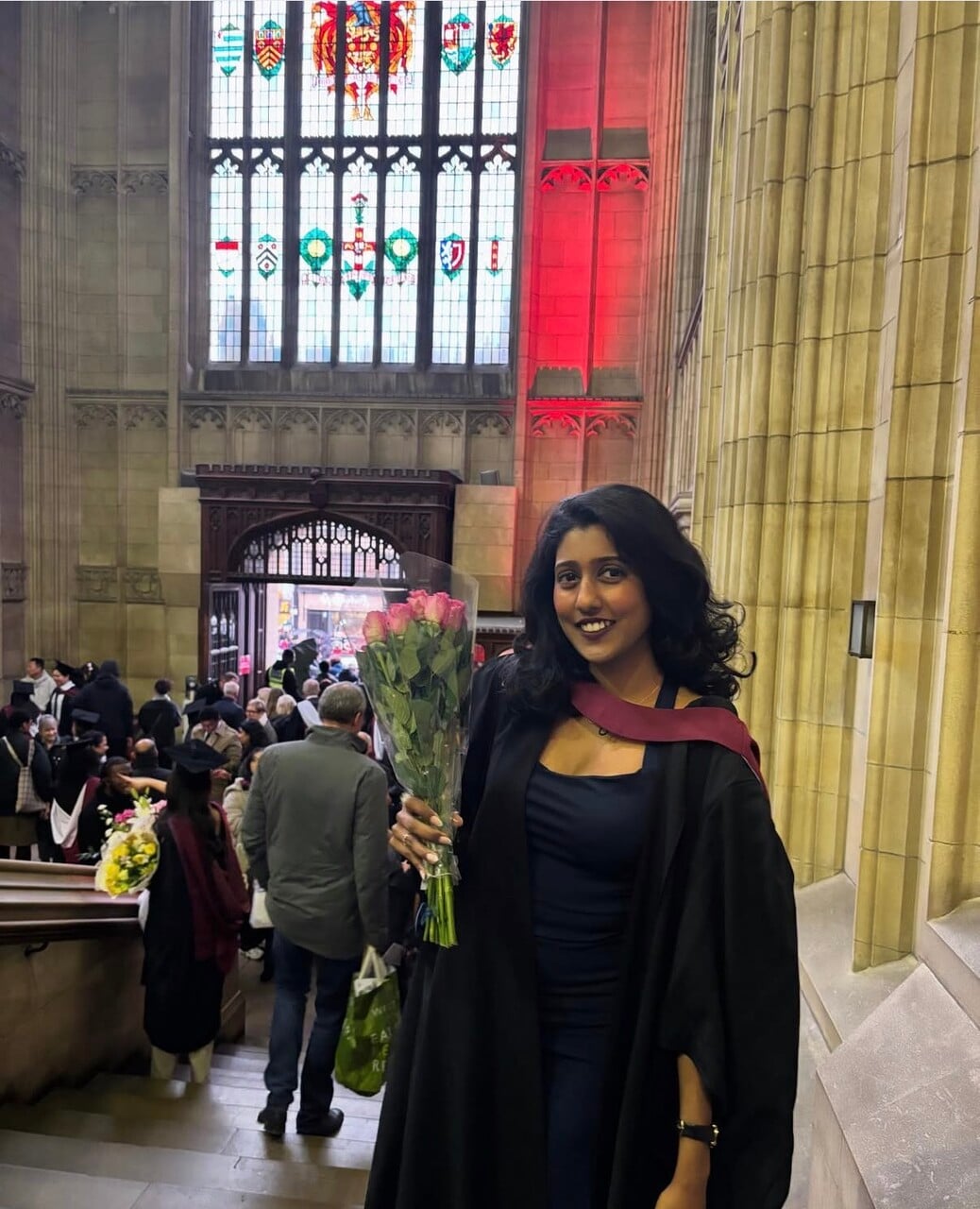
The Journey
This is Karnikka Mahendran from Chennai, India. I pursued an undergraduate honours degree in Law and Political Science. I subsequently qualified to practice law in India and gained a cumulative experience of about 2.5 years in both corporate law and litigation.
Since my University days, I developed a growing interest in migration law and its transboundary implications, particularly through an internship opportunity with the Migration and Asylum Project, India. The grounding experience of assisting asylum seekers through the Refugee Status Determination process in India sparked my curiosity about the intersection of international law, human mobility, and global policy frameworks, and encouraged me to explore the field further. I decided to pursue an LLM in International Law at the University of Bristol, UK. I saw this as an opportunity not only to specialise in an area I am intrigued by but also to broaden my perspective and explore the diverse avenues available within this mammoth field.
GREAT Scholarship Details
GREAT Scholarship for Justice and Law 2024, funded in partnership with the British Council and the GREAT Britain Campaign. The scholarship was awarded to one Indian postgraduate student and provided 50 % towards my tuition fees, which was £13,000.
Were You Offered Any Other Scholarships?
My experience applying for the scholarships for my master's was quite unique. I had initially planned to pursue my master’s degree in 2023 and had applied for the Think Big Scholarship offered by the University of Bristol. I was awarded a 50% tuition fee scholarship along with a £3,000 bursary. However, due to personal commitments, I was unable to pursue my studies that year and decided to reapply the following year.
When I reapplied, I did not receive the Think Big Scholarship but later received confirmation that I had instead been awarded the GREAT Scholarship for Justice and Law 2024. In addition to the funding, the award also provided me with access to the University’s Think Big Development Programme, which supports scholars through professional and personal development opportunities beyond academics.
Educational Background
To be very honest, I did not have an exemplary CGPA to begin with. I graduated with a cumulative percentage of around 71.6% during my UG, which followed a relatively strict marking system. Despite meeting all academic requirements for the universities I applied to, I knew I had to demonstrate my merit beyond just grades to land offers and scholarships. I would say that the distinguishing factor in my application was the breadth of experience I built alongside my degree. During university and after graduation, I actively pursued internships, volunteering opportunities, academic research, publications, and extracurricular engagements, including participating in and winning national moot court competitions. Alongside this, I gained practical legal exposure through 2.5 years of work experience in both corporate law and litigation, where I worked with diverse clientele and engaged with matters across different judicial forums.
How Did You Prepare to Apply to the University of Bristol?
How Did You Find Information About GREAT Scholarship and University of Bristol?
Most of my sources for finding universities and scholarships came from online research and word of mouth. I closely followed the journeys of seniors from my university and professional circles who had secured admissions, scholarships, and opportunities abroad, and I spoke to several of them to better understand the process. I did reach out to a few educational consultancies during the process, although I did not rely entirely on them. While they were helpful in suggesting universities that matched my interests and profile, I took it with a pinch of salt and still made it a point to independently research the scholarships and funding opportunities. I actively went through university websites, explored scholarship portals, and looked into country-specific and programme-specific funding opportunities. I researched scholarships offered directly by universities, scholarships specifically available for Indian students, government-funded scholarships, and even legal aid or field-specific funding opportunities. A lot of it honestly came from consistently digging through information online and being proactive about searching for opportunities.
Did You Take Any Standardized Tests? If So, How Did You Prepare for Them?
I took the IELTS as it was a requirement for most of my university and scholarship applications. At the time, I was also working full-time, so balancing preparation with work required a lot of time management. I quickly realised that while the test certainly evaluates your English proficiency, a major part of hitting a good score in IELTS is learning how to effectively manage time under pressure, since every section is strictly time-bound. To prepare, I followed a very practice-oriented approach relying on study materials and mock tests available online. IELTS consists of four sections: Reading, Writing, Listening, and Speaking. I made it a point to practise at least one timed test for each section every day for about 3-4 weeks. This helped me get familiar with the format and honed my speed. I was able to secure an overall band score of 8.5 in IELTS.
How Did You Prepare to Apply for the GREAT Scholarship?
One thing I focused on heavily was making the best possible use of the word count and prioritising brevity. I started drafting my responses quite early to ensure I had enough time to revisit, edit, and refine them multiple times. Another important part of my preparation was sitting down and mapping out all the experiences, achievements, internships, extracurriculars, and work opportunities I had undertaken over the years. From there, I filtered out the examples that best aligned with each question instead of trying to include everything. I think choosing relevant examples and being concise made a huge difference in presenting a focused and authentic application.
How is Your Experience at the University of Bristol?
I personally had a wonderful experience at the institution. The course was incredibly enriching and shaped the way I perceive international law for the better. I enjoyed engaging with the core syllabus, and I was fortunate to emerge as the best performer of my cohort. Beyond academics, the institution gave me a wonderful network of friends and fellow peers. The scholarship also enriched my overall experience beyond academics. As part of the GREAT Scholarship network, all the Law and Justice scholars from across the UK were invited on a study tour to Glasgow, Scotland, where we engaged with important legal landmarks and interacted with professors who introduced us to aspects of the Scottish legal system. In addition to this, we had networking events both within the university and in cities such as Nottingham, where we had the opportunity to meet fellow scholars from diverse backgrounds, exchange experiences, and build meaningful professional and personal connections. Altogether, it was an immensely fulfilling experience that holistically changed me for the better.
How Do You Rate the University of Bristol Academically?
Academically, I would rate the institution quite positively. My programme was intellectually stimulating. The lectures and assignments were designed not just to test theoretical knowledge, but to encourage critical thinking and engagement with real-world legal and policy issues. Another aspect I valued greatly was the faculty. Many of my professors were actively engaged with the very judicial and international institutions I was interested in, and they brought significant practical experience into the classroom. It also paved the way for interesting and varied research and internship opportunities, all of which strengthened my CV.
What Do You Think Made Your Application Stand Out?
My guess would be that I did not try to paint a perfect picture. Instead, I focused on being genuine about my experiences, motivations, and aspirations. Rather than speaking in broad terms, I presented my goals as feasible and actionable steps that I genuinely hoped to work towards. I also carefully acknowledged my shortcomings in achieving my goals and how the course/scholarship would equip me in that regard. I actively made sure that my transferable skills coupled with my willingness to explore, learn, and imbibe came through strongly in my application.
What Would You Have Done Differently if You Were Going Through the Process Again?
I would have definitely started researching for opportunities much earlier. At one point, I experienced what I would call “application fatigue” because I was applying to so many scholarships and university applications at the same time that my answers started sounding repetitive and even generic. I think spacing out applications better would have helped me tailor my responses more specifically to the values and requirements of each scholarship. And most importantly, I would not let self-doubt stop me from applying. There were definitely moments where I felt my chances of receiving certain scholarships were low, or that the application process itself felt too complex and overwhelming to navigate. Looking back, I think I would approach the process with a lot more confidence and trust myself.
What Advice Would You Give Those Looking to Apply for a Similar Scholarship?
I think the first thing is to speak to people who have already received similar scholarships or taken similar academic pathways. I would also place a lot of importance on building a good rapport with your referees, especially if the scholarship requires recommendation letters. Your referees are essentially the only other people apart from you who vouch for you, so I think it is important to have honest conversations with them about your motivations, your goals, and even areas where you feel your profile could benefit from additional context or support. Another piece of advice would be to start early. Giving yourself enough time to reflect, draft, edit, and refine your essays makes a huge difference. I would consciously try to be as specific and crisp as possible instead of giving generic answers. I would also encourage people to cast their net very wide when searching for scholarships. There are many organisations and initiatives offering financial support that are not widely advertised. Finally, I would ask you to try not to be deterred by the taxing application process or the high competitiveness of these scholarships. Just show up and give your best shot, and most importantly, don’t look back once you click the submit button.
Want to submit your
scholarship journey?
Submit Your Story Here!
More Scholarship Recipients

My name is Anna Nana Agyeiwaa Mensah, a professional nurse from Ghana. My interest in Global Health grew out of my experienc .... Read more

My name is Ratul Chakraborty, and I am from Bangladesh. My background is interdisciplinary, actually. Before coming to Germa .... Read more

My name is Mabel Zuñiga. I am a graduate student from Panama pursuing a Master’s degree in Public Policy at the Universit .... Read more
Leave A Comment