
How I Secured a Partially Funded Master’s at the University of Caen Normandy, France Through the France Excellence Eiffel Scholarship
University: University of Caen Normandy
Degree: Master 2 in Statistics, Applied Analysis, and Decision Support
Previous Education: Bachelor’s in Mathematics at École Normale Supérieure of Tétouan; Master’s in Mathematical Modelling at Mohammed V University;
Scholarship: France Excellence Eiffel Scholarship – Funding (€1,181 Monthly Allowance, International and National Transportation, Insurance, Accommodation Assistance, Cultural Activities)
Social Media
LinkedIn: linkedin.com/in/hajar-badraoui/
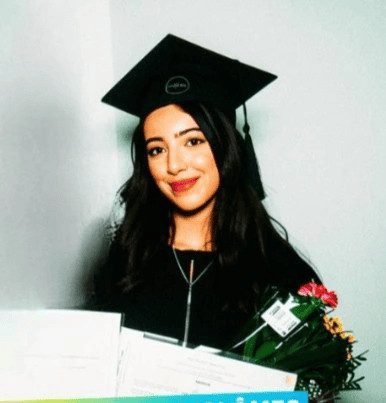
The Journey
My name is Hajar Badraoui, and I am from Morocco. My academic background is mainly in mathematics, mathematical modelling, statistics, and data analysis.
I have always been interested in using mathematics to understand and solve real-world problems. After completing my studies in mathematics and mathematical modelling in Morocco, I decided to continue my education in France to strengthen my knowledge of applied statistics, data science, and scientific research.
For the 2024–2025 academic year, I completed a Master 2 in Statistics, Applied Analysis and Decision Support at the University of Caen Normandy in France. This programme represented an important step toward my objective of pursuing a research career.
Today, I am pursuing a CIFRE PhD at École Polytechnique in collaboration with TotalEnergies. My current research lies at the intersection of climate science, applied mathematics, and renewable energy.
France Excellence Eiffel Scholarship Details
I received the France Excellence Eiffel Scholarship for the 2024–2025 academic year to complete my Master 2 at the University of Caen Normandy.
The scholarship is funded by the French Ministry for Europe and Foreign Affairs and managed by Campus France.
At the Master’s level, I received a monthly allowance of €1,181. The scholarship also included several additional benefits, such as international and national transportation, insurance, assistance with finding accommodation, and access to cultural activities.
Receiving the Eiffel Scholarship was a major achievement for me. Beyond the financial support, it gave me the opportunity to study in an international environment, develop my academic profile, and prepare for a career in research.
Were You Offered any Other Scholarships?
N/A. The France Excellence Eiffel Scholarship was the scholarship I received for this programme.
Educational Background
I completed my Bachelor’s degree in Mathematics at the École Normale Supérieure of Tétouan in Morocco, where I graduated at the top of my class in 2022.
After that, I pursued a Master’s degree in Mathematical Modelling at Mohammed V University in Rabat. This programme allowed me to develop strong skills in applied mathematics, numerical modelling, optimisation, programming, and scientific computing.
I then joined the Master 2 programme in Statistics, Applied Analysis and Decision Support at the University of Caen Normandy for the 2024–2025 academic year.
My institutions used numerical grades rather than the GPA system commonly used in some countries. Therefore, I prefer to describe my academic results through my academic ranking and achievements rather than converting them into an unofficial GPA.
My previous studies prepared me well for the Master 2 programme because they gave me a strong foundation in mathematics and modelling. The Master 2 allowed me to complement that background with advanced skills in statistics, machine learning, data analysis, and decision-support methods.
This combination of mathematics, modelling, and data science later helped me transition toward climate and renewable-energy research during my PhD.
How Did You Prepare to Apply to the University of Caen Normandie?
I began by identifying programmes that were consistent with both my academic background and my long-term professional goals.
I carefully examined the course content, admission requirements, research opportunities, language of instruction, internship possibilities, and career prospects of each programme.
I then prepared the main application documents, including:
My academic CV
- Academic transcripts and diplomas;
- A personalised motivation letter;
- Recommendation letters;
- Proof of language proficiency when requested;
- A clear explanation of my academic and professional project.
I did not send exactly the same motivation letter to every institution. I adapted each letter to the programme and explained why its courses and opportunities were relevant to my previous studies and future plans.
I also started contacting institutions early because scholarship deadlines are often different from regular university admission deadlines.
How Did You Find Information About the France Excellence Eiffel Scholarship and University of Caen Normandie?
I found information through official university websites, Campus France, scholarship platforms, LinkedIn, and social media pages dedicated to scholarships and international study opportunities.
I also contacted programme coordinators when I needed clarification about the admission procedure or the documents required.
For the Eiffel Scholarship, an important point is that students cannot submit their applications directly to Campus France. The application must be submitted by a French higher-education institution on behalf of the candidate.
Therefore, students interested in the Eiffel Scholarship should contact the French institution early and ask whether it selects and nominates candidates for the scholarship.
I did not take the SAT, ACT, GRE, or GMAT because they were not required for my programme.
For language requirements, I submitted the documents requested by the institution. Applicants should always check the specific requirements of their selected programme because some institutions may ask for an official French or English language certificate, while others may accept different forms of proof.
How Did You Prepare to Apply for the France Excellence Eiffel Scholarship?
I first tried to understand the objectives and selection criteria of the Eiffel Scholarship.
I knew that strong academic results were important, but I also understood that the application needed to present a clear and coherent academic project.
In my application, I highlighted:
- My academic achievements;
- My strong background in mathematics and mathematical modelling;
- My motivation to study in France;
- The connection between my previous studies and the selected programme;
- My interest in applied statistics, data science, and research;
- My long-term objective of pursuing a PhD;
- The potential impact of my future work.
I also worked carefully on my motivation letter. Rather than simply listing my achievements, I tried to tell a coherent story about my academic journey, my interests, and my future objectives.
My professors supported my application with recommendation letters. I selected professors who knew my academic work and abilities well, and I gave them enough information about the programme, scholarship, and my future goals.
How is Your Experience at University of Caen Normandie?
My experience at the University of Caen Normandy was very positive and enriching.
The programme was academically demanding, but it allowed me to improve my skills significantly. I studied subjects related to statistics, data analysis, machine learning, optimisation, programming, and applied mathematics.
The programme included both theoretical courses and practical applications. I had opportunities to work on projects, analyse real datasets, and use statistical and programming tools to solve concrete problems.
Living and studying in France also helped me become more independent, adaptable, and confident. It gave me the opportunity to interact with students and professors from different academic and cultural backgrounds.
How Do You Rate the University of Caen Normandie Academically?
I would rate the University of Caen Normandy very highly from an academic perspective.
The professors were knowledgeable and supportive, and the programme provided a good balance between theoretical concepts and practical applications.
The Master 2 was particularly useful for students interested in data analysis, statistics, research, and decision-support methods. It also prepared students for both professional careers and further academic studies.
For me, the programme was especially important because it strengthened the skills I later needed to obtain and begin my PhD.
How Does the University of Caen Normandie Support International Students?
The university and Campus France provided support with several aspects of international student life, including administrative procedures, accommodation, health insurance, and integration.
Nevertheless, international students should prepare themselves carefully. Procedures related to visas, residence permits, housing, banking, university registration, and health insurance can take time.
I recommend starting these procedures as early as possible, regularly checking emails from the university and Campus France, and keeping digital and printed copies of all important documents.
Are Your Classes Conducted in English or French?
My Master’s classes were mainly conducted in French, although English was also important for reading scientific articles, using technical resources, and conducting research.
A good level of French was therefore important for following the courses, communicating with professors and students, and completing administrative procedures.
After completing my Master 2, I decided to continue my academic journey through scientific research.
I am currently pursuing a CIFRE PhD at École Polytechnique in collaboration with TotalEnergies.
My research focuses on the multi-scale temporal variability of offshore wind over the North Sea and the Mediterranean Sea. More specifically, I investigate how large-scale atmospheric circulation, natural climate variability, and climate change influence offshore wind resources.
This research is important for offshore wind-energy development because a better understanding of wind variability can help reduce uncertainties in climate projections and support long-term energy planning.
My PhD combines several fields, including climate science, statistics, data analysis, atmospheric circulation, and renewable energy.
The Eiffel Scholarship played an important role in this journey. It allowed me to complete a specialised Master’s degree in France, strengthen my research skills, and obtain the academic experience required to pursue a PhD.
My academic journey has therefore followed a coherent progression: from mathematics in Morocco, to mathematical modelling, then to statistics and data science in France, and finally to climate and offshore wind-energy research during my PhD.
The Eiffel Scholarship was not only financial support for one academic year. It was an important step toward my current PhD and my future career in scientific research.
Would Potential Students Have Any Problems Not Knowing French?
For a programme taught entirely in English, students may be able to succeed academically without being fluent in French.
However, having at least a basic level of French is highly recommended. It is useful for accommodation, transportation, shopping, medical appointments, administrative procedures, and communication outside the university.
For programmes taught in French, students should have a sufficiently strong level to understand lectures, participate in class, complete assignments, and communicate with professors.
My advice is to begin learning French before arriving in France, even when the selected programme is taught in English.
What Do You Think Made Your Application Stand Out?
I believe several elements contributed to the strength of my application.
First, I had a strong and consistent academic background in mathematics and mathematical modelling. My academic results and ranking demonstrated my seriousness and ability to succeed in a demanding programme.
Second, my academic project was clear and coherent. I explained how the Master 2 programme was connected to my previous education and how it would prepare me for my long-term objective of pursuing research and a PhD.
Third, I personalised my application. I researched the programme carefully and explained why its specific courses and opportunities matched my goals.
My recommendation letters, academic achievements, motivation, and clear professional vision also strengthened my application.
Finally, I believe my application showed that I was not applying only to obtain a degree. I had a broader objective: to develop advanced scientific skills and use them to contribute to research in areas with societal and environmental importance.
What Would You Have Done Differently if You Were Going Through the Process Again?
I would have started the preparation process even earlier.
Some documents, such as recommendation letters, certified translations, academic records, and administrative documents, can take time to obtain.
I would also have contacted more former Eiffel Scholarship recipients to better understand both the selection process and the practical aspects of moving to France.
In addition, I would have created a detailed calendar containing all the important deadlines for:
- University applications;
- Scholarship nomination;
- Recommendation letters;
- Visa procedures;
- Accommodation;
- Campus France procedures;
- University registration.
Starting earlier would have reduced the stress associated with managing several applications and administrative procedures at the same time.
What Advice Would You Give Those Looking to Apply for a Similar Scholarship?
My first piece of advice is to start early. Do not wait until the final deadline to contact the university or prepare your documents.
Applicants should carefully research their selected programme and verify whether the French institution is willing to nominate candidates for the Eiffel Scholarship.
A strong motivation letter is also essential. It should not simply repeat the CV. It should explain the applicant’s academic journey, achievements, motivation, future objectives, and reasons for selecting that specific programme.
The application should tell a coherent story. The selection committee should be able to understand how the applicant’s previous studies are connected to the selected programme and how the programme will contribute to their future plans.
I also recommend selecting referees who genuinely know your academic work. Give them enough time and provide them with information about your achievements, selected programme, and future objectives.
Applicants should remain authentic and avoid exaggerating their experiences. A clear, personal, and well-supported application is more convincing than a generic one.
Most importantly, do not reject yourself before applying. The Eiffel Scholarship is highly competitive, but that should not prevent qualified and motivated students from trying.
I did not know with certainty that I would be selected when I submitted my application. However, applying changed my academic journey and contributed to the path that eventually led me to my current PhD.
Want to submit your
scholarship journey?
Submit Your Story Here!
More Scholarship Recipients
My name is Fahim Faisal, and I am from Brahmanbaria, Bangladesh. I am a Master’s student in Control Science and Engineerin .... Read more
My name is Catarina Teixeira, and I am from Portugal. I studied Genetics and Biotechnology at the University of Trás-os-Mon .... Read more
Hi, I'm Ushna from Pakistan. I recently completed my M.Sc. in Chemistry at the School of Science, Tianjin University, China, .... Read more
Leave A Comment