
Leipzig University Scholarships for International Students 2027
Students considering Leipzig University can explore scholarships that range from fully funded support to partial awards. This shortlist highlights higher coverage options first.
For institution funded support at Leipzig University, these scholarships are frequently highlighted when prioritizing higher coverage. Free Tuition is full tuition and typically covers full tuition fees and except for long-term and second undergraduate degree students.
Outside the university’s own funding routes, Leipzig University students may be eligible for external programs that can offer substantial support. Here are a few to consider. DAAD EPOS (Development-Related Postgraduate Courses) is a fully funded award, and the listed benefits often include full tuition fee waiver, health insurance, and A monthly stipend of €934 for Master's students. DAAD Scholarships is usually considered fully funded, and typical coverage can include €992 for master's and €1,300 for Ph.D. students, health insurance, and one-time research allowance. A strong option is Friedrich-Ebert-Stiftung (FES) Doctoral Scholarship which is partially funded and often covers monthly allowance of €934 for students, monthly allowance of €1,200 for postgraduates, and €276 family allowance and if applicable.
This is only a shortlist. Additional scholarships and funding options appear further down on this page.
Leipzig University Scholarships for International Students
The scholarships at Leipzig University can help fund your study expenses. There are currently 7 scholarships being offered to international students at the Leipzig University, all with varying requirements, benefits, and application processes. We have compiled them in this list to help you find the scholarship that best fits you.
Undergraduate Scholarships
External Scholarships
There are many degrees that are open to international students right now — find yours.
Leipzig University Admissions
Here are the official admission pages for Leipzig University:
| Degree | Admissions Pages |
|---|---|
| Bachelor's | International Students Admissions Page |
| Master's | International Students Admissions Page |
Leipzig University Application Deadlines
Tuition Fees at Leipzig University for International Students
Indicative annual tuition fee ranges for international students at Leipzig University. Exact fees vary by program, so always confirm the current cost on the university's official tuition fee pages.
| Degree Level | Typical Annual Range |
|---|---|
| Bachelor's Tuition | Free |
| Master's Tuition | Free |
Please note that tuition fees can vary based on the specific program you choose. For the most accurate and current fee information, consult the official tuition fee pages linked above.
Leipzig University Scholarship Recipients
International students who received scholarships to study at Leipzig University, documented by Global Scholarships.

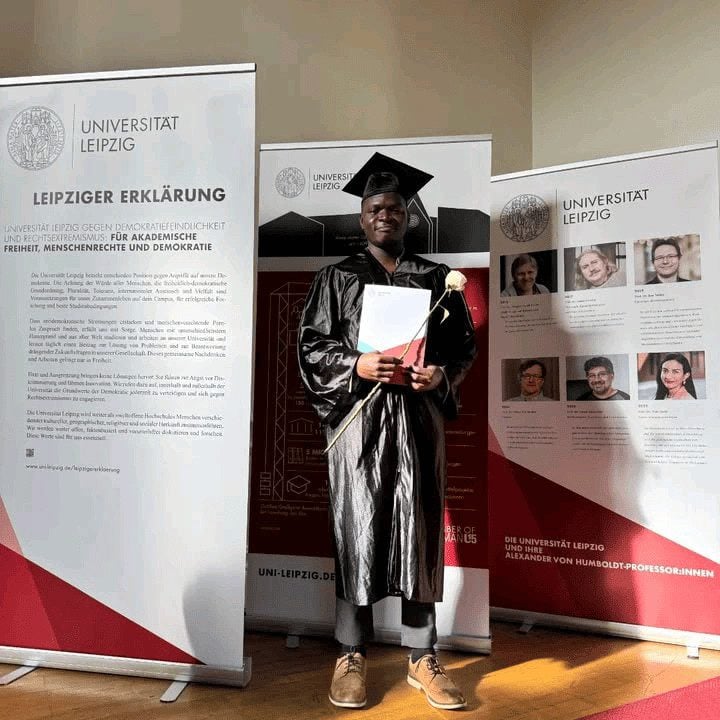
What Scholarship Recipients Say
Advice and insights from international students who successfully secured funding to study at Leipzig University.
"Both my Master’s and PhD studies have been generously funded by the DAAD (German Academic Exchange Services) Scholarship. Funding covered: round-trip travel between home country and Germany, monthly living allowance, annual book allowance, German language course, and travel expenses for research conducted in the home country."
"Read about the application process, eligibility criteria, required application documents, master programme curriculum, the faculty and their research areas, on the SEPT Competence Centre at Leipzig University website, as well as the DAAD scholarship database."
"Building on this professional background, I pursued a Master of Business Administration (MBA) through the SEPT Program at Leipzig University, Germany, which focuses on the management and development of small and medium enterprises (SMEs) and their roles within value chains."
"The structure of the International MBA SEPT offered by Leipzig University, a leading university renowned for top-class research, greatly intrigued me. One of the most exciting prospects of the program for me is the opportunity to conduct research in Nigeria's MSME sector after being immersed in Leipzig’s rich entrepreneurial ecosystem – a high-tech centre and home to unicorn businesses, including Co-working spaces, SpinLab, Impact Hub, HHL Digital Space, Startbahn 13, among others."
Frequently asked questions
Common questions about scholarships, admissions, and studying at Leipzig University.
Yes, there are some Leipzig University funded/fee-free options that include online learning, but most “classic” scholarships (like DAAD-funded degree scholarships) are mainly for on-campus study. Also, there are no scholarships that are for completely online degrees.
Both, but it depends heavily on the degree level and program. Leipzig University notes that its degree programmes are “mostly taught in German,” with “a few degree programmes with English as a language of instruction.” In recipient stories, English-taught study shows up clearly: Evi Mariana said, “Both my Master’s and PhD programs are conducted in English,” and Mutiu Adebowale OYERO wrote, “My master’s programme classes… were conducted in English.” Even if your program is English-taught, recipients still recommend learning German for daily life. Evi highlighted that German helps with “administrative matters” and daily living.
Usually no fixed age limit, but some scholarships apply “time since last degree” rules or program-specific criteria. For example, Leipzig University’s own master’s FAQ for Sport and Exercise Psychology states plainly: “No, there is not” an age limit. For DAAD scholarships (often used at Leipzig), DAAD guidance commonly says there is “usually no fixed age limit,” and DAAD’s EPOS FAQ notes: “Is there an age limit? No, but the latest academic degree should not be older than 6 years.”
Scholarships can cover a wide range of subjects, often across all faculties, depending on the funding source. A major university-wide option is the Deutschlandstipendium, where Leipzig University states that “all existing and new students of our university can apply,” and selection considers performance plus engagement and circumstances. This makes it relevant across STEM and humanities, including engineering, business, and more. From recipient examples: Mutiu Adebowale OYERO pursued an International MBA (business/management); Evi Mariana completed an MBA and later a PhD in Agricultural Economics (STEM-adjacent/social science depending on track); and Abdul Moiz Uppal connected Leipzig to Erasmus+ mobility while studying Political Science/Public Administration (humanities/social sciences).
Medicine note (international eligibility): Medicine exists at Leipzig University, but it is typically German-taught and highly competitive in Germany. Leipzig University explicitly flags that for Medicine, Dentistry, Pharmacology and Veterinary Medicine, proof of German skills is required by the application deadline (not later). International students can be eligible to apply, but you should assume stricter language and selection constraints than many other subjects, and confirm the exact admission route for your applicant group before relying on scholarship plans.
It depends on the scholarship. Some are open to (almost) all nationalities enrolled at Leipzig, while others target specific regions. For example, Leipzig’s Deutschlandstipendium is framed as open to “all existing and new students” (so international students can be included if admitted/enrolled). DAAD EPOS-type funding is explicitly aimed at “participants from developing countries,” and Leipzig University’s ITK online courses require residence in a “DAC-listed country.” Recipient stories show wide nationality coverage in practice: Evi Mariana (Indonesia) and Mutiu Adebowale OYERO (Nigeria) both used DAAD EPOS pathways connected to Leipzig.
Sometimes yes, sometimes no, depending on the program language and what alternative proofs are accepted. Leipzig University states that for German-taught programmes you generally need German at DSH-2 level (or equivalent certificates such as TestDaF TDN4), and it also notes that for certain medical degrees you must submit the German proof by the application deadline. For English-taught programmes, the university explains you need English proficiency (often around B2, with specifics set by the programme). In real recipient stories, you can see both paths: Evi Mariana said, “I needed to take the IELTS test,” while Mutiu Adebowale OYERO used an “English as a medium of instruction” letter and wrote, “No IELTS/TOEFL/GMAT/GRE was taken.” Also, Abdul noted he “even took the TOEFL… even though it wasn’t mandatory” to strengthen his profile, so tests can be helpful even when optional.
There isn’t one single university-wide minimum grade; requirements vary by programme, and some admissions are restricted. For example, Leipzig’s BA American Studies states admission is restricted by a local numerus clausus based on the GPA of your school-leaving certificate. For some master’s contexts, Leipzig also notes that “your school grade (numerus clausus) has no impact on your master’s application,” and selection can depend on a broader portfolio and ranking. In a concrete master’s FAQ example, Leipzig’s Sport and Exercise Psychology programme states “There is no minimum grade required to apply,” but the selection committee ranks applications according to the bachelor’s final mark. Recipient evidence supports how grades help in competitive funding: Mutiu Adebowale OYERO highlighted he “finished top 2% of my class (4.34 out of 5 GPA),” which is the kind of academic signal that often strengthens scholarship competitiveness.
A strong background is usually a mix of (1) solid academic performance, (2) fit with the programme’s goals, and (3) evidence you’ll use the opportunity well. Leipzig’s Deutschlandstipendium explicitly targets “particularly talented and high-performing students” and also considers “special successes, extracurricular activities and personal or social circumstances.” Recipient stories show what this looks like in practice: Mutiu Adebowale OYERO combined top grades (“4.34 out of 5 GPA”) with research output and SME-focused goals; Evi Mariana emphasized aligning with requirements and learning from prior recipients; and Abdul Moiz Uppal tied his “academic achievements” and “strong English skills” to later mobility opportunities, plus he summed up the long-term advantage with, “Languages open doors.”
Documents vary by level (BA/MA) and by scholarship, but common requirements include transcripts, degree certificates, CV, motivation letter/personal statement, language proof, and identity documents, and sometimes recommendations and proof of work experience. In real Leipzig-related scholarship applications, Mutiu Adebowale OYERO described collecting recommendation letters (one from an employer/CEO and one from a thesis supervisor), certifying copies of transcripts/certificates at the German embassy, and using an English-medium-of-instruction letter.
Often, Leipzig University itself does not advertise a single blanket “application fee” for all programmes, but many international applicants will pay third-party processing fees depending on their route and programme. For example, some applications are handled through uni-assist, which charges processing fees (a Leipzig medical application guide explicitly references paying a uni-assist processing fee of 75€). Check the latest guidelines for updated informationl.
There are many degrees that are open to international students right now — find yours.
About the Author: Hyun Lee


Leave A Comment