
Fulbright Scholar Abiha Anjum from Pakistan Shares Her Journey of Securing a Fully Funded Master's at the Emory University, United States
University: Emory University
Degree: Master of Science in Business Analytics
Previous Education: Bachelor of Business Administration (BBA), Institute of Business Administration (IBA), Karachi
Scholarship: Fulbright Master’s/PhD Program – Fully Funded (Tuition and Academic Expenses, Monthly Living Stipend, Book Allowance, Computer Allowance)
Other Offered Scholarships: Emory University Merit-Based Scholarship – Partial Funding (USD 40,000 Toward Tuition Expenses)
Social Media
LinkedIn: linkedin.com/in/abiha-anjum/
The Journey
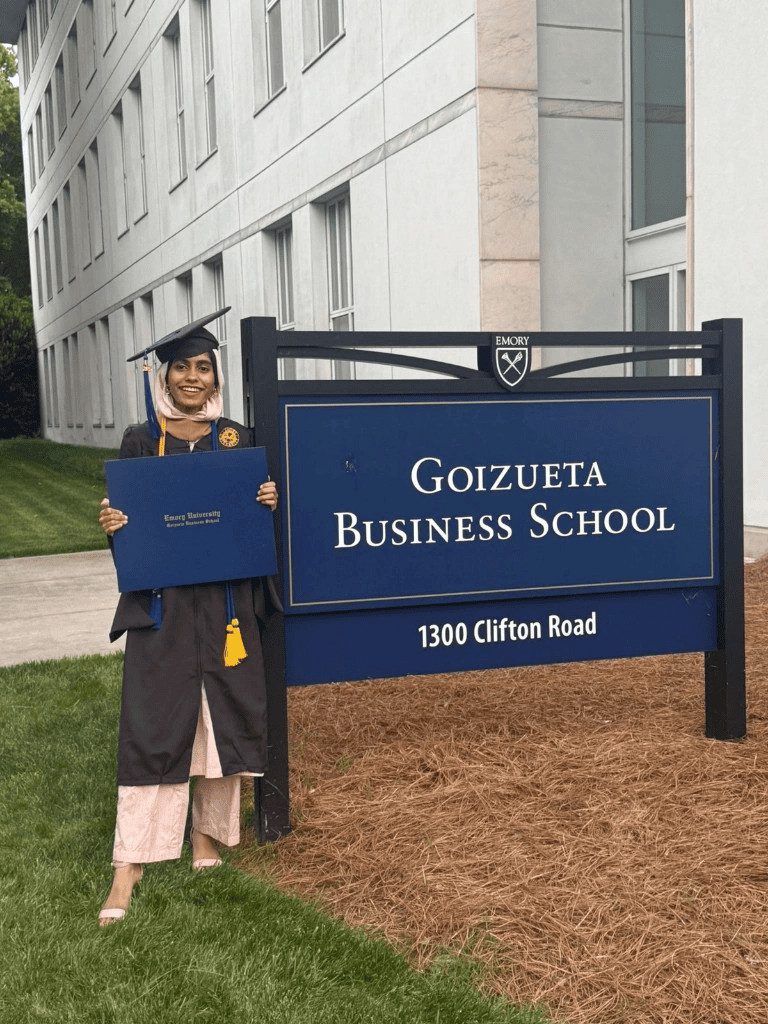
My name is Abiha Anjum, and I am from Karachi, Pakistan. I recently graduated with a Master of Science in Business Analytics from Emory University as a Fulbright Scholar.
My interest in business analytics developed during my undergraduate studies when I took an Introduction to Marketing Analytics course as an elective. Through hands-on experience with tools such as Python, R, SQL, and Tableau, I explored predicting models, data visualization, A/B testing, and regression analysis. Although the field initially seemed overwhelming, I quickly became fascinated by its ability to transform complex data into actionable business insights.
What attracted me most to business analytics was its broad impact across industries. From understanding consumer behavior and forecasting market trends to risk management and financial decision-making, analytics plays a critical role in helping organizations make informed decisions. To deepen my understanding, I completed additional analytics training, connected with industry professionals, and participated in research on sentiment analysis and brand reputation management.
Coming from Pakistan, I have also witnessed the growing gap between the demand for data-driven decision-making and the availability of analytics education and expertise. This inspired my long-term goal of contributing to the development of business analytics in Pakistan by helping organizations leverage data effectively and by supporting the growth of analytics education for future generations.
Pursuing a master's degree in Business Analytics was therefore a natural step toward building the knowledge and skills needed to make a meaningful impact in this field.
Fulbright Master's/PhD Program Details
I was awarded the Fulbright Master's/PhD Program, administered by the United States Educational Foundation in Pakistan (USEFP) and funded by the U.S. Department of State.
The scholarship fully funded my Master of Science in Business Analytics at Emory University for the 2024–2025 academic year. The award covered tuition and academic expenses and also included a monthly living stipend, book allowance, and computer allowance, making it possible for me to focus entirely on my studies and professional development.
Were You Offered Any Other Scholarships?
Yes. In addition to the Fulbright Master's/PhD Program, I was awarded a merit-based scholarship from Emory University worth USD $40,000 toward tuition expenses. The award provided a tuition reduction of USD $20,000 per semester. However, I ultimately attended Emory University through the Fulbright Program.
Educational Background
I completed my Bachelor of Business Administration (BBA) from the Institute of Business Administration (IBA), Karachi, graduating with a CGPA of 3.91. Throughout my undergraduate studies, I consistently maintained strong academic performance and was placed on the Dean's List every semester.
My business education provided a strong foundation in management, marketing, finance, and strategic decision-making. During my studies, I became increasingly interested in the role of data in solving business problems. This interest was strengthened when I took an Introduction to Marketing Analytics course, where I gained exposure to tools such as Python, R, SQL, Tableau, and learned techniques including predictive modeling, data visualization, A/B testing, and regression analysis.
Beyond coursework, I pursued additional learning opportunities to deepen my understanding of analytics and its applications. I also engaged with industry professionals and participated in research related to sentiment analysis.
These experiences helped me appreciate how data-driven insights can improve organizational decision-making and confirmed that business analytics was the field I wanted to pursue at the graduate level.
My undergraduate education therefore served as the bridge between my business background and my future specialization in business analytics, equipping me with both the domain knowledge and analytical curiosity needed to succeed in the field.
How Did You Find Information About Fulbright Master's/PhD Program and Emory University?
I first learned about the Fulbright Program during informational sessions held at my undergraduate university, the Institute of Business Administration (IBA), Karachi. These sessions introduced me to international scholarship opportunities and sparked my interest in applying.
To further guide my preparation, I connected with a professor at my university who was a former Fulbright scholar. His mentorship played a key role in helping me understand the application process, expectations, and overall journey. I also reached out to Fulbright alumni to gain additional insights into their experiences studying in the United States.
Among all sources of guidance, my professor’s mentorship was the most influential in shaping my understanding of the program and strengthening my application strategy.
My application process for the institutions was guided through the Fulbright selection framework, where I initially shared my preferred universities based on extensive research. My preferences were shaped by factors such as university rankings, curriculum structure, program strength in business analytics, and conversations with individuals already working in the field in the United States.
While I had clear preferences, the final list of universities was developed collaboratively with the Fulbright advising team, who also considered program fit and competitiveness. As a result, I ultimately applied to four universities in total.
The overall application preparation process took approximately one and a half months. During this time, I focused on refining my application materials, aligning my academic and career goals with each program, and ensuring that my profile clearly reflected my background in business administration and my interest in business analytics.
Key considerations throughout the process included academic reputation, curriculum relevance, career outcomes for graduates, faculty expertise, and overall alignment with my long-term goal of applying analytics in business consulting, particularly in Pakistan
Did You Take Any Standardized Tests? If So, How Did You Prepare for Them?
Yes, I took both the GRE and TOEFL as part of my application process.
For the GRE, I scored 320 overall, with 160 in each section. I prepared for approximately two months through a structured self-study plan. My preparation included timed practice sets, focused vocabulary building, and revision of core quantitative and verbal concepts. I also used resources such as a subscription to GregMat and practice questions from Magoosh. In addition, I followed guidance and content shared by GRE educator Saad Amer, which helped me understand test strategies and time management techniques.
For the TOEFL, I scored 114. I prepared for about one month, focusing primarily on practice tests and improving my familiarity with the test format. To strengthen my listening skills, I regularly exposed myself to English audio content, including conversations and music, which helped improve comprehension and fluency under timed conditions.
How Did You Prepare to Apply for the Fulbright Master's/PhD Program?
I attended Fulbright information sessions during my undergraduate studies, which provided initial guidance on the application process and requirements.
For my application, I independently wrote my personal statement and study objectives, starting with multiple drafts that I developed and refined over time. I followed an iterative revision process, where I first sought feedback from a reviewer who critically evaluated my drafts in detail, marking areas that needed improvement extensively. My initial draft received significant feedback, which helped me identify gaps in clarity, structure, and alignment with Fulbright expectations.
I then revised my essays and shared them again with different reviewers over multiple rounds, approximately four to five iterations in total. Each round helped me refine my narrative, strengthen my goals, and better align my academic and professional aspirations with the scholarship objectives. In the final stage, I received feedback from a professor who was himself a Fulbright scholar, which was particularly valuable in polishing the final version.
Overall, I believe the strength of my application came from a combination of well-crafted essays, consistent academic performance, and strong letters of recommendation.
How is Your Experience at Emory University?
My experience at Emory University was very positive overall. The faculty members were highly knowledgeable and supportive, and I especially appreciated the emphasis on critical thinking and applied learning throughout the program.
The curriculum was well-structured and intellectually engaging, and I found the coursework in business analytics both rigorous and practical. The program office was also very organized and helpful in supporting students throughout the degree.
At the same time, the program was intensive due to its accelerated 10-month structure, which made the academic workload quite demanding. While it was challenging, it ultimately pushed me to grow academically and professionally.
How Do You Rate Emory University Academically?
I would rate Emory University as excellent academically. The program offered a strong balance of theoretical foundations and applied learning, with a curriculum designed to develop critical thinking and real-world problem-solving skills. The faculty were highly knowledgeable and engaged, and the overall academic rigor ensured a deep and meaningful learning experience.
How Does Emory University Support International Students?
Emory University provides strong support for international students through its program office and career services. Since the MS in Business Analytics cohort is primarily composed of international students, the environment is well-adapted to their academic and personal needs.
The program office is highly organized, responsive, and supportive, ensuring that students receive timely guidance throughout the program. The career office is also very helpful, offering regular sessions and resources to support career development and job readiness.
In addition, the university is respectful and inclusive of students’ personal and cultural needs. For example, dietary preferences such as halal food were accommodated during events and gatherings, reflecting an overall culture of understanding and inclusivity. These efforts made the experience welcoming and supportive for international students.
Are Your Classes Conducted in English or the Country's Native Language?
All of my classes at Emory University were conducted in English. I did not face any language-related challenges, as my prior education in Pakistan was also in English medium institutions. This helped me adapt smoothly to the academic environment, and I was already well-versed in both academic reading and communication in English.
What Did You Pursue After the Fulbright Master's/PhD Program?
After completing my Master’s degree, I returned to Pakistan in accordance with the Fulbright Program requirement to serve in my home country for two years.
I am currently working as an Associate Software Consultant at 10Pearls. In this role, I am applying my analytical and technical skills in a professional setting, contributing to software and data-driven solutions. This position allows me to further strengthen my industry experience while working within the technology and consulting domain in Pakistan.
What Do You Think Made Your Application Stand Out?
I believe several key factors strengthened my application.
First, my strong academic performance throughout my undergraduate studies demonstrated consistency and commitment, reflected in my high CGPA.
Second, my GRE score highlighted my readiness for graduate-level analytical and quantitative rigor, supporting my overall academic profile.
Third, my essays played a central role in clearly communicating my academic journey, motivation, and long-term goals. Through multiple rounds of revision and feedback, I refined my narrative to ensure clarity, focus, and strong alignment between my background in business administration and my interest in business analytics.
Finally, the Fulbright interview further strengthened my application, as it allowed me to directly communicate my goals, experiences, and motivation in a more personal and interactive setting. I believe my ability to clearly articulate my vision during the interview as well as my vision to assimilate in the US culture as well as represent Pakistan's culture contributed positively to my overall selection.
What Would You Have Done Differently if You Were Going Through the Process Again?
If I were to go through the process again, I would be more strategic and balanced in selecting my university preferences. Initially, I focused heavily on top-tier institutions based on rankings and reputation, including highly competitive programs such as MIT and similar universities. As a result, only a limited number of my preferences were ultimately included in the final application list.
In hindsight, I realize that a more balanced mix of ambitious, moderate, and wellaligned programs would have allowed for greater alignment with the selection process and possibly a broader range of outcomes. While I am extremely satisfied with my experience at Emory University, I now understand the importance of being both ambitious and realistic when shortlisting universities within the Fulbright application framework.
This experience taught me to approach university selection more strategically, ensuring alignment not just with aspirations but also with fit and selection dynamics.
What Advice Would You Give Those Looking to Apply for a Similar Scholarship?
My first piece of advice is that applicants should aim to be strong in at least one major component of their application, whether that is academic performance (CGPA), standardized test scores, or essays. A weaker area in one aspect does not necessarily eliminate your chances, as long as other parts of your application are strong. In particular, essays should always be given serious attention regardless of academic profile, as they play a crucial role in shaping your overall narrative and vision.
Second, I would emphasize the importance of a structured and iterative drafting process. Writing strong essays requires multiple rounds of revision, feedback, and refinement. Seeking critical feedback and being open to revising your initial drafts significantly improves clarity, coherence, and alignment with the scholarship’s objectives.
Finally, for the interview stage, it is essential to have a clear and well-defined vision of your post-scholarship goals. Applicants should be able to articulate how they plan to contribute to their home country after returning, as this is a key focus of the Fulbright Program. Additionally, it is important to demonstrate cultural awareness and readiness to represent your home country positively while studying abroad, highlighting how you will contribute to and benefit from the international academic environment.
Want to submit your
scholarship journey?
Submit Your Story Here!
More Scholarship Recipients
My name is Shah Hussain, and I am from Khyber Pakhtunkhwa, Pakistan. I completed my Bachelor’s in Psychology at the Univer .... Read more

I am June from the Philippines. I am an educator for Social Sciences and Humanities. I recently earned my Master in Southeas .... Read more
Hi, my name is Abdul Hafeez, and I come from a small town called Nasirabad in Sindh, Pakistan. Currently, I am pursuing a ma .... Read more
Leave A Comment