
University of Sydney Scholarships for International Students 2027
University of Sydney is linked to scholarships that can reduce costs in meaningful ways. Here are a few strong options prioritized by funding level.
On the institution side, University of Sydney is connected to scholarships that can reduce tuition and sometimes extend to other study costs. These are practical starting points. Sydney International Undergraduate Academic Excellence Scholarship is a full tuition award, and the listed benefits often include 100% of tuition fees and student services fees. International Tuition Fee Scholarship is usually considered full tuition, and typical coverage can include 100% of tuition fees. A strong option is Vice-Chancellor’s International Scholarships Scheme which is partially funded and often covers $5,000 to $40,000. International Stipend Scholarship is partially funded, and coverage often includes a stipend of $41,753 annually.
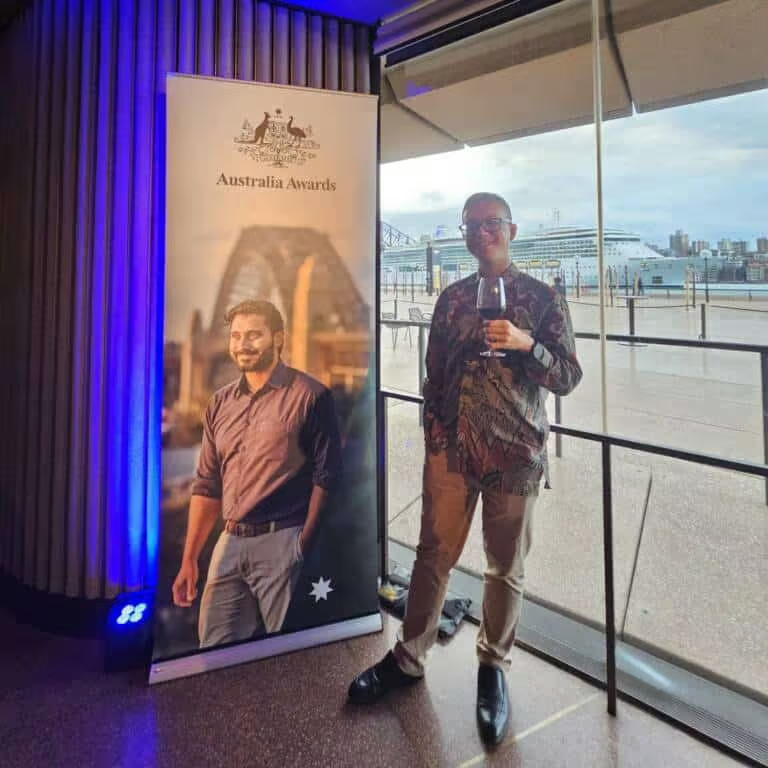
Beyond campus funding, University of Sydney applicants often explore outside opportunities including government backed and independent programs. These are common starting points. Australian Government Research Training Program (RTP) is fully funded, and coverage often includes tuition fees, living stipend, and allowances to cover additional costs associated with undertaking a Higher Degree by Research. Australia Awards Scholarships is fully funded and typically covers tuition fees, A fortnightly contribution for basic living costs and based on a set rate, and health insurance. COLFUTURO Scholarship Loans is commonly categorized as partially funded support, and coverage that often includes tuition support, health insurance support, and living expenses support.
For the complete set of linked scholarships including additional options and details, continue below on this page.
University of Sydney Scholarships for International Students
The scholarships at University of Sydney can help fund your study expenses. There are currently 10 scholarships being offered to international students at the University of Sydney, all with varying requirements, benefits, and application processes. We have compiled them in this list to help you find the scholarship that best fits you.
Undergraduate Scholarships
Graduate Scholarships
External Scholarships
There are many degrees that are open to international students right now — find yours.
University of Sydney Admissions
Here are the official admission pages for University of Sydney:
| Degree | Admissions Pages |
|---|---|
| Bachelor's | International Students Admissions Page |
| Master's | International Students Admissions Page |
Admissions and Scholarship Results at University of Sydney
Here are some of the admissions and scholarship results from previous applicants to University of Sydney, which you might find helpful. For more results to University of Sydney, please see the University of Sydney Admissions Profile Page .
| Nationality / Region | SAT/ACT | EFC | GPA | Scholarship | Status |
|---|---|---|---|---|---|
| Asia | 1500 | N/A | N/A | $7000 USD (per year) | Accepted |
University of Sydney Application Deadlines
| Degree | Admission Deadline |
|---|---|
| Bachelor's (Semester 2) | May 15, 2026 |
| Bachelor's (Semester 1) | December 1, 2026 |
| Bachelor's and Master's (Semester 1) | May 15, 2026 |
| Master's (Semester 1) | December 18, 2026 |
Tuition Fees at University of Sydney for International Students
Indicative annual tuition fee ranges for international students at University of Sydney. Exact fees vary by program, so always confirm the current cost on the university's official tuition fee pages.
| Degree Level | Typical Annual Range |
|---|---|
| Bachelor's Tuition | 49,200 – 65,900 AUD |
| Master's Tuition | 49,700 – 69,300 AUD |
Please note that tuition fees can vary based on the specific program you choose. For the most accurate and current fee information, consult the official tuition fee pages linked above.
University of Sydney Scholarship Recipients
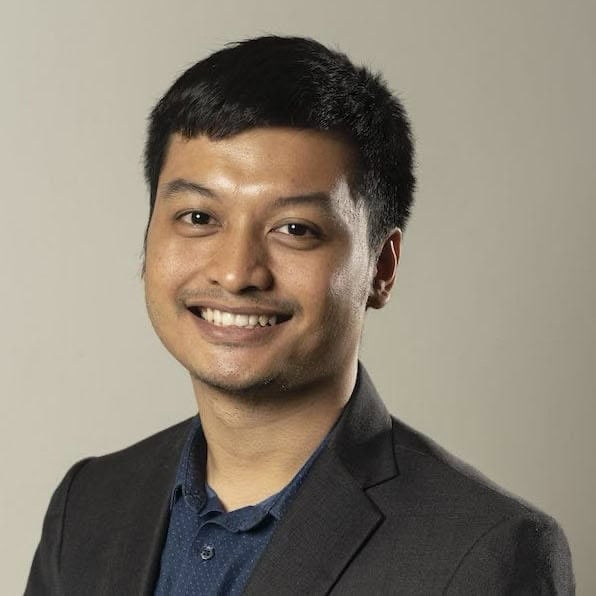
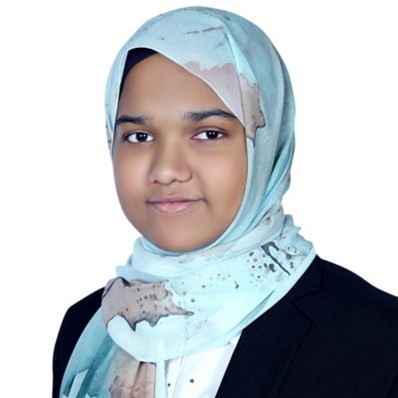
International students who received scholarships to study at University of Sydney, documented by Global Scholarships.

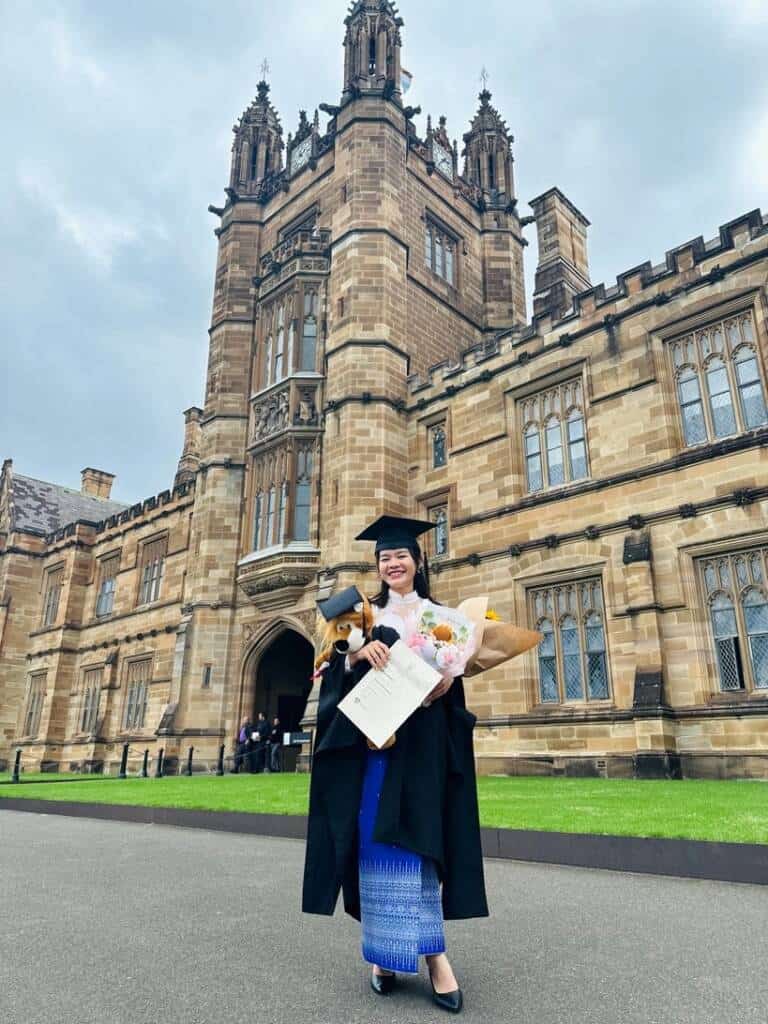
What Scholarship Recipients Say
Advice and insights from international students who successfully secured funding to study at University of Sydney.
"Sydney International Undergraduate Academic Excellence Scholarship (SIUAES) from the University of Sydney. It covers all tuition and amenities fees for the entire Bachelor's Program."
"Always being proactive in finding scholarship opportunities and information about them, build and strengthen your academic and research profile."
"I’m currently studying Chemical and Biomolecular Engineering at the University of Sydney."
"With the knowledge, skills, and connections I’ve built here, I hope to contribute meaningfully to improving Cambodia’s healthcare system."
"Sydney International Student Award: 20% reduction on tuition fees for the duration of the degree."
Frequently asked questions
Common questions about scholarships, admissions, and studying at University of Sydney.
The University of Sydney does not provide in-house scholarships that cover the entire duration of your stay. However, you can consider the Australia Awards Scholarship, which is a government-funded program offering full scholarships to international students at the university. To apply, visit the official scholarship page to check the eligibility criteria, deadlines, and requirements. It is important to note that applying for external scholarships like this may involve a different admission process.
The acceptance rate at the University of Sydney is estimated to be 30%, making admission highly competitive for international students. The university receives thousands of applications each year, but the number of available seats is limited, especially for in-demand courses. Most of the time, Bachelor of Arts degrees have higher application slots than Bachelor of Science degrees.
Yes, there are scholarships connected to online study, but eligibility can be very specific.
Scholarships at the University of Sydney span a wide range of subjects, STEM, engineering, business, health, and humanities, depending on the scholarship. Real examples from Global Scholarships recipients include: Ella Suita (Chemical and Biomolecular Engineering), Minh-Hieu Vu (Bachelor of Commerce: Marketing & Management), Francis Danny Gomas (Master’s in Cybersecurity), Dany Koem (Master of Pharmacy), and Kevin Abimanyu Jatmiko (PhD in Anthropology—humanities/social sciences).
Many University of Sydney scholarships are open to international applicants from a wide range of countries, while others target specific “priority markets” or partner-country programs (like government-funded awards). Global Scholarships recipient stories show how broad it can be in practice: Minh-Hieu Vu (Vietnam), Ella Suita (Indonesia), Francis Danny Gomas (Fiji), Dany Koem (Cambodia), and Kevin Abimanyu Jatmiko (Indonesia). Also, some flagship awards are explicitly global. Minh-Hieu received a scholarship that’s promoted as being awarded internationally, and he emphasized planning early because requirements are demanding.
Often, yes, unless you meet an approved exemption through prior study in English. The University’s standard English requirement is IELTS 6.5 overall with no band below 6.0 (some courses/faculties require higher). In recipient stories, English testing was a big part of “making it real”: Minh-Hieu Vu shared that for his scholarship, “You have to get an unconditional offer,” which he said came from having “your IELTS/TOEFL test score and all GPA grades.” Dany Koem met his requirements with IELTS 7.5, and Kevin Abimanyu Jatmiko noted, “the overall score needed is 7.0 with no band below 6.5” for his PhD pathway.
There isn’t one single “minimum grade” for every applicant. Requirements vary by course level (undergraduate vs postgraduate) and by program (and scholarships are usually even more competitive). That said, recipient stories show the kind of academic strength that often wins awards: Minh-Hieu Vu wrote, “I acquired a notable 9.9/10 GPA,” and Ella Suita reported A-Level results of “3 A* 1 A.” At the postgraduate/research end, Dany Koem entered with a Bachelor’s GPA of 3.88/4.0, while Kevin Abimanyu Jatmiko emphasized that for PhD selection, “having a strong and complete document submitted to the committee is important.”
Many University of Sydney scholarships don’t have a universal age cap; they focus more on academic merit, eligibility status (domestic/international), and the degree you’re applying for.
A strong scholarship profile usually combines (1) solid academics, (2) evidence you can handle English instruction, and (3) a clear, credible reason your degree matters. Minh-Hieu Vu described Sydney as requiring “a high proficiency level in both academic aptitude and fluency in English,” and he backed it up with an IELTS 8.0 and top grades. Ella Suita felt her edge was “my experience in organisations, holding both leadership and non-leadership roles.”
If you’re applying for research scholarships (PhD/MPhil), eligibility often revolves around research readiness. Kevin emphasized research proposal writing, supervisor fit, and submitting a strong document package rather than a “separate scholarship test.”
Exact documents depend on your degree and scholarship, but common requirements include academic transcripts/results, proof of English proficiency (or exemption evidence), identity documents (passport), and scholarship-specific statements (personal statement/essay/SOP) plus references. A very practical example comes from Minh-Hieu Vu, who said an unconditional offer was obtained by having “your IELTS/TOEFL test score and all GPA grades,” and he added that the scholarship statement of purpose “consists of 2 questions that are 1300 words long in total.” Le Khanh Nam also pointed out that admissions can involve essays: “There are also 2 essays you need to do.” For research degrees, Kevin Abimanyu Jatmiko listed key PhD documents such as “curriculum vitae, academic transcripts and graduation certificates,” plus (where applicable) a writing sample, publications list, and supervisor approval letter.
Yes for many international applicants: the University of Sydney charges a non-refundable application processing fee of A$150 for international student applications (covering applications within one year)
There are many degrees that are open to international students right now — find yours.
About the Author: Hyun Lee


Leave A Comment