
University of San Diego Scholarships for International Students 2027
To help students manage tuition and living expenses, University of San Diego connects to scholarships across different funding levels. Here are several top options to review first.
Among the university based funding routes linked to University of San Diego, these scholarships tend to stand out for their level of support and overall value. Graduate Assistantships is commonly categorized as partially funded support, and coverage that often includes an hourly wage and tuition scholarships depending on the department or office. With Music Scholarships, students may receive partially funded support, and coverage frequently includes $1,200-$10,000 for choral scholars award recipient and $500-$15,000 for Music Scholarships recipient. Undergraduate Merit Scholarships is a partially funded award, and the listed benefits often include $18,000–$28,000 annual scholarship award.
To broaden funding options beyond institutional awards at University of San Diego, these external and government scholarships are commonly considered as well. Fulbright Foreign Student Program is usually considered fully funded, and typical coverage can include roundtrip transportation from the country of origin to the US, monthly living stipend, and tuition fees. A strong option is AAUW’s International Fellowship which is partially funded and often covers $20,000 for Master's and first professional degree recipients, $25,000 for doctoral students, and $50,000 for postdoctoral students.
To see every scholarship associated with this institution and compare coverage and eligibility, browse the sections below.
University of San Diego Scholarships for International Students
The scholarships at University of San Diego can help fund your study expenses. There are currently 6 scholarships being offered to international students at the University of San Diego, all with varying requirements, benefits, and application processes. We have compiled them in this list to help you find the scholarship that best fits you.
Undergraduate Scholarships
Graduate Scholarships
External Scholarships
There are many degrees that are open to international students right now — find yours.
University of San Diego Admissions
Here are the official admission pages for University of San Diego:
| Degree | Admissions Pages |
|---|---|
| Bachelor's | International Students Admissions Page |
| Master's | International Students Admissions Page |
University of San Diego Application Deadlines
| Degree | Admission Deadline |
|---|---|
| Bachelor's (Fall) | January 15, 2027 |
Tuition Fees at University of San Diego for International Students
Indicative annual tuition fee ranges for international students at University of San Diego. Exact fees vary by program, so always confirm the current cost on the university's official tuition fee pages.
| Degree Level | Typical Annual Range |
|---|---|
| Bachelor's Tuition | 61,340 USD |
| Master's Tuition | 18,660 – 31,050 USD |
Please note that tuition fees can vary based on the specific program you choose. For the most accurate and current fee information, consult the official tuition fee pages linked above.
University of San Diego Scholarship Recipients
International students who received scholarships to study at University of San Diego, documented by Global Scholarships.
What Scholarship Recipients Say
Advice and insights from international students who successfully secured funding to study at University of San Diego.
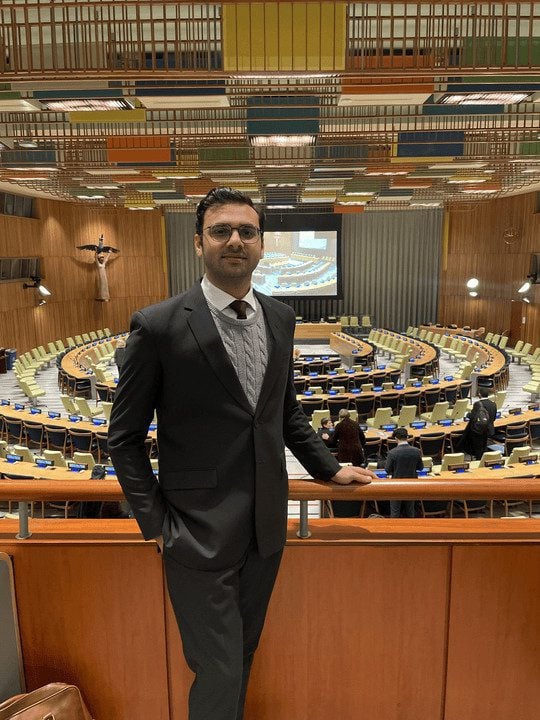
"Through the Fulbright Scholarship, every major aspect of my master’s degree at the University of San Diego is funded—tuition, day-to-day living in the United States, health insurance, and even international travel—lifting a huge financial burden so I can fully focus on my studies and peacebuilding work."
"When I compared graduate programs, the University of San Diego stood out because it combines serious academic rigor in peace studies with practical engagement in global peacebuilding initiatives and hands-on learning opportunities, rather than keeping everything confined to the classroom or purely theoretical discussions."
"Being at the University of San Diego as a Fulbright scholar allows me to bring together my long-standing passion for social justice, governance, and development in a graduate environment that sharpens my ability to contribute to peacebuilding in Pakistan and connects my previous professional work with a deeper understanding of peace and justice."
Frequently asked questions
Common questions about scholarships, admissions, and studying at University of San Diego.
On GlobalScholarships, the scholarships listed under the University of San Diego (USD), such as Undergraduate Merit Scholarships, Music Scholarships, and Graduate Assistantships, are tied to being admitted to USD and are typically discussed in the context of campus-based study rather than “online-course-only” awards.
USD-linked scholarships span a wide range of subjects, with some awards being broad (open to many majors) and others being program-specific. In terms of major areas, USD offers programs across humanities and social sciences (e.g., peace studies), business, engineering, and health-related fields (including nursing and health science). As a real example of a humanities/social-science-aligned pathway, Talha Ali pursued Peace and Justice and said “The University of San Diego stood out for its blend of academic rigor and practical engagement with global peacebuilding initiatives.”
It depends on the scholarship type. Many USD’s university scholarships are described as being for international students, without restricting to specific countries, so the practical requirement is being an “international Bachelor’s student or applicant” and meeting USD admissions requirements for your chosen program.
External scholarships connected to studying at USD can be more nationality-specific. For example, Fulbright’s foreign-student funding is administered through Fulbright commissions/embassies and eligibility varies by country.
Some external programs also limit eligibility by citizenship/residency categories (for instance, some women-focused fellowships are for non-U.S. citizens). So, the safest way to think about it is: many USD-linked institutional scholarships are “open to international students,” while major external scholarships each have their own nationality rules.
Often yes for international applicants, but it can vary by program and by your prior education. USD’s online graduate admissions guidance for international students states that an official score report from TOEFL-iBT, IELTS, or the Duolingo English Test is required for international applicants, and it also explains that the English exam requirement may be waived only if you earned a qualifying degree (e.g., a 4-year bachelor’s or 2-year master’s) with a cumulative GPA of 3.0 or higher from an institution where English is the official language of instruction.
USD admissions and scholarship decisions are typically holistic and program-dependent, so a single universal “minimum GPA” is not always published for every pathway. Instead, minimums (if any) often show up at the program level or in specific policy rules (for example, USD’s online graduate international guidance references GPA 3.0+ as part of the limited circumstances under which an English exam waiver may be considered).
Many major scholarship routes used by USD students do not set an age limit, but you must meet eligibility rules (degree level, admissions status, and any sponsor-specific requirements). That said, some scholarships can have target-group constraints (such as “first-year applicants,” “women applicants,” or specific professional stages). So the right approach is to treat “age limits” as uncommon, but always check the exact scholarship’s criteria.
A strong academic background for USD scholarships usually looks like: solid grades in relevant coursework, clear fit with your program, and evidence you will thrive academically (plus leadership, service, talent, or research depending on the scholarship).
For graduate funding, your profile often needs to show both academic readiness and purpose. Talha Ali described how his Fulbright + USD profile stood out because of “the clear and consistent trajectory between my academic background, four years of professional experience in the peace and development sector, and my long-term commitment to creating impact in Pakistan.” He also underscored the importance of narrative quality: “Take your time with the application, especially the personal statement. Be honest, reflective, and specific.”
Minimum eligibility is therefore scholarship-specific, but the recurring baseline is: (1) meet USD admission requirements for your level (undergraduate/graduate), (2) meet any scholarship’s stated status rules (e.g., “international student,” “first-year applicant,” “master’s/PhD student”), and (3) submit required materials on time.
Undergraduate (including scholarships): At a minimum, you should expect an admissions application and academic records (transcripts). For scholarships, requirements can differ: GlobalScholarships notes that USD’s Undergraduate Merit Scholarships do not require additional materials beyond applying for admission (you’re automatically considered if eligible), while USD’s Music Scholarships require additional items such as a separate scholarship application form, a letter of recommendation, and an audition.
Graduate (including scholarships): Graduate applications commonly involve transcripts plus program-specific materials (often a statement/personal statement and recommendation letters). In a real USD example via external funding, Talha Ali shared that “The Fulbright application process is comprehensive, requiring strong personal statements, academic transcripts, GRE scores, and letters of recommendation,” and he added that he spent weeks refining his personal statement with mentor feedback. For international graduate applicants (especially in USD’s online graduate admissions guidance), additional documentation may include English proficiency test scores (TOEFL/IELTS/Duolingo) or a formal waiver request backed by proof that English was the language of instruction, plus a course-by-course credential evaluation when your prior degree was earned outside the U.S.
Undergraduate: Yes. USD’s Common Data Set lists an application fee of $55 (and indicates it can be waived for applicants with financial need).
Graduate: It varies by school/program. For example, USD’s Knauss School of Business “How to Apply” pages state an application fee of $125 for their graduate programs, while some nursing graduate application pages list a $55 application fee. Separately, USD’s online graduate programs list an application fee of $45 for online degree students, so your exact fee depends on whether you are applying to an on-campus graduate program, a specific school (business/law/nursing, etc.), or an online degree format.
There are many degrees that are open to international students right now — find yours.
About the Author: Hyun Lee


Leave A Comment