
Kyushu University Scholarships for International Students 2027
Kyushu University is linked to scholarships that can reduce costs in meaningful ways. Here are a few strong options prioritized by funding level.
On the institution side, Kyushu University is connected to scholarships that can reduce tuition and sometimes extend to other study costs. These are practical starting points. Enrollment and Tuition Fees Exemption Program is a full tuition award, and the listed benefits often include 25%, 50%, and or 100% tuition fee and 50% or 100% enrollment fee.
Beyond campus funding, Kyushu University applicants often explore outside opportunities including government backed and independent programs. These are common starting points. Japanese Government (MEXT) Scholarship is fully funded, and coverage often includes tuition fees, ¥143,000 to ¥145,000 per month for research students, and ¥117,000 for undergraduate students. ADB–Japan Scholarship Program is fully funded and typically covers full tuition fees, monthly allowance and accommodation, and books and instructional materials.
For the complete set of linked scholarships including additional options and details, continue below on this page.
Kyushu University Scholarships for International Students
The scholarships at Kyushu University can help fund your study expenses. There are currently 4 scholarships being offered to international students at the Kyushu University, all with varying requirements, benefits, and application processes. We have compiled them in this list to help you find the scholarship that best fits you.
Undergraduate Scholarships
Graduate Scholarships
External Scholarships
There are many degrees that are open to international students right now — find yours.
Kyushu University Admissions
Here are the official admission pages for Kyushu University:
| Degree | Admissions Pages |
|---|---|
| Bachelor's | International Students Admissions Page |
| Master's | International Students Admissions Page |
Tuition Fees at Kyushu University for International Students
Indicative annual tuition fee ranges for international students at Kyushu University. Exact fees vary by program, so always confirm the current cost on the university's official tuition fee pages.
| Degree Level | Typical Annual Range |
|---|---|
| Bachelor's Tuition | 535,800 Yen |
| Master's Tuition | 535,800 Yen |
Please note that tuition fees can vary based on the specific program you choose. For the most accurate and current fee information, consult the official tuition fee pages linked above.
Kyushu University Scholarship Recipients
International students who received scholarships to study at Kyushu University, documented by Global Scholarships.
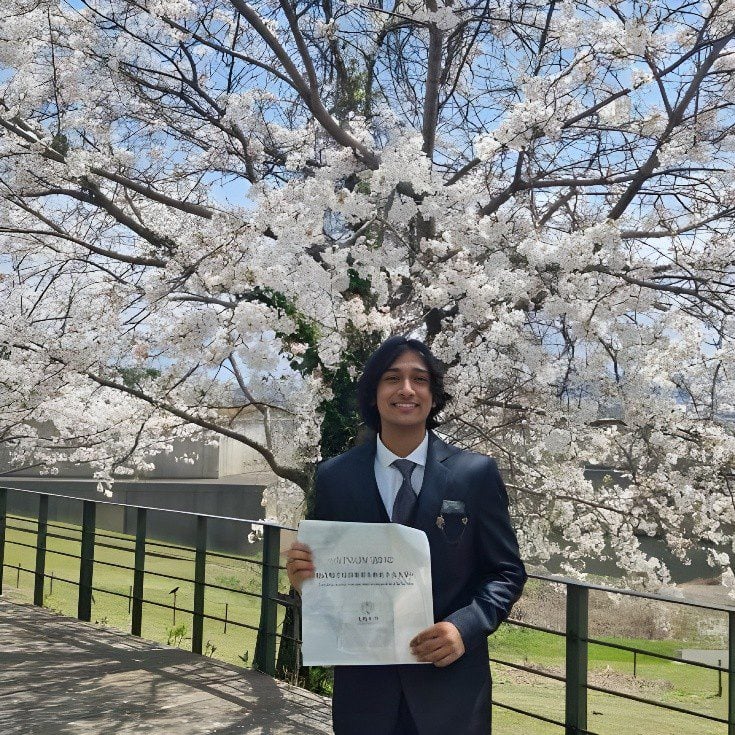

What Scholarship Recipients Say
Advice and insights from international students who successfully secured funding to study at Kyushu University.
"I was fortunate to receive the MEXT (Monbukagakusho) Scholarship, awarded by the Japanese Government. This fully funded scholarship covers my tuition, provides a monthly stipend, and includes travel expenses to and from Japan. It’s a prestigious award that supports international students in Japanese universities, and I’m incredibly grateful for the opportunity."
"Hello! I’m Nauman, originally from Pakistan, and currently pursuing my Master’s degree in Automotive Science at Kyushu University in Japan."
"Overall, I’d say it’s been quite positive. Academically, the program is strong, especially if you’re involved in research. The university has good facilities, supportive professors, and a lot of autonomy in terms of research direction, which I really appreciated. You’ll find a lot of international collaboration too, depending on your lab and field."
"Yes, my program is conducted in English. Most master's and PhD programs in engineering and sciences at Kyushu University have English-based tracks. So coursework, thesis writing, and lab meetings were all in English. I didn’t face major issues, not knowing Japanese when it came to academics or research."
"My name is Raghav Bansal, and I'm from India. I'm currently pursuing my bachelor's degree in Information and Electrical Engineering at Kyushu University. Beyond academics, I'm passionate about playing soccer and strumming an acoustic guitar in my free time."
"The 1-year intensive Japanese language course is designed specifically to prepare scholarship students for academic life in Japanese universities. By the end of this course, you will develop strong reading and writing skills necessary for understanding lectures, textbooks, and technical materials."
Frequently asked questions
Common questions about scholarships, admissions, and studying at Kyushu University.
Most Kyushu University scholarships are designed for students who are actually enrolled at Kyushu University in Japan (on-campus degree, research, exchange, or other in-person student statuses), so “online-only degree scholarships” are uncommon.
Both exist. Kyushu University offers programs conducted in English (it publicly notes “5 undergraduate programs and more than 60 graduate programs conducted in English”), while many regular degree courses, especially at the undergraduate level, are conducted in Japanese.
In recipient stories, Raghav Bansal (India, MEXT undergraduate scholar) said, “All the classes are conducted in Japanese,” while Nauman (Pakistan, MEXT master’s scholar) said, “Yes, my program is conducted in English.”
It depends on the scholarship. For example, Japanese Government (MEXT) scholarships typically have age-related eligibility rules that vary by scholarship type and intake year.
By contrast, some Kyushu University-linked scholarships list eligibility by status/nationality/financial need rather than an explicit age cap.
Scholarships are available across many subject areas, because Kyushu University spans humanities, business/economics, law, sciences, engineering, agriculture, design, and health/medical fields.
Examples from recipient stories include engineering: Raghav Bansal studied Information & Electrical Engineering, and Nauman pursued Automotive Science (battery research) under MEXT.
Medicine/health: Kyushu University lists international graduate programs including Medical Sciences/Health Sciences tracks; however, eligibility and practical training requirements for clinical medicine can be program-specific (and may require Japanese, depending on the track), so you should check the exact program language and admission rules.
It varies by scholarship. Some are broadly for international (non-Japanese) applicants, while others may be tied to specific governments or schemes.
Kyushu University’s scholarship pages also include examples of nationality-linked programs, and recipient stories show successful MEXT scholars from India (Raghav Bansal) and Pakistan (Nauman).
It depends on the program and route. For some English-taught study routes, Kyushu University sets English proof expectations (for example, exchange programs note acceptance can be based on TOEFL iBT 79 or IELTS 6.0 if enough courses are taught in English in the chosen school).
Recipient stories show waivers can happen: Raghav Bansal said, “I didn’t need to take any English language proficiency tests like TOEFL or IELTS,” because his schooling was English-medium, and he added JLPT is “not mandatory” but can help. Nauman shared that he “didn’t need to take the GRE or TOEFL” for MEXT via the embassy track, but still emphasized that some Japanese ability helps for daily life.
Kyushu University does not publish one universal “minimum GPA” that applies to all faculties and all admissions routes; requirements are program-specific and selection can be competitive.
In recipient examples, Raghav Bansal reports a very strong academic record (including high school “96%”) before joining Kyushu University under MEXT, and Nauman notes he graduated with a “strong GPA” before his MEXT master’s at Kyushu University.
Strong academics help, but the “story” and fit also matter, especially for competitive funding like MEXT. In his story, Raghav Bansal said his “strong academic background” plus essays about cultural/technical exchange helped his application stand out.
For research-heavy scholarships, a well-aligned research plan and references are key: Nauman wrote, “I spent weeks refining my Research Proposal,” and emphasized recommendation letters that highlight academic skills and drive.
Exact documents vary by program, but typical Kyushu University applications commonly include an application form, academic records (certification/transcripts), and ID/passport copies; many programs also request recommendation letters and proof of language ability (when relevant).
Scholarship applications can add more: in stories, Nauman highlighted the research proposal and recommendation letters (“recommendation letters highlighted…”), while Raghav Bansal emphasized essays and noted test requirements can differ by route (e.g., not needing TOEFL/IELTS in his case).
Yes. Kyushu University publishes application fees (e.g., 17,000 JPY for “School” and 30,000 JPY for “Graduate school,” with different amounts for certain categories like non-degree/research students). Check with the latest guidelines for updated information.
There are many degrees that are open to international students right now — find yours.
About the Author: Hyun Lee


Leave A Comment