
How Muhammad Ali Idrees, a Pakistani Scholar, Secured a Fully Funded Master of Science in Public Policy and Management at Carnegie Mellon University Through the Fulbright Scholarship
University: Carnegie Mellon University
Degree: Master of Science in Public Policy and Management
Previous Education: Master’s and MPhil in Economics, Islamia University of Bahawalpur
Scholarship: Fulbright Scholarship – Tuition, Living Allowance, Health Coverage and Air Travel; 2022–May 2024
LinkedIn: linkedin.com/in/muhammadaliidrees/
The Journey
The first journey I made for my education was ten miles long, on a bicycle. It began in a village in Punjab and took me to school in a nearby small town. Carnegie Mellon University would come much later.
I grew up in a family of farmers, where hard work was a noble trait. The people around me understood the patience it takes to work towards a result that does not arrive immediately. That upbringing became the anchor of my life. I learned to respect effort, to keep going when progress was slow, and to take responsibility for the work in front of me.
I also learned that other people can have very definite opinions about how far you should expect to go. I refused to treat those doubts as a verdict on my future. There was enough work involved in pursuing an education without giving the naysayers a vote on whether I should try.
My education eventually took me into economics, including master’s and MPhil studies at the Islamia University of Bahawalpur, and then into a career in Pakistan’s federal civil service. Working in government gave my academic interests a practical purpose. The questions I encountered affected public resources and the lives of people far beyond the office in which a decision was made.
Fulbright would take me from that professional world to Pittsburgh. I arrived carrying experience in public service, a clear sense of what I needed to learn, and a fair amount of Punjabi stubbornness. All three proved useful.
The Gap I Wanted to Bridge
While working in the Ministry of Finance, I had to analyse substantial amounts of data alongside policy guidelines. I could see how much depended on the connection between the analysis and the people expected to act on it.
Some technically capable people understood data science but had limited exposure to the realities of public policy practice. Some policy practitioners understood institutions, politics and administrative constraints but lacked the technical skills to interrogate data themselves. When these groups worked in separate silos, useful analysis could struggle to influence a decision.
That became the central argument of my Fulbright application. I wanted to be a bridge between the two. I wanted to understand how an analytical result was produced, what its assumptions were, and how it could inform a policy that government could actually implement.
My experience had already shown me the problem. Further study would give me stronger tools to address it. I wanted to combine public policy and management with data analysis, and then bring that combination back into public service.
My Fulbright Application
Fulbright had long been the scholarship I wanted to pursue. This was my first attempt, and I had not applied elsewhere. I was drawn to the opportunity to study in the United States and to the programme’s wider purpose of building understanding between people and countries.
The 2022 Fulbright Student competition in Pakistan opened in March 2021, with an application deadline of 9 June 2021. The cycle ran through application review and interviews, nomination, university placement, and pre-departure arrangements. I began my studies at Carnegie Mellon in August 2022. It is useful for applicants to understand that the process starts well before the year in which they travel.
The strength of my case, as I saw it, was its connection to work I was already doing. I could explain the gap I had encountered in government, the skills I needed, and how I intended to use them. I believe that coherence helped my application, although the selection panel would be better placed to say what ultimately persuaded it.
As for standardised test scores, mine were sufficient to get me into Carnegie Mellon. I will let the admission letter do the talking. My advice is to prepare seriously for the tests while also giving the rest of the application the attention it deserves. Your purpose, experience, and choice of programme need to make sense together.
Why I Chose Carnegie Mellon
Heinz College made sense to me because it brought public policy, management and analytical methods into the same education. I wanted a programme where I could strengthen my understanding of government while developing the technical ability to work more confidently with evidence.
The Master of Science in Public Policy and Management offered that combination. My studies included statistical reasoning, programming in R and Python, database management, policy analysis and public financial management, alongside work on the operationalisation of artificial intelligence. These subjects connected directly to the questions that had brought me to graduate school.
I was particularly interested in what happens between producing an analysis and making a decision. Who will use the result? What are the limitations of the data? How will an institution implement the recommendation? Heinz gave me a setting in which I could examine those questions from several directions.
The fit was clear: I could bring practical experience of government into the classroom and return to government with a stronger analytical foundation.
What the Scholarship Made Possible
Fulbright provided the financial support for graduate study, including tuition, a living allowance, health coverage and air travel. That support allowed me to devote myself to the academic programme and to participate fully in university life.
For a student coming from a farming family in rural Punjab, access to that opportunity carried considerable meaning. It made an international education attainable and gave me the responsibility to use it well.
Returning to the Classroom After Seven Years
Carnegie Mellon’s academic rigour was real. I was returning to formal study after a gap of about seven years, and the transition was demanding. Professional experience gave me useful context, but I still had to rebuild the habits required for an intensive graduate programme.
Technical coursework required sustained attention. I had to become comfortable with being a learner again, including the occasions when understanding came more slowly than I wanted. That was a valuable experience for someone accustomed to carrying responsibility at work.
The adjustment taught me to be patient with the process while remaining demanding of my own effort. My experience in government helped me see why the material mattered, and that connection gave me a reason to persist when the workload became difficult.
The work ethic I had learned at home remained useful in Pittsburgh. There were more computers involved, but progress still depended on doing the work.
Taking Part in University Life
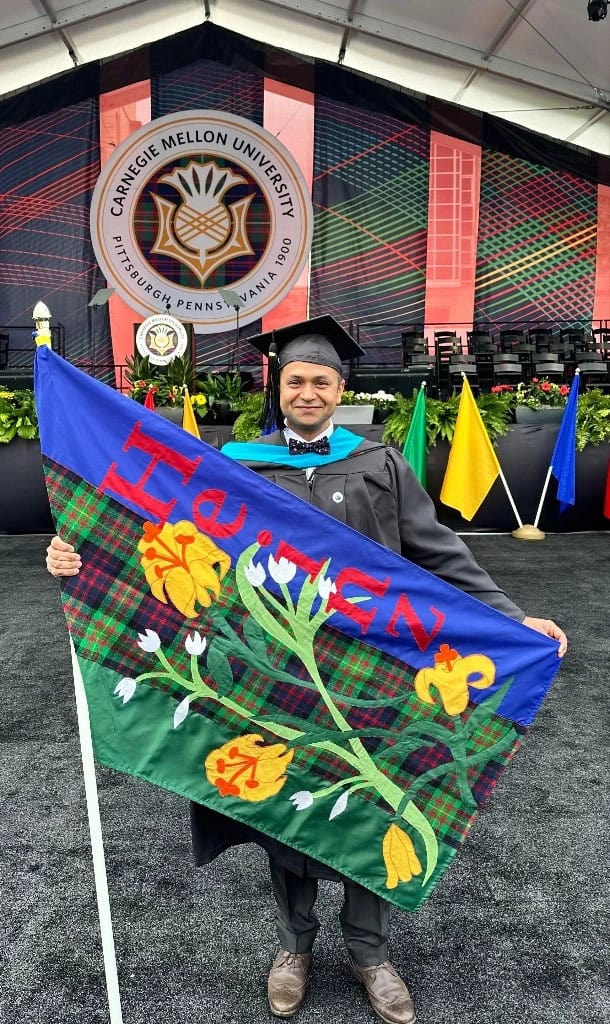
I wanted to participate fully in the community around me. I served as Editor-in-Chief of the Heinz Journal, represented Heinz College in the Graduate Student Assembly, and worked as an adviser to the Joint Funding Committee.
Those roles gave me opportunities to work with students whose backgrounds and interests differed from my own. Editing a policy journal required care with arguments and evidence. Student government involved representation and negotiation. The funding committee brought questions about priorities and the allocation of limited resources into campus life.
I also stayed active in sports and joined the Carnegie Involvement Association, known on campus as CIA, for Sweepstakes, CMU’s distinctive buggy racing competition. I competed as a Hill 3 pusher in 2024. (Our club won both the men’s and women’s titles that year.)
Being part of these activities helped me feel that I belonged. I was contributing to the place where I was studying and learning from people I might never have met through coursework alone.
Punjabi Hospitality in Pittsburgh
On most weekends, I hosted barbecue gatherings and brought friends over to my place. (Yes, I rented a townhouse.) I took Punjabi hospitality to Pittsburgh quite seriously. The barbecues were my unofficial contribution to international relations.
Those gatherings became an important part of my experience. Sharing a meal gave people time to talk, laugh, and get to know each other beyond their academic work. It also gave me a way to share something of the home and culture I had brought with me.
I travelled to many places across the United States and made lifelong friendships with Americans and people from around the world. Those relationships remain among the most valuable things I took away from Fulbright.
Living abroad also broadened the way I understood other people. I became more aware of how much a person’s experience can explain their perspective, and how much can be learned by listening carefully.
Bringing the Learning Back to Public Service
I completed my degree in May 2024 and returned to Pakistan. Today, I serve as Chief of Staff to the Federal Minister for Finance and Revenue.
My responsibilities include examining summaries and proposals for the Cabinet, Prime Minister, and President, and preparing analytical briefs for the Finance Minister. I review legal and fiscal aspects of policies and legislation, support coordination on public financial management reforms, and follow up on decisions across institutions.
In this work, the connection I sought through Fulbright remains central. A policy proposal needs sound evidence, an understanding of the institutional setting, and a realistic account of its fiscal and implementation requirements. My education helps me examine those elements together.
CMU strengthened the way I question an assumption, assess the limits of an analysis, and communicate its implications to a decision-maker. The ability to move between technical detail and practical policy considerations is particularly valuable in an office where many different issues require attention.
I remain conscious of the distance between the village where I grew up and the responsibilities I now hold. Education helped me travel that distance. The values I learned in my family continue to shape how I approach the work.
My Advice to Future Applicants
Start with a problem you care about and understand. Explain what your experience has taught you, where your present skills fall short, and why the programme you are seeking is the right next step. A clear account of that connection gives an application substance.
Prepare early. Leave enough time for tests, documents and thoughtful revisions to your essays. Research the programmes carefully so that you can explain their relevance to your goals. Looking back, I would give myself an even earlier start on refreshing the technical foundations needed for graduate study after years in professional service.
I succeeded on my first Fulbright attempt, but that is one person’s experience. Other applicants may need more than one attempt, and there are worthwhile opportunities beyond the scholarship I chose. Use each application to improve how clearly you understand and present your purpose.
Once you arrive, take part in the life around you. Join an organisation, try a campus tradition, invite people over and travel when you can. Some of the most lasting lessons will come from the friendships you make.
Above all, let yourself apply. A rural background and a long gap since your last degree can make the next step feel distant. They can also give you experience, persistence, and a perspective worth bringing into the room. Take useful advice seriously, and keep working when the advice amounts only to doubt.
When I think about this journey, I still picture the boy on the bicycle. He could not see every place education would eventually take him. He knew where school was, and he kept pedalling.
Want to submit your
scholarship journey?
Submit Your Story Here!
More Scholarship Recipients

My name is Mst. Mariya Akter Reya, and I am from Thakurgaon, Bangladesh. I have always been passionate about mathematics, pa .... Read more
My name is Mudiwa Njawaya, and I am from Zimbabwe. I am pursuing a Bachelor's Degree in International Economics and Trade at .... Read more
My name is Millicent Chineme Eze-Chikwe, and I am from Nigeria. I am a lawyer by profession. I studied for my Bachelor of La .... Read more
Leave A Comment