
How David Guzman, a Panamanian Scholar, Secured a Fully Funded Master’s in Electrical Engineering at the University of Arkansas, United States Through the Fulbright Program
University: University of Arkansas
Degree: Master’s in Electrical Engineering (Power Engineering)
Previous Education: Undergraduate degree in Electrical Engineering, Universidad Tecnológica de Panamá (UTP)
Scholarship: Fulbright Program – Fully Funded (Graduate Education Expenses)
Other Offered Scholarships: SENACYT Scholarship
Social Media
LinkedIn: linkedin.com/in/daguzman/
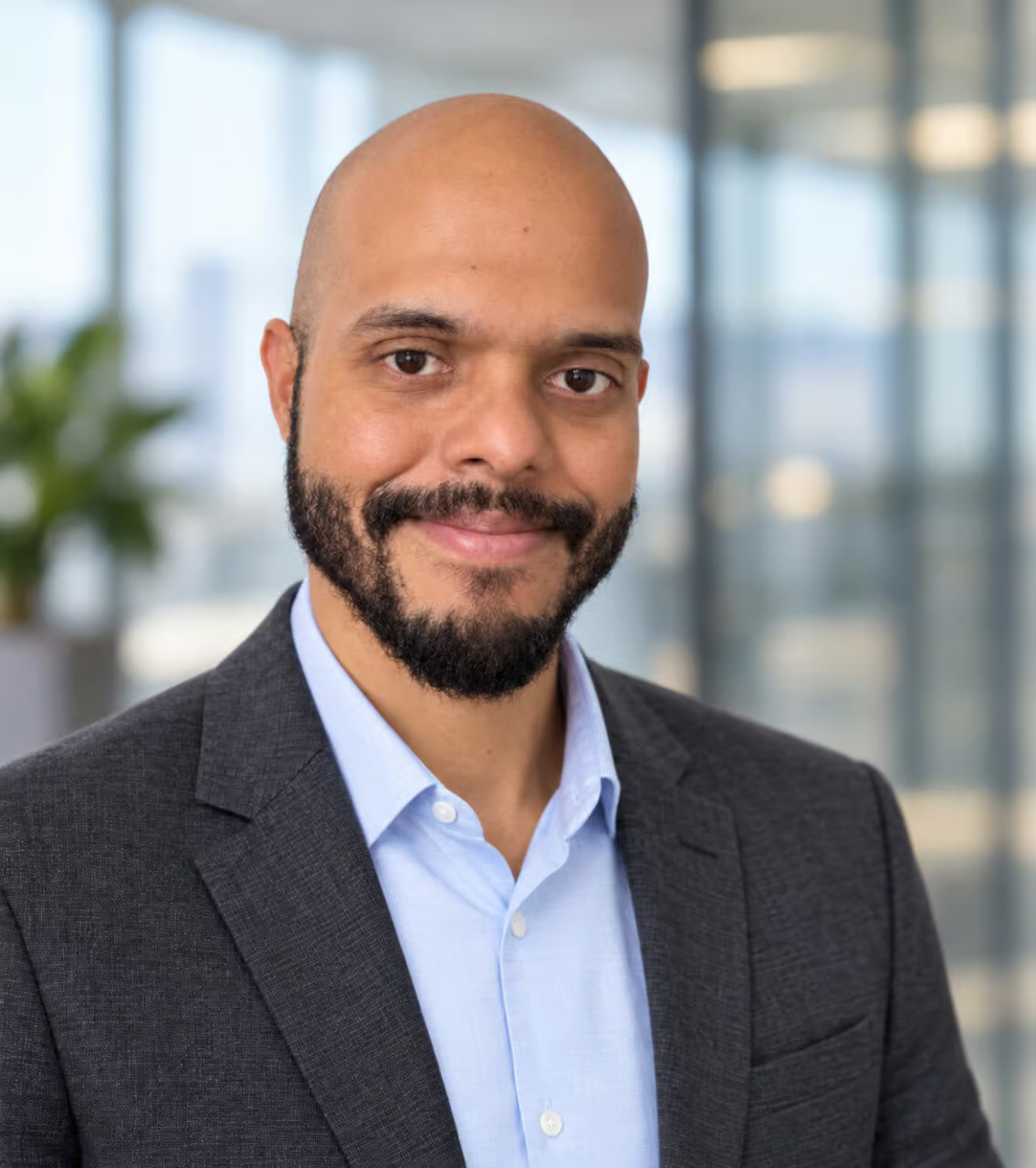
The Journey
My name is David Guzman, and I am from Panama. I was born and raised in Panama City. I went to the United States to attend the University of Arkansas through the Fulbright Program, where I completed a master's degree in electrical engineering with a specialization in power engineering.
I have always been fascinated by physics and by understanding how things work. Growing up, I was especially interested in astronomy and astrophysics, and at one point I even wanted to become an astronaut or astrophysicist. Since astrophysics was not a common career path in Panama, electrical engineering offered a good combination of physics, practical problem-solving, and strong employment opportunities.
Once I started studying electrical engineering, I became particularly interested in energy: how it is generated, transmitted, distributed, and ultimately used. I was fascinated by how the electrical grid operates, how power systems and electricity markets work, and how energy moves from one place to another. That interest ultimately led me to pursue graduate studies in power engineering.
Fulbright Program Details
I attended the University of Arkansas through the Fulbright Program. I do not remember the exact monetary value of the scholarship today, but I was fortunate that it covered all of my expenses related to completing my graduate education. I am very grateful for the opportunity and the support the program provided.
Were You Offered Any Other Scholarships?
Around 2010-2011, when I applied for the Fulbright Scholarship, I also applied for other scholarship opportunities through SENACYT in Panama and was fortunate to be selected. I do not remember the exact scholarship name or amount today.
I ultimately decided to pursue the Fulbright Scholarship. My family strongly encouraged me to choose Fulbright because of its reputation, and I feel very fortunate and honored that I had the opportunity to be part of the program.
Educational Background
I completed my undergraduate degree at the Universidad Tecnológica de Panamá (UTP), where I graduated with honors. I do not remember my exact GPA today.
I knew fairly early that I wanted to study abroad. My mother was a big influence on that decision. She is also a Fulbright scholar, and she always encouraged me to think about education as a way to create more opportunities. At the same time, my family was very clear with me that studying abroad would not be something they could simply pay for. If I wanted that opportunity, I needed to work hard and find a scholarship that could make it possible.
Growing up, I saw firsthand what education had allowed my mother to accomplish and the opportunities it helped her create for my sister and me. I also had other family members who had pursued graduate degrees abroad and built careers that I admired. That gave me something tangible to work toward.
I also feel that the education I received at UTP prepared me well for that next step. Beyond the technical foundation, it taught me how to study, work through difficult material, and be persistent. Those skills were important when I later went through the scholarship application process and moved abroad for graduate school.
How Did You Prepare to Apply to the University of Arkansas?
I spent time preparing the written applications and understanding what each institution expected from applicants. I read a lot of articles online about how to apply for US institutions and what the best practices were at the moment.
How Did You Find Information About Fulbright Program and University of Arkansas?
At the time, finding scholarship opportunities was a little different from today. The internet was available, but social media and online information were not nearly as prevalent. A lot of scholarship announcements still appeared in newspapers.
My grandmother helped me tremendously with this. She would go through the newspaper, save articles about scholarships and other opportunities, and put together folders for me with anything she thought might be relevant. I sometimes think of her as my personalized news feed before we really had news feeds. She did this for many people in our family, and I am very grateful for it.
I was working while going through the application process, and she also helped me stay on top of paperwork and other things I needed to get done without missing work. I genuinely do not think I would have had the same opportunities without her support.
For the University of Arkansas specifically, the university hosted meet-and-greet events in Panama. I attended one of those events, liked what I learned about the university and its programs, and that played an important role in my decision to attend. In a way, you could say they recruited me.
Did You Take Any Standardized Tests? If So, How Did You Prepare for Them? If So, How Did You Prepare for Them?
I took both the TOEFL and the GRE. I was fortunate to already be bilingual and fluent in English by that point. I prepared for the TOEFL by taking practice tests and reviewing the format, but language itself was not a major barrier for me.
The GRE was a different story. I bought preparation books, studied quite a bit, and actually ended up taking the exam twice. After my first attempt, the Fulbright team was very direct with me: my score needed to improve, particularly in the English writing portion.
Being an engineer, writing had never been my strongest area, so I had to go back, prepare more seriously, and take the test again. I did much better the second time, and that became the score I used for my application. It was a good lesson that being comfortable with a subject is not the same as being prepared for a standardized test. Sometimes you simply need to put in the work, understand where you are weak, and try again.
How Did You Prepare to Apply for the Fulbright Program?
A significant part of my preparation was studying for the GRE, but the written portion of the application was probably just as important. I had to prepare several application letters and essays for the universities and the scholarship process, and writing was not something that came naturally to me at the time.
Fortunately, the Fulbright Program provided resources to help with the application process, including feedback and proofreading support. My family and friends also helped a lot. They read some of my early drafts, which honestly needed quite a bit of work, and helped me improve them.
I also spent time looking for examples and videos online about how to structure application essays and communicate my story more clearly. That process taught me that a strong application is not necessarily something you write once and submit. For me, it took several drafts, feedback from other people, and a willingness to keep improving it before I was comfortable with the final result.
How is Your Experience at the University of Arkansas?
My experience at the University of Arkansas was fantastic. I genuinely loved my time there. The university was great, the campus was beautiful, and I really enjoyed that part of the United States. The area has a lot of mountains and nature, and the fall colors are something I particularly remember.
It was also an important period of my life personally. I met my wife while I was at the University of Arkansas, and we now live together in Panama. So I have a lot of very good memories associated with my time there.
How Do You Rate the University of Arkansas Academically and Why?
I would rate the University of Arkansas very highly academically. There were a lot of resources available to students, including writing centers and other academic support, and I had the opportunity to work with some very smart people.
My advisor, Dr. Balda, had a particularly strong influence on my experience. He was very knowledgeable, but he was also demanding. He expected a high level of work from his students and consistently pushed us to improve. At times, that was challenging, but it helped raise my academic level and made me a better engineer. I am very grateful to him for that.
How Does the University of Arkansas Support International Students?
I had a very positive experience as an international student. The university had international student and cultural programs that created opportunities to meet people from different countries, share our cultures, and learn from each other.
Food was a surprisingly big part of that experience. I remember going to potlucks with Vietnamese friends where there would be an enormous table of food, making dumplings with other international friends, and eating barbecue with my American friends. I developed friendships with people from many different countries, and that cultural exchange was one of my favorite parts of studying in the United States.
What Did You Pursue After the Fulbright Program? (Work, Further Study, Research or Something Else?)
After completing my scholarship and graduate studies, I returned to Panama and began looking for work. I first joined a local utility company, which gave me the opportunity to start applying what I had studied in power engineering in a professional setting.
After that, I joined the company where I still work today. I have now been there for approximately 12 years. I started as a product engineer and, over time, progressed to my current role as Engineering Director.
I do not think that career progression would have been possible without the education I received abroad and the technical, professional, and personal tools I developed during that experience. The Fulbright scholarship gave me an opportunity that had a lasting impact on my career.
What Do You Think Made Your Application Stand Out?
I think my application stood out because I had a strong combination of academics, English proficiency, and personality. During my bachelor's degree at the Universidad Tecnológica de Panamá, I graduated with honors. I do not believe the university had an official class ranking, but based on what I remember, I was probably among the top few students in my class.
I also spoke English well and was fairly outgoing. Before applying for Fulbright, I had the opportunity to spend some time living in Germany. That experience gave me confidence that I could adapt to another country, meet new people, and live abroad successfully.
I also had a clear reason for wanting to continue studying power engineering. I was interested in learning more about power systems, transmission, and distribution, and I wanted to bring some of that knowledge back to Panama after completing my studies. I think the combination of my academic background, my ability to communicate in English, my previous international experience, and being comfortable interacting with people helped make me a strong candidate.
What Would You Have Done Differently if You Were Going Through the Process Again?
If I were going through the process again, I would prepare much better for the GRE the first time and spend more time developing my writing skills.
Writing and communication are extremely useful, not only in academics but also throughout your professional life. Being able to explain your ideas clearly, tell your story, and communicate what you want to accomplish makes a real difference when applying for scholarships and universities.
Looking back, I would have started working on those skills earlier instead of learning some of those lessons during the application process itself.
What Advice Would You Give Those Looking to Apply for a Similar Scholarship?
My main advice would be to plan ahead and understand why you want the scholarship in the first place. Think about what you want to accomplish, what your goals are, and how studying abroad fits into those goals.
It also helps to have a target. Think about what country you would like to study in, which universities or programs interest you, and what you want to learn from the experience. Having that direction makes it easier to prepare and build a stronger application.
Academically, study hard and try to maintain a good GPA because that certainly helps. But I would also encourage people to be open to new experiences. A scholarship like Fulbright can open a lot of doors and expose you to people, places, and opportunities you may not have expected.
The doors may open for you, but you are still the one who has to walk through them.
Want to submit your
scholarship journey?
Submit Your Story Here!
More Scholarship Recipients
My name is Shah Hussain, and I am from Khyber Pakhtunkhwa, Pakistan. I completed my Bachelor’s in Psychology at the Univer .... Read more
I am June from the Philippines. I am an educator for Social Sciences and Humanities. I recently earned my Master in Southeas .... Read more
Hi, my name is Abdul Hafeez, and I come from a small town called Nasirabad in Sindh, Pakistan. Currently, I am pursuing a ma .... Read more
Leave A Comment