
Worcester Polytechnic Institute Scholarships for International Students 2027
Students considering Worcester Polytechnic Institute can explore scholarships that range from fully funded support to partial awards. This shortlist highlights higher coverage options first.
For institution funded support at Worcester Polytechnic Institute, these scholarships are frequently highlighted when prioritizing higher coverage. Presidential Scholarships is a partially funded award, and the listed benefits often include amount varies and but students with an IB score of more than 40 are guaranteed a minimum of $25,000 USD per year. Specialty Merit-Based Scholarship Programs is usually considered partially funded, and typical coverage can include stipend ranging from $10,000 to $25,000. A strong option is Graduate Assistantships which is partially funded and often covers direct compensation through salary.
Outside the university’s own funding routes, Worcester Polytechnic Institute students may be eligible for external programs that can offer substantial support. Here are a few to consider. Fulbright Foreign Student Program is fully funded, and coverage often includes roundtrip transportation from the country of origin to the US, monthly living stipend, and tuition fees.
This is only a shortlist. Additional scholarships and funding options appear further down on this page.
Worcester Polytechnic Institute Scholarships for International Students
The scholarships at Worcester Polytechnic Institute can help fund your study expenses. There are currently 5 scholarships being offered to international students at the Worcester Polytechnic Institute, all with varying requirements, benefits, and application processes. We have compiled them in this list to help you find the scholarship that best fits you.
Undergraduate Scholarships
Graduate Scholarships
External Scholarships
There are many degrees that are open to international students right now — find yours.
Worcester Polytechnic Institute Admissions
Here are the official admission pages for Worcester Polytechnic Institute:
| Degree | Admissions Pages |
|---|---|
| Bachelor's | International Students Admissions Page |
| Master's | International Students Admissions Page |
Admissions and Scholarship Results at Worcester Polytechnic Institute
Here are some of the admissions and scholarship results from previous applicants to Worcester Polytechnic Institute, which you might find helpful. For more results to Worcester Polytechnic Institute, please see the Worcester Polytechnic Institute Admissions Profile Page .
| Nationality / Region | SAT/ACT | EFC | GPA | Scholarship | Status |
|---|---|---|---|---|---|
| India | N/A | N/A | 3.89/ 4.00 | Fully funded | Accepted |
| Europe | N/A | N/A | 4 | N/A | Rejected |
| USA | 1550 | N/A | N/A | $30000 USD (per year) | Accepted |
| East Asia | 1430 | 7000 | N/A | $60000 USD (per year) | Accepted |
| India | 1530 | N/A | 3.7 | $25000 USD (per year) | Accepted |
Worcester Polytechnic Institute Application Deadlines
| Degree | Admission Deadline |
|---|---|
| Bachelor's (Fall - Early Action 1 and Early Decision 1) | November 1, 2026 |
| Bachelor's (Fall - Early Action 2 and Early Decision 2) | January 5, 2027 |
| Bachelor's (Fall - Regular Decision) | February 1, 2027 |
| Master's (Fall) | January 1, 2027 Different Master's programs have different deadlines |
Tuition Fees at Worcester Polytechnic Institute for International Students
Indicative annual tuition fee ranges for international students at Worcester Polytechnic Institute. Exact fees vary by program, so always confirm the current cost on the university's official tuition fee pages.
| Degree Level | Typical Annual Range |
|---|---|
| Bachelor's Tuition | 61,790 USD |
| Master's Tuition | 20,280 – 30,420 USD |
Please note that tuition fees can vary based on the specific program you choose. For the most accurate and current fee information, consult the official tuition fee pages linked above.
Worcester Polytechnic Institute Scholarship Recipients
International students who received scholarships to study at Worcester Polytechnic Institute, documented by Global Scholarships.

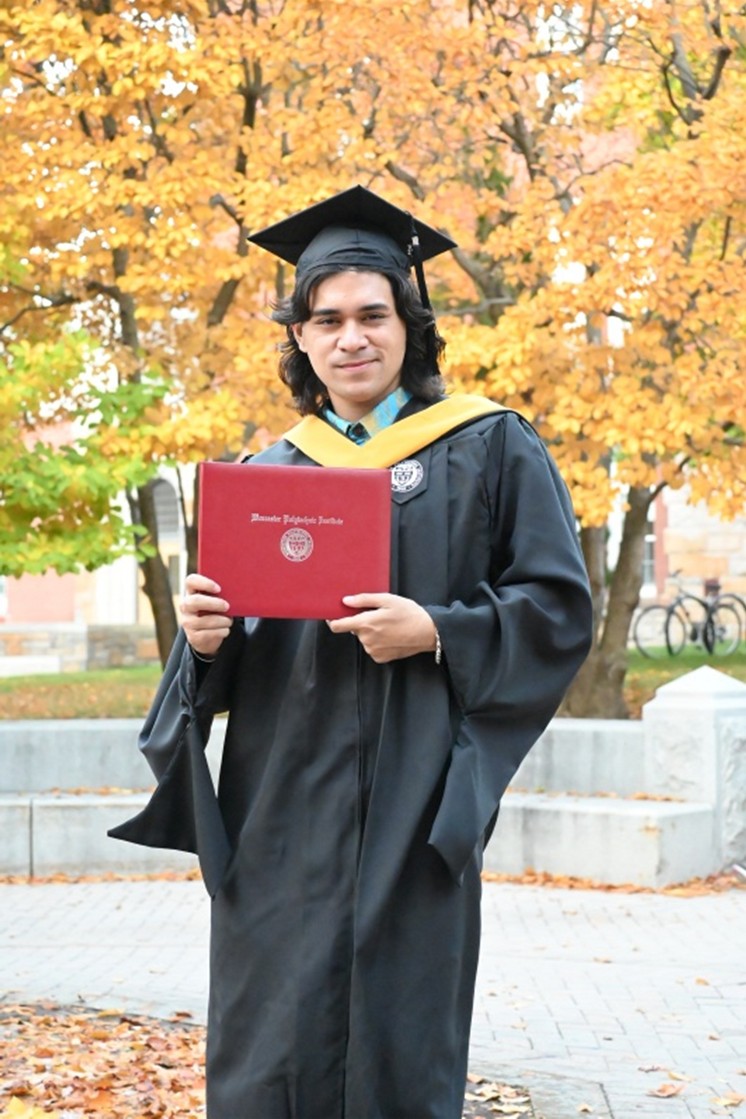

What Scholarship Recipients Say
Advice and insights from international students who successfully secured funding to study at Worcester Polytechnic Institute.
"In 2022, I applied to WPI and was selected to pursue my PhD in Biology & Biotechnology with a fully funded scholarship that covers my tuition fees, provides a monthly stipend, and includes health insurance."
"I watched numerous YouTube videos and spoke with people already in grad school. Before the application window opened, I had already compiled a list of schools I intended to apply to. I carefully reviewed each school's requirements to ensure I met them and paid close attention to the deadlines."
"I received the Fulbright Scholarship to pursue my Master’s in Biomedical Engineering at Worcester Polytechnic Institute (WPI) in 2023."
"My experience at WPI has been transformative, giving me academic opportunities, an invaluable cultural exchange, and a professional network that embodies Fulbright’s mission of building bridges through education."
"Through the Fulbright Program, I’ve been able to access world-class education and gain exposure to global networks dedicated to climate change."
"The application process can be stressful, but trust me, studying abroad is even more demanding than you might imagine. Reach out to people who have gone through the process, but ensure you've done your homework before asking for help."
Frequently asked questions
Common questions about scholarships, admissions, and studying at Worcester Polytechnic Institute.
Yesm mainly at the graduate level. WPI has graduate awards (tuition discounts) that can apply “whether you study full-time, part-time, on campus, or online,” and one of the listed award types is specifically for “online or part-time on-campus students.”
WPI scholarships and funding can cover a wide range of subjects, especially STEM, and many awards are not limited to just one major. In the Global Scholarships stories, recipients at WPI studied Biomedical Engineering (Daniel Alvarenga), Biology & Biotechnology (Racheal Oluwabukola Asaolu and Abeer Asif), and Community Climate Adaptation (Chang Jonathan). WPI also lists merit scholarships tied to areas like biology/biotech, chemical engineering, robotics, and business-related programs (e.g., BizTech). Beyond STEM, WPI’s Global Scholarship can be applied to signature project experiences that include the Humanities & Arts Requirement (HUA) alongside major projects (IQP/MQP), so humanities-related learning can be directly supported through these WPI project pathways.
It depends on the scholarship type, but WPI supports both domestic and international students. For undergraduate applicants, WPI notes competitive merit-based scholarships for first-year and transfer students and also highlights up to two International Leadership Awards per year specifically for incoming first-year international students (non-citizens). In the Global Scholarships recipient stories at WPI, funded students came from Honduras (Daniel Alvarenga), Samoa (Chang Jonathan), Nigeria (Racheal Oluwabukola Asaolu), and Pakistan (Abeer Asif), which is a helpful real-world snapshot of nationality diversity in externally funded routes like Fulbright and fully funded PhD offers.
Often yes for international applicants, but waivers can be possible depending on your background and the level/program. For undergraduate international admission, WPI states that international applicants “must submit proof of English language proficiency” via exams such as TOEFL/IELTS/Duolingo (with limited exemptions in specific cases). For graduate admission, WPI says non-native English applicants must submit TOEFL/IELTS/Duolingo for most programs, and it also explains formal waiver pathways (for example, qualifying study in an English-speaking country, or certain work experience in the U.S.).
The recipient stories show how this looks in practice. Racheal Oluwabukola Asaolu earned an IELTS 8.0, but she wrote: “The English proficiency test requirement was waived because I informed the school that the mode of communication during my undergraduate and master’s studies was English.” On the other hand, Chang Jonathan shared that he “was also required to sit for both the TOEFL and the GRE exams,” and Abeer Asif still prepared seriously even with an English-medium background: “As for the TOEFL, even if you speak English well, I’d still recommend a lot of practice—I certainly did, even though English has always been my main medium of education.”
WPI’s published materials tend to emphasize holistic review rather than a single universal “minimum grade,” and competitiveness can vary by program. A useful benchmark: WPI’s Common Data Set (2024–25) reports an average high school GPA of 3.9 for enrolled first-year students who submitted GPA, which suggests many successful applicants have strong grades.
The Global Scholarships stories also give real examples from scholarship recipients at WPI: Racheal Oluwabukola Asaolu reported a CGPA of 4.83 and said she graduated top of her department, while Abeer Asif reported a CGPA of 3.82, and Chang Jonathan described graduating with an “above-average GPA.” These don’t set a “minimum,” but they do show what successful scholarship-supported profiles have looked like at WPI.
WPI scholarships typically focus on academic status (first-year, transfer, enrolled student) and eligibility rules like enrollment, merit, or financial need—rather than a strict age cap. However, external scholarships (for example, government scholarships like Fulbright) can have country-specific rules, so you should always check the exact scholarship’s terms.
In practice, a “good” scholarship profile at WPI often combines strong academics with evidence you’ll thrive in project-based learning: solid grades, relevant coursework, leadership/community involvement, and strong written materials (personal statement + recommendations). WPI’s merit scholarship criteria explicitly include academic performance plus recommendations and personal statement (and, for some awards, your intended program of study).
The Global Scholarships stories show what stood out for funded students at WPI. Racheal Oluwabukola Asaolu treated her personal statement as a core asset: “I placed significant importance on my personal statement, treating it as a second CV.” Abeer Asif emphasized effort and iteration: “I rewrote my Fulbright application about 8 or 9 times.” Daniel Alvarenga highlighted the classic graduate package: “I drafted and refined my statement of purpose over several months… and secured strong recommendation letters,” which aligns closely with what many graduate scholarships and assistantships reward.
Undergraduate (typical WPI requirements): You generally apply via the Common Application and submit official high school transcripts plus recommendation letters (school counselor + teacher). If you are an international applicant, you must also submit proof of English proficiency (TOEFL/IELTS/Duolingo, with limited exceptions). If you are applying for need-based aid as an international student, WPI also requires the CSS Profile.
Graduate (typical WPI requirements): WPI describes typical graduate requirements as transcripts from all post-secondary institutions attended, letters of recommendation, a personal statement/statement of purpose, and a résumé/CV—plus test scores (GRE/GMAT) and English proficiency scores if applicable, depending on your program.
The recipient stories make these documents feel more concrete. Chang Jonathan explained that his process included “supporting documents such as a personal statement, a detailed study plan, academic transcripts, and a police clearance,” plus TOEFL/GRE. Racheal Oluwabukola Asaolu said the documents she gathered “typically included my CV, unofficial academic transcripts… certificates, proof of English proficiency, and a personal statement,” and she stressed choosing recommenders intentionally. Daniel Alvarenga similarly focused on refining the statement of purpose and securing recommendation letters.
Undergraduate: WPI announced it eliminated its undergraduate application fee, and WPI’s Common Data Set (2024–25) indicates the institution has no application fee for first-year admission reporting purposes. If you ever encounter a fee in a specific pathway, it’s still worth asking about fee-waiver options. This is common in many admissions processes, and it also mirrors what scholarship recipients do (for example, Racheal Oluwabukola Asaolu wrote that she “reached out to the schools to request waivers for the application fee”).
Graduate: WPI states a non-refundable $70 application fee is required for on-campus graduate programs, and it notes the fee is waived for online programs.
There are many degrees that are open to international students right now — find yours.
About the Author: Hyun Lee


Leave A Comment