
Tokyo University of Marine Science and Technology Scholarships for International Students 2027
In today’s era, Japan is a world-leader in terms of research, technology, education, and overall society. Therefore, there’s no better to go and learn from than a Japanese institution, such as Tokyo University of Marine Science and Technology.
Scholarships, grants, and other forms of funding are offered by Tokyo University of Marine Science and Technology to international students. We’ll discuss them in this article, and you can use them to fulfill your dream of studying abroad without incurring high costs. So, let’s get started!
Tokyo University of Marine Science and Technology Scholarships for International Students
External Scholarships
There are many degrees that are open to international students right now — find yours.
Tokyo University of Marine Science and Technology Admissions
Here are the official admission pages for Tokyo University of Marine Science and Technology:
| Degree | Admissions Pages |
|---|---|
| Master's | International Students Admissions Page |
Tuition Fees at Tokyo University of Marine Science and Technology for International Students
Indicative annual tuition fee ranges for international students at Tokyo University of Marine Science and Technology. Exact fees vary by program, so always confirm the current cost on the university's official tuition fee pages.
| Degree Level | Typical Annual Range |
|---|---|
| Bachelor's Tuition | 535,800 Yen |
| Master's Tuition | 535,800 Yen |
Please note that tuition fees can vary based on the specific program you choose. For the most accurate and current fee information, consult the official tuition fee pages linked above.
Tokyo University of Marine Science and Technology Scholarship Recipients
International students who received scholarships to study at Tokyo University of Marine Science and Technology, documented by Global Scholarships.
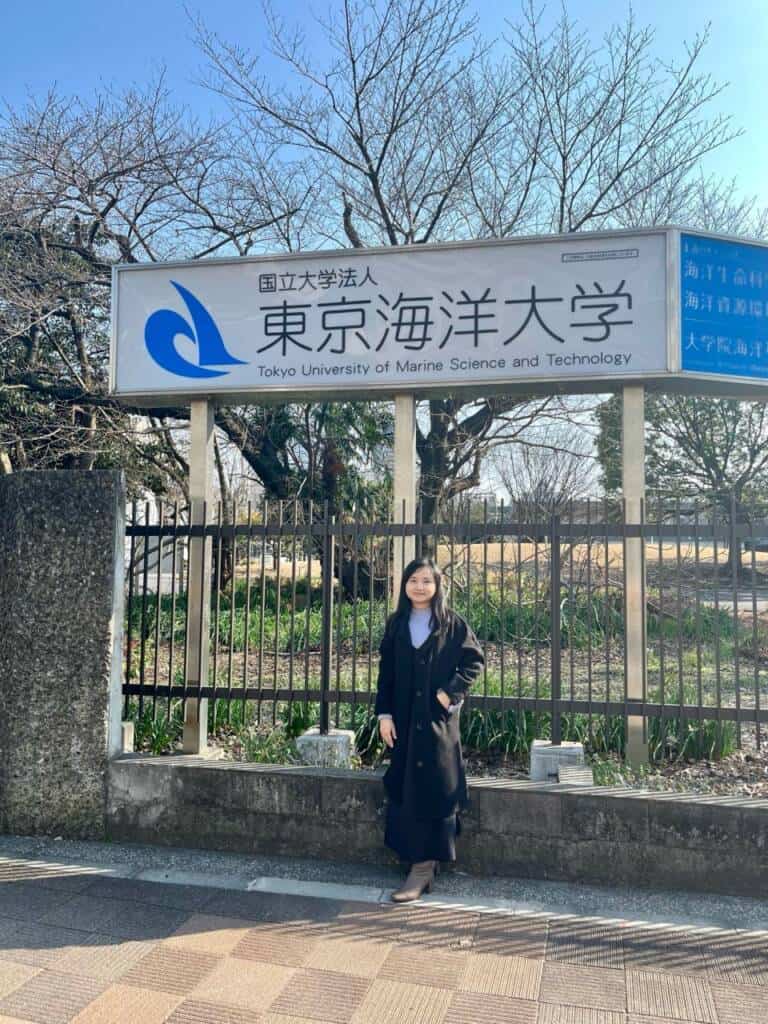
What Scholarship Recipients Say
Advice and insights from international students who successfully secured funding to study at Tokyo University of Marine Science and Technology.
"There are two types of MEXT Scholarships: University Recommendation and Embassy Recommendation. I applied through the University Recommendation pathway, which is more competitive but offers comprehensive support. The scholarship covers all tuition fees and research expenses, with a monthly stipend of approximately ¥140,000."
"I would strongly recommend that other applicants dedicate more time to practicing English proficiency tests if they have already decided to apply for the scholarship."
"Finally, I would like to emphasize the importance of preparing an outstanding research proposal if you decide to apply for the MEXT Scholarship. Having a high GPA from your previous university and an English proficiency certificate will be tremendously helpful. I believe these elements are crucial not only for the MEXT Scholarship but for most academic scholarships."
"The application process involved several key steps: Step 1: Finding a Supervisor First, I had to contact a professor at the university and request acceptance as a doctoral candidate under their supervision. Step 2: Research Proposal Next, I needed to prepare a comprehensive research proposal outlining the work I would conduct in Japan. Step 3: University Application After preparing all required documents, I submitted them to my prospective supervisor, who then forwarded the application to the university. Step 4: MEXT Application Once I received acceptance from the university, I had to prepare documents again, specifically for the MEXT application."
Frequently asked questions
Common questions about scholarships, admissions, and studying at Tokyo University of Marine Science and Technology.
TUMSAT’s main scholarships are designed for students who are formally enrolled (undergraduate/graduate/research students) and participating in university life (e.g., interviews and selection rounds), so they are generally not “online-course scholarships.”
Both exist, but it depends heavily on the level and program. Many undergraduate pathways in Japan are primarily Japanese, and TUMSAT also provides Japanese-language education for international students (including dissertation-writing support in Japanese). At the graduate level, there are programs/courses where English is used extensively, and some programs are structured so you can study and be examined in English in major subjects (with certain parts still potentially Japanese depending on the major and exam section). In scholarship stories, MEXT recipient Chaw Su Thin focused strongly on English readiness. She said she “achieved an overall score of 6.5” on IELTS, showing how English can be central for international graduate study routes.
It depends on the scholarship type. Many university-recommended or private scholarships focus more on academic performance and enrollment status than age. However, major government scholarships can have strict age rules. For example, MEXT (a common path for international graduate students) publishes age eligibility requirements by scholarship category and year. In practice, you should check the specific scholarship you’re applying for (TUMSAT-recommended, private foundation, or MEXT), because the age rule, if any, comes from that scholarship’s official guidelines, not just the university.
Scholarships at TUMSAT generally apply to the subjects the university actually teaches, marine and ocean-related fields, rather than being limited to one narrow department. At TUMSAT you’ll find strong coverage in STEM and applied fields (marine biology and resources, food/production sciences connected to fisheries, marine environmental science, marine resources/energy, maritime systems and ocean engineering, marine electronics/mechanical engineering, logistics and information engineering) and also policy/humanities-oriented study (such as ocean policy and culture / marine policy and management).
- Engineering: TUMSAT has maritime/marine engineering and systems fields, and scholarships commonly apply to enrolled students in these majors.
- STEM: STEM is a core strength of TUMSAT (marine science, engineering, environment, resources, data/logistics-related areas).
- Humanities/social science: Ocean policy/culture and marine policy/management are examples where social science and policy intersect with marine issues.
Many opportunities at TUMSAT are open broadly to international students, but eligibility depends on the scholarship channel. In the TUMSAT recipient story, Chaw Su Thin studied in Japan as a Myanmar national through MEXT.
Often yes, or at least it’s strongly helpful, because programs and entrance exams may require language evaluation (English and/or Japanese), or allow you to use official scores for exemption or conversion. For some graduate admissions routes, accepted proof can include TOEIC/TOEFL/IELTS and/or Japanese competency measures, depending on what you’re applying for.
In the MEXT pathway, Chaw Su Thin highlighted how central this can be: she took IELTS and said she “achieved an overall score of 6.5,” and she advised future applicants to prepare carefully for English proficiency testing.
TUMSAT admissions and scholarship decisions are typically holistic within each program (transcripts, exams, interviews, research fit, etc.), so there isn’t always a single universal “minimum GPA” published for every route. From the scholarship recipient side, Chaw Su Thin emphasized academics: she said she “maintained a high GPA,” and later advised that having a strong GPA is “tremendously helpful” for scholarships like MEXT.
A strong background usually means (1) high academic performance in your prior degree(s), (2) a clear fit with TUMSAT’s marine-focused research/education areas, and (3) a credible plan for what you will do at TUMSAT (especially for graduate scholarships). Research experience, a focused topic, and proof you can work in English/Japanese as required all help.
In her MEXT story, Chaw Su Thin described a very typical “strong background” profile: graduate-level preparation plus research direction, and she stressed “preparing an outstanding research proposal” as a key factor for scholarship success.
The exact checklist depends on whether you’re applying for undergraduate, master’s, PhD, or non-degree/research-student status, and also whether you’re applying for a scholarship (like MEXT) at the same time. Commonly requested documents for graduate-level applications include: a statement of purpose and research proposal, official academic transcripts, official graduation (or expected graduation) certificates, academic/employment history forms, recommendation letters, and identification documents such as a copy of your passport. Depending on where you live, you may also need residence-status documentation, and language scores (TOEFL/IELTS/TOEIC and/or Japanese competency evidence) may be required or used for exemptions.
Chaw Su Thin also described the MEXT-style flow in a very practical way: she said one of her first steps was to “contact a professor” to secure supervision, and she explained that she had to prepare documents for the university and then “prepare documents again” for the MEXT submission, so expect two layers of paperwork if you pursue a government scholarship route.
Yes, TUMSAT generally charges an entrance examination fee as part of the application/admissions process (the amount varies by level/program). Always confirm the exact fee and payment method in the current year’s admissions and fee pages because amounts and procedures can be updated.
There are many degrees that are open to international students right now — find yours.
About the Author: Hyun Lee


Leave A Comment