
Kumoh National Institute of Technology Scholarships for International Students 2027
To help students manage tuition and living expenses, Kumoh National Institute of Technology connects to scholarships across different funding levels. Here are several top options to review first.
Among the university based funding routes linked to Kumoh National Institute of Technology, these scholarships tend to stand out for their level of support and overall value. A strong option is KIT Scholarship for Freshmen which is full tuition and often covers 100% tuition fee for students with TOEFL (PBT) 597, TOEFL (CBT) 247, TOEFL (IBT) 99, TOEIC 850, New TEPS 386, TEPS 700, TOPIK 5, IELTS 7.0 and 50% tuition fee for students with TOEFL (PBT) 570, TOEFL (CBT) 230, TOEFL (IBT) 85, TOEIC 750, New TEPS 327, TEPS 600, TOPIK 4, IELTS 6.0.
To broaden funding options beyond institutional awards at Kumoh National Institute of Technology, these external and government scholarships are commonly considered as well. Global Korea Scholarship (GKS) is commonly categorized as fully funded support, and coverage that often includes tuition fees, airplane tickets, and living stipend.
To see every scholarship associated with this institution and compare coverage and eligibility, browse the sections below.
Kumoh National Institute of Technology Scholarships for International Students
The scholarships at Kumoh National Institute of Technology can help fund your study expenses. There are currently 3 scholarships being offered to international students at the Kumoh National Institute of Technology, all with varying requirements, benefits, and application processes. We have compiled them in this list to help you find the scholarship that best fits you.
Graduate Scholarships
External Scholarships
There are many degrees that are open to international students right now — find yours.
Kumoh National Institute of Technology Admissions
Here are the official admission pages for Kumoh National Institute of Technology:
| Degree | Admissions Pages |
|---|---|
| Bachelor's | International Students Admissions Page |
| Master's | International Students Admissions Page |
Tuition Fees at Kumoh National Institute of Technology for International Students
Indicative annual tuition fee ranges for international students at Kumoh National Institute of Technology. Exact fees vary by program, so always confirm the current cost on the university's official tuition fee pages.
| Degree Level | Typical Annual Range |
|---|---|
| Bachelor's Tuition | 3,622,000 – 4,042,000 KRW |
| Master's Tuition | 4,442,000 – 4,880,000 KRW |
Please note that tuition fees can vary based on the specific program you choose. For the most accurate and current fee information, consult the official tuition fee pages linked above.
Kumoh National Institute of Technology Scholarship Recipients
International students who received scholarships to study at Kumoh National Institute of Technology, documented by Global Scholarships.
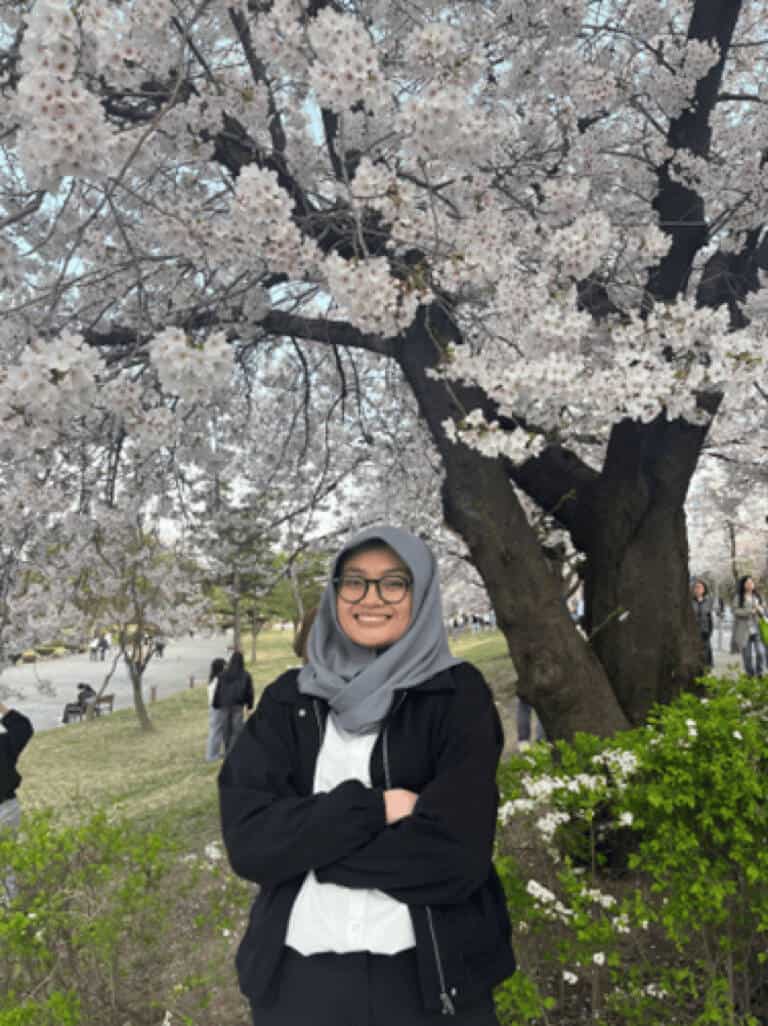
What Scholarship Recipients Say
Advice and insights from international students who successfully secured funding to study at Kumoh National Institute of Technology.
"I was honored to receive a fully funded scholarship from the Korean government for my graduate studies."
"My research focuses on the Internet of Vehicles, Blockchain, and the Metaverse."
"Both my Master’s and PhD institutions were very welcoming to international students."
"My Master’s university offered student dormitories, making the initial transition smooth."
Frequently asked questions
Common questions about scholarships, admissions, and studying at Kumoh National Institute of Technology.
KIT scholarships are designed for students enrolled in KIT programs (degree or approved non-degree programs), not for stand-alone online courses. KIT does offer online learning through open platforms (like K-MOOC/OCW), but these are typically free/open learning options rather than scholarship-funded degree enrollments.
Both can happen, but Korean is common, especially at undergraduate level, while some graduate courses/labs can run in English depending on the department and supervisor English-taught study is possible in some contexts: Syed Ali Hassan shared that “Courses at both institutions were conducted entirely in English,” including during his Master’s period at KIT.
It depends on the scholarship. Government scholarships like GKS often have age rules that change by year and by track (undergraduate vs graduate). In contrast, KIT internal scholarships and professor/lab-based funding are typically tied more to enrollment status, academic results, and research fit than to a fixed age cap.
In recipient stories, scholarships were won via different pathways: Alivia Kirana Hartono Putri was funded by GKS, while Hope Leticia described a “professor scholarship” model where a lab funds your education.
Most KIT scholarships are not “subject-restricted” in the way some foundations are; instead, they apply across eligible departments as long as you meet the academic/language/research criteria. Because KIT is engineering-strong, many funded paths naturally cluster in engineering and STEM fields (especially at graduate level through labs and projects).
Many KIT scholarship routes are aimed at international students (non-Korean nationals), but exact nationality eligibility depends on the scholarship. For example, GKS is a Korean government scholarship with country/nationality rules that can vary by year and track.
To make this concrete, recipient stories connected to KIT include international students from multiple countries: Hope Leticia (Uganda), Alivia Kirana Hartono Putri (Indonesia), and Syed Ali Hassan (Pakistan) in his prior education background.
For many KIT admissions/scholarship routes, language test scores matter a lot, either as an admission minimum or as a scholarship booster. KIT graduate admission guidelines commonly require minimum Korean or English test scores, and higher scores can unlock tuition-exemption scholarships.
But not all scholarship paths require certificates in the same way. For example, Alivia noted that “GKS doesn’t require English or Korean language certificates” in the way people often assume, yet she still chose to submit strong scores (IELTS/TOPIK) to strengthen her case.
- Scholarship advantage example: Alivia’s story lists IELTS 7.0 and TOPIK Level 5, and she mentioned getting extra allowance because she “nailed the TOPIK… Level 5.”
- KIT scholarship mechanics: KIT tuition-exemption scholarships may require specific TOPIK/IELTS/TOEFL thresholds depending on scholarship type.
There isn’t one universal GPA line that fits every program and intake, but grades absolutely matter for both admission competitiveness and scholarships. In scholarship pathways, explicit GPA thresholds can apply.
From a recipient perspective, Alivia entered with a listed GPA of 3.44/4.00 and still won full funding through GKS. And Hope Leticia emphasized that “grades are very important,” adding that some universities require “a 3.25/4.5 GPA and above,” with even higher expectations in some science/technology contexts.
A strong fit between your background and the department/lab is a big factor, especially for professor-funded scholarships at graduate level. Syed Ali Hassan described KIT’s “Professor’s Scholarship” as being awarded “based on academic merit and research alignment,” which is exactly how many lab-funded offers work.
Applicants who combine solid grades with clear direction tend to do well. Hope Leticia described choosing research areas, identifying labs, reading publications, and emailing professors, basically treating it like a targeted research job search. And Alivia shared that even with a “decent but not exceptional” GPA, her research alignment and international activities helped her stand out.
Document requirements depend on program level, but commonly include an application form, proof of graduation, transcripts, language proficiency records, identity/nationality documents, and study/essay materials.
In practice, scholarship recipients also prepared the “story” documents that admissions committees expect: Syed said he prepared “motivation letters, CVs, recommendation letters, and research proposals,” which maps closely to what many graduate routes and lab applications want.
KIT is widely known for engineering and applied sciences, but it also offers business and broader academic structures. Popular areas include Mechanical Engineering, Electronic Engineering, Computer/AI and Software, Civil/Environmental, Industrial Engineering, Materials/Polymer/Chemical fields, IT Convergence, Optical/Biomedical-related engineering, Business Administration, and mathematics/big-data-oriented study paths.
If you want a personal match example, Hope Leticia pursued research in areas like “Internet of Vehicles, Blockchain, and the Metaverse,” while Alivia pursued Industrial Engineering and specialized in topics like Human Factors/Interaction Design within that field.
No, Kumoh National Institute of Technology does not charge an application fee for international students.
There are many degrees that are open to international students right now — find yours.
About the Author: Hyun Lee


Leave A Comment