
Hiroshima University Scholarships for International Students 2027
Hiroshima University is linked to scholarships that can reduce costs in meaningful ways. Here are a few strong options prioritized by funding level.
On the institution side, Hiroshima University is connected to scholarships that can reduce tuition and sometimes extend to other study costs. These are practical starting points. Admission Scholarship Program is a fully funded award, and the listed benefits often include a tuition fee waiver and a 50,000 JPY stipend for one year.
Beyond campus funding, Hiroshima University applicants often explore outside opportunities including government backed and independent programs. These are common starting points. Japanese Government (MEXT) Scholarship is fully funded, and coverage often includes tuition fees, ¥143,000 to ¥145,000 per month for research students, and ¥117,000 for undergraduate students.
For the complete set of linked scholarships including additional options and details, continue below on this page.
Hiroshima University Scholarships for International Students
The scholarships at Hiroshima University can help fund your study expenses. There are currently 3 scholarships being offered to international students at the Hiroshima University, all with varying requirements, benefits, and application processes. We have compiled them in this list to help you find the scholarship that best fits you.
Graduate Scholarships
External Scholarships
There are many degrees that are open to international students right now — find yours.
Hiroshima University Admissions
Here are the official admission pages for Hiroshima University:
| Degree | Admissions Pages |
|---|---|
| Bachelor's | International Students Admissions Page |
| Master's | International Students Admissions Page |
Tuition Fees at Hiroshima University for International Students
Indicative annual tuition fee ranges for international students at Hiroshima University. Exact fees vary by program, so always confirm the current cost on the university's official tuition fee pages.
| Degree Level | Typical Annual Range |
|---|---|
| Bachelor's Tuition | 535,800 Yen |
| Master's Tuition | 535,800 Yen |
Please note that tuition fees can vary based on the specific program you choose. For the most accurate and current fee information, consult the official tuition fee pages linked above.
Hiroshima University Scholarship Recipients
International students who received scholarships to study at Hiroshima University, documented by Global Scholarships.
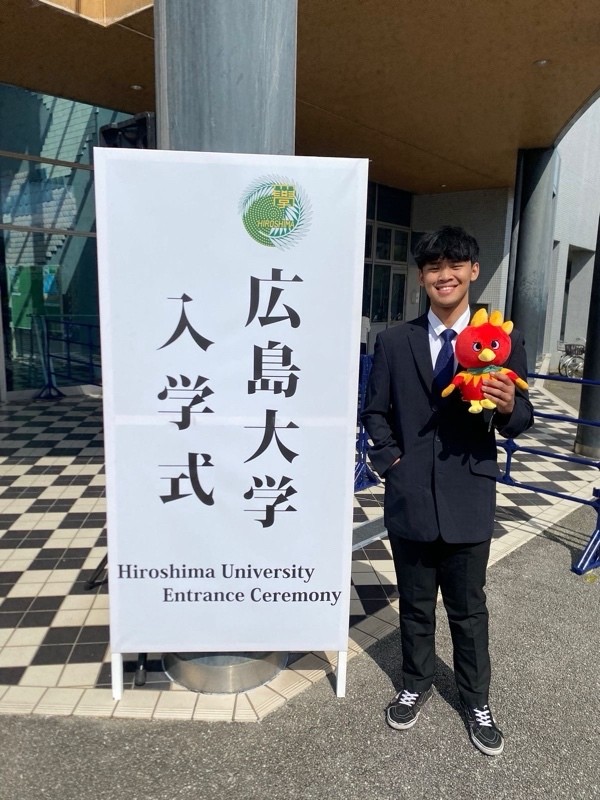
What Scholarship Recipients Say
Advice and insights from international students who successfully secured funding to study at Hiroshima University.
"I was awarded the MEXT Scholarship through the University Recommendation route. This scholarship covers tuition, round-trip airfare, and provides a monthly stipend of 117,000 yen, which is sufficient to live comfortably as a student in Hiroshima."
"First, I recommend finding an online community—such as Facebook groups or Reddit forums—where past and current applicants share experiences and advice. These platforms can provide valuable insight and encouragement throughout the application process."
"I chose Integrated Global Studies because I am passionate about understanding global interconnections and learning how to address worldwide challenges."
"Campus life in Hiroshima has been extremely positive. People are open and friendly, and I quickly felt a sense of belonging despite our diverse backgrounds. My professors are engaged and enthusiastic, making learning enjoyable even though English is not their first language. Most courses are conducted in English, and Japanese language courses are available for those interested in learning the language."
"The International Student Support Office has been essential in helping me settle into daily life, including housing, paperwork, and understanding local services. Their support made the transition to living in Japan much smoother."
"Pursuing advanced studies in this field allowed me to deepen my expertise and contribute to research focused on sustainability and the development of functional materials for a better future."
Frequently asked questions
Common questions about scholarships, admissions, and studying at Hiroshima University.
Most Hiroshima University scholarships are designed for degree-seeking students who enroll officially (typically on campus) rather than for standalone online courses.
It’s both, depending on the program. Hiroshima University explicitly offers an English-taught undergraduate degree via the Department of Integrated Global Studies (IGS), and the university’s own messaging has stated that in IGS “all the classes are conducted in English.” Beyond IGS, many bachelor-level programs are primarily Japanese (the university notes that admission procedures and classes are given in Japanese except for some programs). You can also confirm course language via the Hiroshima University syllabus, which labels courses by language of instruction (Japanese/English/bilingual).
Recipient perspective: Bintang shared that “Most courses are conducted in English,” and added that Japanese language courses are available for students who want them.
It depends on the scholarship. Many university/private scholarships do not have a single universal age cap, but major government scholarships can. For instance, MEXT scholarship guidelines include an age condition. Always check the specific scholarship rules for the year you apply, because the age window can vary by scholarship type and intake.
Scholarships are often open to many fields as long as you meet eligibility and merit requirements, but some are program-specific (like IGS funding). Academically, Hiroshima University spans humanities, social sciences, and STEM, including schools such as Letters (humanities), Law, Economics (business-related), Science, Engineering, Informatics & Data Science, and biomedical fields (Medicine, Dentistry, Pharmaceutical Sciences, and Biomedical & Health Sciences at graduate level).
It varies by scholarship. Some Hiroshima University program scholarships are aimed at non-Japanese nationals. Government scholarships can have nationality rules too; for example, MEXT guidelines state applicants must have the nationality of a country that has diplomatic relations with Japan and that applicants with Japanese nationality are not eligible (with limited dual-nationality exceptions described in the guidelines). In practice, Hiroshima University scholarships may be open broadly to international students, but you must match each scholarship’s nationality and visa/residency conditions.
Language testing depends on the language of instruction and the admissions route. For English-taught study (like IGS), English test proof is commonly used. Bintang reported submitting an “English proficiency test – IELTS, scored 7.5.” For some graduate pathways and scholarship routes, proof can be waived if your prior education was in English; Oluwaseyi said, “I was exempted from submitting any English language test scores” because his prior programs were taught in English.
For Japanese-taught programs, Japanese proficiency (often JLPT or equivalent evidence) may be required for admission and/or for succeeding academically, even if it’s not always a strict admissions checkbox. For scholarships, strong language proof can help, especially for English-taught programs, but some scholarship rules allow exemptions (as Oluwaseyi experienced). Always follow the specific program’s admissions guide and the scholarship’s documentation rules.
There is no single university-wide minimum GPA that applies to every program and scholarship; requirements are program-specific and selection is often holistic. For example, Hiroshima University’s IGS admissions materials emphasize document screening and interviews in English rather than a single numeric cutoff, and scholarships like MEXT are highly competitive and merit-based.
Recipient perspective: rather than citing a posted GPA, recipients often highlight overall profile strength. Bintang emphasized that his mix of academics plus activities showed he was “not only academically capable but also committed to making a positive impact on society.”
A strong academic background usually means solid transcripts plus evidence you can thrive in the program’s language and style of study. For research-heavy scholarships (like MEXT at graduate level), research readiness matters a lot: Oluwaseyi said his application stood out due to “publishing three peer-reviewed research articles” and presenting clear academic goals. For undergraduate entry (like IGS), a compelling personal statement/essays, clear motivation, and consistent achievement can matter alongside test scores; Bintang highlighted essays, an IELTS 7.5 score, and documented achievements/activities.
Documents depend on the program, but Hiroshima University’s IGS admissions guide (Selection System A) lists a clear example set: Personal Statement, Educational Background, proof of eligibility, proof of English language proficiency, academic transcripts and test results, copy of passport, and an application documents checklist. Many programs also require recommendation letters and additional forms.
Recipient perspective (undergraduate/IGS-style): Bintang reported submitting “my high school diploma,” certificates/records of activities, “a recommendation letter,” an English test score, and “Two essays explaining my motivations.”
Recipient perspective (PhD/MEXT-style): Oluwaseyi described preparing a research plan, “a strong academic CV,” recommendation letters, and ensuring “academic transcripts and certificates” were properly certified, plus securing acceptance from a host professor.
Hiroshima University offers undergraduate study through 12 schools (including humanities, business-related economics, STEM, and biomedical fields) and a wide range of graduate degrees across multiple graduate schools. Examples include Engineering, Science, Informatics & Data Science, Applied Biological Science, Economics/management-related graduate programs, and Biomedical & Health Sciences. If you want to browse what’s currently offered (and filter by English vs Japanese), the Hiroshima University syllabus tool lists a “Language of Instruction” code for each class.
- Undergraduate schools include: Integrated Arts and Sciences, Letters (Humanities), Education, Law, Economics, Science, Medicine, Dentistry, Pharmaceutical Sciences, Engineering, Applied Biological Science, Informatics and Data Science.
- English-taught undergraduate option: Integrated Global Studies (IGS) (a full-time English program leading to a bachelor’s degree).
Yes. Hiroshima University publishes standard fees by student status. For example, the application fee is listed as JPY 17,000 for undergraduate applicants, and JPY 30,000 for graduate applicants (master’s/doctoral), with separate fees for non-degree research students. Check the latest guidelines for the updated information.
There are many degrees that are open to international students right now — find yours.
About the Author: Hyun Lee


Leave A Comment