
Kyoto University Scholarships for International Students 2027
Funding at Kyoto University can be easier to navigate when you start with the most generous options. Below is a shortlist prioritized by the level of support.
University scholarships associated with Kyoto University often form the core of an applicant’s funding plan. Here are a few notable options to review first. With Tuition Exemption, students may receive full tuition support, and coverage frequently includes half or full tuition fee waiver and possible deferment of tuition fee. Teaching and Research Assistantships is a partially funded award, and the listed benefits often include annual salary based on the degree and experience and other factors and living allowance.
In addition to university awards, students connected to Kyoto University may also consider government and external scholarships. Here are a few widely relevant options. A strong option is ADB–Japan Scholarship Program which is fully funded and often covers full tuition fees, monthly allowance and accommodation, and books and instructional materials. Japanese Government (MEXT) Scholarship is fully funded, and coverage often includes tuition fees, ¥143,000 to ¥145,000 per month for research students, and ¥117,000 for undergraduate students.
You can find more university scholarships and external or government scholarships further down on this page.
Kyoto University Scholarships for International Students
The scholarships at Kyoto University can help fund your study expenses. There are currently 5 scholarships being offered to international students at the Kyoto University, all with varying requirements, benefits, and application processes. We have compiled them in this list to help you find the scholarship that best fits you.
Graduate Scholarships
External Scholarships
There are many degrees that are open to international students right now — find yours.
Kyoto University Admissions
Here are the official admission pages for Kyoto University:
| Degree | Admissions Pages |
|---|---|
| Bachelor's | International Students Admissions Page |
| Master's | International Students Admissions Page |
Tuition Fees at Kyoto University for International Students
Indicative annual tuition fee ranges for international students at Kyoto University. Exact fees vary by program, so always confirm the current cost on the university's official tuition fee pages.
| Degree Level | Typical Annual Range |
|---|---|
| Bachelor's Tuition | 535,800 Yen |
| Master's Tuition | 535,800 Yen |
Please note that tuition fees can vary based on the specific program you choose. For the most accurate and current fee information, consult the official tuition fee pages linked above.
Kyoto University Scholarship Recipients
International students who received scholarships to study at Kyoto University, documented by Global Scholarships.
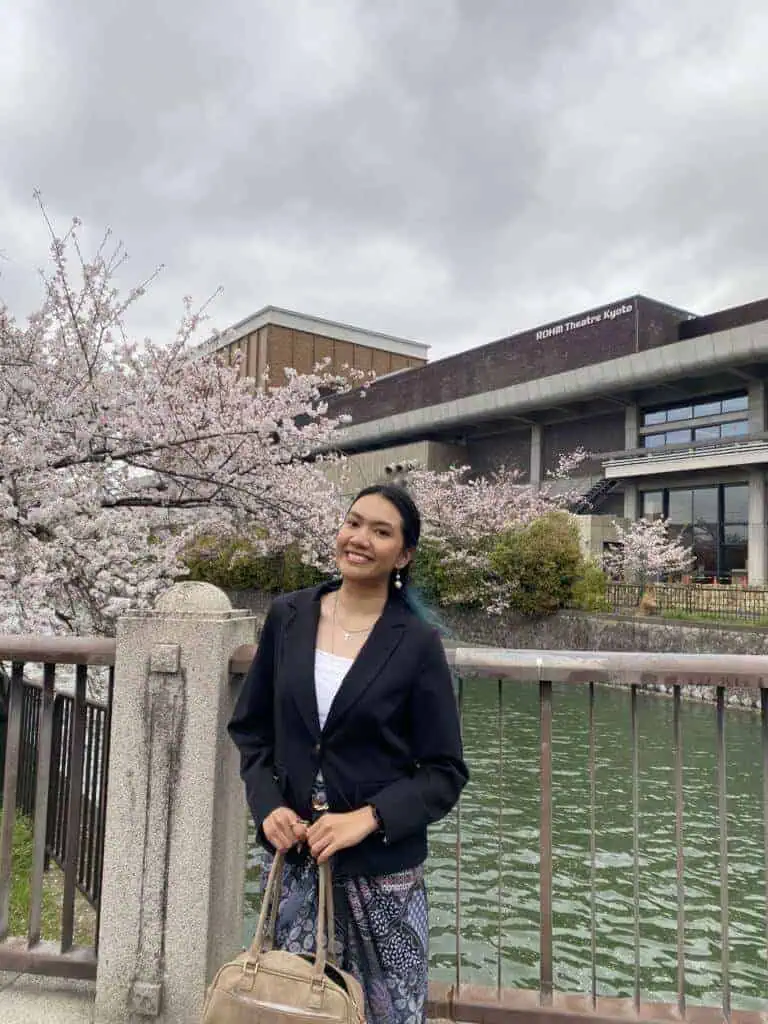


Scholarship Recipient Insights at Kyoto University
3 degree-study stories feature study at Kyoto University.
Featured Recipients by Nationality
| Nationalities | Stories per nationality |
|---|---|
| Cambodian, Indonesian, Malaysian | 1 each |
Degree Levels and Subjects
| Degree level | Stories | Subjects |
|---|---|---|
| Master’s | 2 | Agriculture; Natural Resource Economics |
| Bachelor’s | 1 | Chemical Science and Technology |
Funding Routes Reported by Featured Recipients
| Funding route | Stories | Recipients |
|---|---|---|
| MEXT Scholarship | 2 | Lyhong So — Master’s, Natural Resource Economics — embassy recommendation; Griselda — Bachelor’s, Chemical Science and Technology, Kyoto iUP — university recommendation following an initial iUP award |
Funding Packages Reported by Recipients
| Recipient and degree/program | Reported coverage |
|---|---|
| Lyhong So — Master’s, Natural Resource Economics | MEXT covered full tuition, a monthly living stipend and round-trip airfare. |
| Griselda — Bachelor’s, Chemical Science and Technology, Kyoto iUP | MEXT provided full tuition exemption, JPY 120,000 monthly and round-trip travel between Japan and Indonesia. Initially received a Kyoto iUP scholarship, then transferred to MEXT through university recommendation. Reported scholarship-covered two-month Japanese preparation before arrival and the programme’s six-month preparatory course before the degree. |
Firsthand Academic Experiences
| Recipient and degree/program | Experience described |
|---|---|
| Lyhong So — Master’s, Natural Resource Economics | Coursework and research strengthened economic theory, quantitative analysis, policy evaluation and research design. Valued critical discussion, supervisor guidance and international peers. |
| Griselda — Bachelor’s, Chemical Science and Technology, Kyoto iUP | The iUP preparatory course developed daily and academic Japanese. Entered with little Japanese and reached a level sufficient for conversation with local students by her first semester; the degree gradually introduces more Japanese-language lectures. |
Examples of Featured Recipients’ Application Backgrounds
| Recipient and degree/program | Scholarship/application route | Reported background and preparation |
|---|---|---|
| Lyhong So — Master’s, Natural Resource Economics | Embassy-recommended MEXT | Food Science bachelor’s at Royal University of Agriculture, GPA 3.56, with an A (4.0) thesis result and Honda Young Scientist Award. Read agricultural/environmental-economics literature, refined a feasible proposal and practised embassy examinations and interview explanations. |
| Griselda — Bachelor’s, Chemical Science and Technology, Kyoto iUP | Kyoto iUP admission → university-recommended MEXT | Cambridge A Levels: A* in Mathematics, Physics and English, and A in Chemistry; salutatorian and science-competition participation. Used university fairs and school-counsellor guidance; connected scientific projects and prospective research with her motivation in essays and interviews. |
How Recipients Met Language Requirements
| Language requirement route | Stories / total degree-study stories | Recipients and examples |
|---|---|---|
| Embassy English examination | 1/3 | Lyhong So — Master’s, Natural Resource Economics passed the embassy written examination and interview in Cambodia. Prepared the English examination with previous papers; his embassy route did not require IELTS. |
| IELTS for the application | 1/3 | Griselda — Bachelor’s, Chemical Science and Technology, Kyoto iUP took IELTS after an intensive course, using past papers and online videos. |
Standardized Tests Reported by Featured Recipients
| Test | Stories reporting the test / total degree-study stories | Linked recipients and reported scores |
|---|---|---|
| Cambridge A Levels | 1/3 | Griselda — Bachelor’s, Chemical Science and Technology, Kyoto iUP — A*, A*, A and A* in Mathematics, Physics, Chemistry and English respectively. |
English-taught programs / stories reporting teaching language: 0/1.
Teaching Language in Featured Degree Stories
| Recipient and degree/program | Reported teaching language |
|---|---|
| Griselda — Bachelor’s, Chemical Science and Technology, Kyoto iUP | Could take the entire first year’s lectures in English; Japanese-language lectures increase from the second year in her department. |
Application Timelines Reported by Recipients
| Recipient and degree/program | Application or scholarship route | Reported application timeline |
|---|---|---|
| Griselda — Bachelor’s, Chemical Science and Technology, Kyoto iUP | Kyoto iUP / university-recommended MEXT | University application led to an initial iUP scholarship → Kyoto recommended her to MEXT and she transferred to that award. Language preparation included two months before arrival and a six-month preparatory course before the bachelor’s degree. |
Country-Specific Application Timeline Examples
| Country and route | Recipient and degree/program | Reported sequence or timing |
|---|---|---|
| Japanese Embassy in Cambodia — MEXT recommendation | Lyhong So — Master’s, Natural Resource Economics | Reviewed relevant publications and potential supervisors → passed embassy written examination and interview → contacted supervisors → completed university screening and interview → received final acceptance. |
Other Offers in Featured Applicants’ Journeys
| Recipient | Reported alternative | Decision described in the story |
|---|---|---|
| Griselda — Bachelor’s, Chemical Science and Technology, Kyoto iUP | BINUS University BINUS Widya Scholarship: full-ride; University of Toronto scholarship: CAD 100,000 partial funding | Enrolled at Kyoto in Chemical Science and Technology with MEXT support. |
What Recipients Pursued After Studying at Kyoto University
| Recipient | Degree/program at Kyoto University | Reported outcome |
|---|---|---|
| You Yuan | MSc Agriculture, GPA 4.0/4.0 | Subsequently pursuing a PhD at Nanyang Technological University’s Asian School of the Environment, funded by the NTU Research Scholarship. Researching palm-oil sustainability and smallholder farming in Malaysia. |
A Separate MEXT Research-Student Account
| Recipient and activity | Funding and preparation | Firsthand research experience |
|---|---|---|
| Lubanda (Luyando) Hamweendo — Research-student scholarship, Clinical Neuroscience | MEXT research support included tuition support and a monthly stipend. BSc and diploma in Mental Health and Clinical Psychiatry, approximately five years of clinical work and national-guideline committee experience. Took embassy English/Japanese tests and TOEIC before university entrance examinations. | Developed a research question on long-term neuroleptic use in children. Read potential supervisors’ work and sent a focused proposal with his CV; reported rigorous meetings, strong mentoring and multidisciplinary collaboration at Kyoto. |
What Scholarship Recipients Say
Advice and insights from international students who successfully secured funding to study at Kyoto University.
"Funding: Full research scholarship support (tuition support and the standard MEXT benefits, including a monthly stipend and support for travel/visa/accommodation as applicable through the scholarship route). The important part for me was that it covered the core costs and allowed me to focus on research."
"I identified supervisors whose research aligned with my interests and read their recent papers thoroughly. I wrote a clear research proposal and a strong statement of purpose showing why Japan and Kyoto University were the right fit. I prepared and gathered supporting documents early: transcripts, recommendation letters, a polished CV, and any required certificates."
"My time at Kyoto University has been intellectually stimulating. The research environment is rigorous, with regular meetings, strong mentorship, and multidisciplinary collaboration. Supervisors and lab members have been supportive; the international student office provides practical help with visa, housing, orientation, and every other thing that I needed to do."
"I received the MEXT (Monbukagakusho) Scholarship from the Japanese Government through the Embassy Recommendation track. The scholarship fully covers tuition fees, provides a monthly living stipend, and includes round-trip airfare."
"I am currently pursuing a Master’s degree in Natural Resource Economics at Kyoto University in Japan as a MEXT Scholar. My work focuses on agriculture, climate change, and rural development, with the goal of contributing practical and evidence-based solutions to support sustainable development in Cambodia and Southeast Asia."
"My experience at Kyoto University has been both academically rigorous and personally transformative. The academic environment encourages independent thinking, critical discussion, and strong methodological training. Through coursework and research, I have deepened my understanding of economic theory, quantitative analysis, and policy evaluation."
Frequently asked questions
Common questions about scholarships, admissions, and studying at Kyoto University.
Most scholarships connected to Kyoto University assume you will be an on-campus student (because applications are handled through Kyoto University and many programs require you to be physically in Japan for exams).
Both exist. Kyoto University offers multiple degree options “conducted entirely in English,” with entrance exams and support available in English for those programs. At the undergraduate level, Kyoto University also explains that “classes are generally taught in Japanese” except for specific English-taught degrees and Kyoto iUP.
From a recipient’s perspective, Lubanda (Luyando) Hamweendo (MEXT, Kyoto University) shared that “many graduate-level research programs and seminars for international students are conducted in English,” while some lab/admin tasks can be bilingual.
Kyoto University-administered scholarships vary by program, and many do not publish a single university-wide age cap. However, major external/government scholarships commonly used at Kyoto University do have age rules.
For example, the official Study in Japan (MEXT) guidance says research-student applicants must be “under 35 years of age,” and the MEXT (University Recommendation) guidelines also specify birthdate-based age eligibility for research students.
Generally, scholarships follow your admitted degree program, so funding can apply across STEM and non-STEM fields. Kyoto University spans humanities and social sciences (e.g., Letters, Law, Economics) and STEM (e.g., Science, Engineering, Informatics, Agriculture), plus professional/health fields (Medicine, Pharmaceutical Sciences, Public Health).
Medicine: Kyoto University has a Faculty/Graduate School of Medicine, and MEXT even explicitly lists longer scholarship durations for medicine-related undergraduate tracks. That said, Kyoto University also cautions that, outside designated English-taught programs, undergraduate classes are generally in Japanese—so medicine is typically most realistic for international students at the graduate/research level unless you have strong Japanese.
Engineering: Kyoto University highlights an English-taught undergraduate degree option in Civil Engineering, and engineering is also a major graduate pathway.
Business: Kyoto University includes Economics and a Graduate School of Management, where scholarship options may be available depending on route and timing.
Kyoto University hosts scholarship routes that are broad (open to many international students) and others that are nationality- or region-linked (depending on the funding body).
For government scholarships like MEXT, the guidelines state that applicants “must have the nationality of a country that has diplomatic relations with Japan.” As a real example of breadth, Lubanda (Luyando) Hamweendo studied at Kyoto University on MEXT as a Zambian scholar.
It depends on the program. For Kyoto iUP, Japanese proficiency is not required at application, and applicants may optionally submit JLPT for reference. For English, Kyoto iUP accepts only TOEFL or IELTS (or a designated alternative form for native speakers), and it publishes typical successful-candidate scores (e.g., TOEFL iBT 90 / IELTS 6.5), while stating there is no single minimum score requirement.
For other degrees, requirements vary by faculty/graduate school. Some graduate programs explicitly require TOEFL/IELTS documentation in their application procedures.
Scholarship-wise, requirements vary by route. Lubanda noted that “we also had to take the English and Japanese tests prepared by the Embassy,” and added, “I had to write TOEIC” because proof of recent English proficiency was requested in her process, so having valid test results can directly help for scholarships even when a program itself is flexible.
Kyoto University does not publish one universal “minimum GPA” for all admissions; selection depends on the faculty/graduate school and can include entrance exams, document screening, and interviews. Kyoto iUP, for example, frames expectations as “high level academic excellence” rather than a single global GPA cutoff.
However, some scholarship tracks do set grade thresholds. The MEXT (University Recommendation) guidelines state that “international students with outstanding academic achievements” must have a GPA of 2.30 or above (per MEXT’s scale) to qualify and maintain eligibility.
A strong profile usually combines academic strength, fit for the program, and a clear purpose. Kyoto iUP explicitly expects “high level academic excellence” and strong English competence.
In a research scholarship example, Lubanda emphasized that aligning with supervisors and presenting a focused proposal mattered: she described reading supervisors’ work, emailing with a concise research idea, and writing “a clear research proposal and a strong statement of purpose” tied to real clinical problems.
It varies by status (undergraduate, graduate, research student) and by faculty, but common documents include transcripts, graduation/expected graduation certificates, recommendation letters, and identification documents.
For example, Kyoto University’s international research-student guidance lists items such as an application form, graduation certificate, academic transcript, a recommendation letter, and a passport copy. Kyoto iUP’s application guidelines similarly emphasize official transcripts across your full secondary schooling (and higher-education transcripts if applicable).
From experience, Lubanda summed it up as: “I prepared and gathered supporting documents early: transcripts, recommendation letters, a polished CV, and any required certificates.”
Yes. Kyoto University’s official FAQ lists examination fees of JPY 17,000 for undergraduates and JPY 30,000 for graduate students (with some cases of reduced graduate examination fees depending on screening method). Check the latest guidelines for updated information.
There are many degrees that are open to international students right now — find yours.
About the Author: Hyun Lee


Leave A Comment